From Strategic Planning to Results: Developing Implementation and Performance Measurement Frameworks

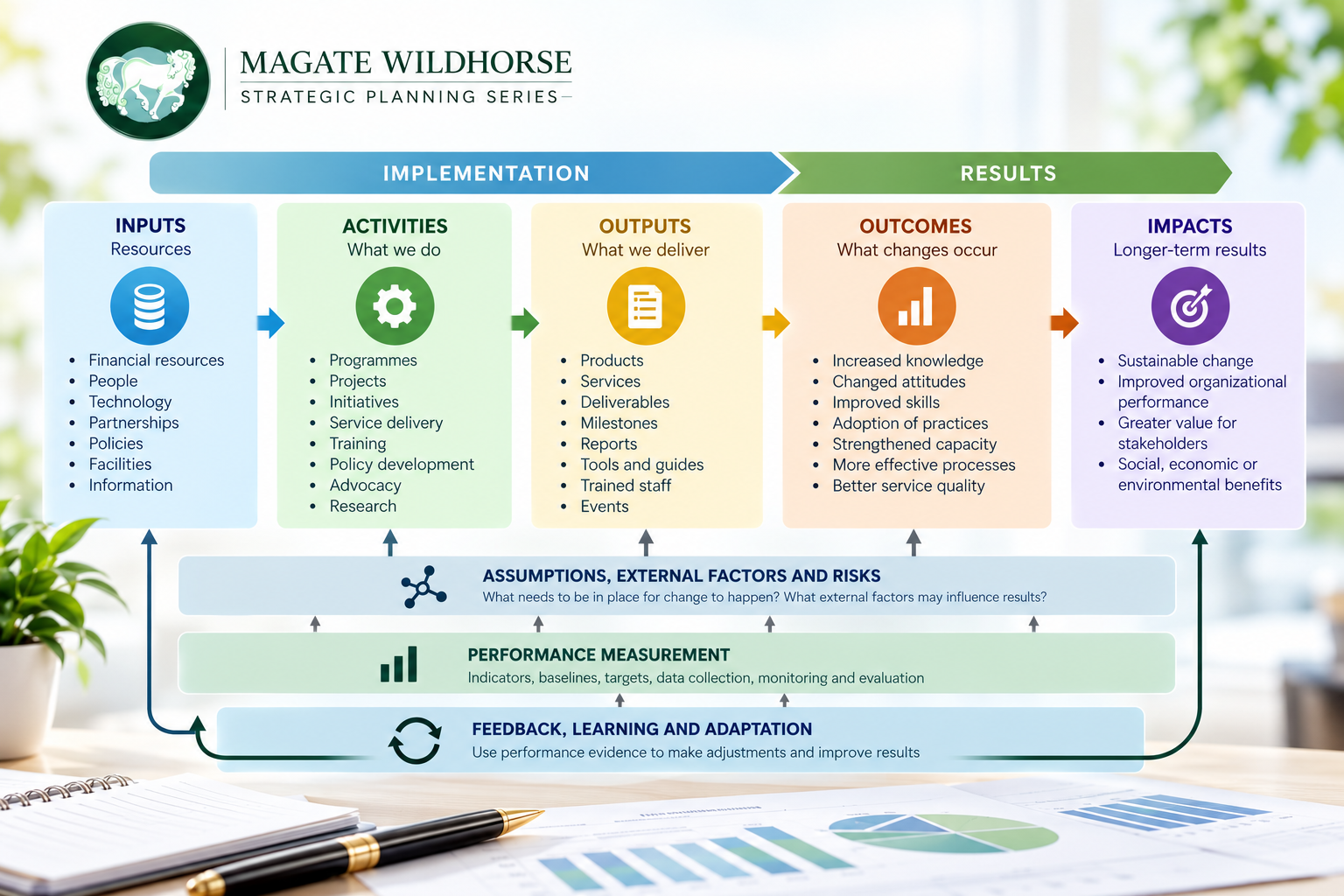
Magate Logo, white horse on green moss agate stone. Logic model illustrating implementation to results, plants

This article concludes our series examining the strategy development process, the series commenced with an article on overall strategy development and continued from environmental analysis and strategy formulation to implementation and performance measurement.

Developing a strategic plan is an important achievement, but the true test of strategy lies in its implementation and the results it produces. Organizations may invest considerable time and resources in environmental analysis, stakeholder engagement, strategy formulation and the identification of strategic priorities, yet struggle to translate their plans into meaningful organizational outcomes.

Effective strategic management therefore requires two interconnected frameworks: an implementation framework, which guides how the strategy will be executed, and a performance measurement framework, which establishes how progress, achievements and results will be monitored and evaluated.

Together, these frameworks help organizations move beyond strategic intentions to coordinated action, organizational accountability, continuous learning and measurable results.

Strategy Development and Delivery as a Cyclical Process

Strategy development and delivery can be understood as a four-stage, iterative process comprising environmental analysis, strategy formulation, strategy implementation, and performance monitoring and evaluation, also referred to as strategy evaluation and control.

These stages are interconnected rather than strictly sequential. Information generated through performance monitoring and evaluation may reveal changing circumstances, implementation challenges, emerging opportunities or the need to revisit strategic assumptions. Such findings should inform adjustments to organizational priorities, resource allocations and, where necessary, the strategy itself.

This cyclical approach helps organizations remain responsive to changes in their operating environments while maintaining a clear focus on their mission, strategic objectives and intended results.

Developing the Strategy Implementation Framework

An implementation framework translates strategic goals and objectives into coordinated activities, deliverables, responsibilities, timelines and resource requirements.

It provides the operational structure through which an organization puts its strategy into action. Its development involves action planning, activity coordination, institutional alignment and the establishment of mechanisms for oversight and accountability.

An effective implementation framework should identify:

  • Strategic initiatives and activities required to achieve each objective.
  • Expected outputs, deliverables and implementation milestones.
  • Individuals, departments or teams responsible for execution.
  • Timelines and dependencies between activities.
  • Financial, human, technological and other resource requirements.
  • Funding sources, Feasibility considerations, trade-offs and implementation risks.
  • Communication, coordination and reporting arrangements.

These elements are commonly organized into an implementation matrix or action plan that enables managers and teams to understand their responsibilities and track execution.

However, implementation involves more than developing an action plan. It also requires the organizational capabilities, structures, systems and behaviours necessary to deliver the strategy.

The Five Dimensions of Strategy Implementation: The CADAP Framework

The [1]CADAP Framework provides a useful lens for examining five interconnected dimensions of strategy implementation: Capability, Agility, Design, Alignment and People.

Capability: Organizations must possess or develop the resources, competencies, processes and institutional capacity required to execute their strategies. This includes financial resources, technical expertise, leadership capability, technology and operational systems. Capability gaps may require training, recruitment, partnerships, investment or adjustments to implementation priorities.

Agility: Effective implementation requires the ability to respond to emerging risks, opportunities and changes in the operating environment. Agility enables organizations to make timely decisions, reallocate resources and adapt implementation approaches without losing sight of their strategic direction.

Design: Organizational design concerns the structures, processes, governance arrangements and decision-making mechanisms through which work is organized and coordinated. Implementation may require changes to reporting relationships, workflows, departmental responsibilities or operating systems to support strategic priorities.

Alignment: Strategic objectives must be reflected in organizational policies, budgets, departmental plans, operational priorities and performance expectations. Alignment reduces competing priorities, duplication and fragmentation while helping different parts of the organization work toward shared results.

People: Employees, managers, executives and other stakeholders are central to successful strategy execution. Their understanding, commitment, competencies and participation influence implementation effectiveness. Leadership, meaningful engagement, clear responsibilities, incentives and timely communication help build ownership and sustain commitment.

The five dimensions reinforce one another. For example, an organization may have adequate financial resources and technical capability but still experience implementation difficulties because of poorly designed processes, conflicting departmental priorities or limited employee commitment.

Consequently, effective strategy implementation requires cultural, structural and systems alignment, supported by clear, consistent and well-timed communication.

Developing the Performance Measurement Framework

While the implementation framework establishes how strategic initiatives will be executed, the performance measurement framework determines whether implementation is progressing as intended and contributing to desired organizational results.

Performance monitoring and evaluation involves comparing actual performance against planned objectives, targets and expected results. It draws on both financial and non-financial indicators to assess efficiency, effectiveness, progress and outcomes.

A performance measurement framework should establish clear performance indicators, baseline values, targets, data sources, collection methods, measurement frequency and reporting responsibilities.

Financial indicators may include revenue growth, profitability, expenditure, cost efficiency and return on investment. Nonfinancial indicators may address service quality, customer satisfaction, stakeholder engagement, employee performance, organizational capacity, innovation and social or environmental outcomes.

Importantly, completing planned activities does not necessarily mean that strategic objectives have been achieved. An organization may successfully deliver a training programme, for example, without achieving the intended improvements in employee competencies or organizational performance.

Performance measurement must therefore extend beyond tracking activities and outputs to examining outcomes and, where appropriate, longer-term impacts.

Tools for Linking Strategy, Implementation and Results

Organizations can use several complementary tools to establish the relationships between strategic activities, expected results and performance measures.

Theory of Change (ToC): A Theory of Change explains how and why particular activities and interventions are expected to produce desired outcomes and longer-term impacts. It identifies the causal pathways, assumptions and external conditions that influence whether change occurs. This helps organizations examine the underlying logic of their strategies and determine what evidence is needed to assess progress.

Logic Model: A logic model provides a structured, often visual representation of the relationship between resources or inputs, activities, outputs, outcomes and impacts. Commonly used in government and nonprofit organizations, it supports programme planning, performance measurement, monitoring and evaluation by clarifying what an intervention is expected to achieve and how results will be assessed.

Private-sector organizations also use tools such as:

Business Model Canvas (BMC):  Which maps the key components of an organization’s business model, including its value proposition, customers, resources, activities, partnerships, revenue streams and cost structure. Although primarily a business modelling tool rather than a performance measurement framework, it can inform strategic implementation and the selection of relevant performance measures.

Objectives and Key Results (OKRs): Connects clearly defined objectives with measurable key results. OKRs help translate strategic priorities into focused, time-bound performance commitments and enable teams to assess progress toward desired outcomes.

Objectives, Goals, Strategies and Measures (OGSM): Provides a structured approach for translating strategic direction into specific goals, supporting strategies and measurable indicators. It helps connect organizational aspirations with execution and performance accountability.

The selection of tools should reflect an organization’s mandate, strategic objectives, operating environment and performance information needs. These tools are not necessarily mutually exclusive and may be combined where appropriate.

Monitoring, Evaluation and Strategic Learning

Performance monitoring and evaluation should be embedded throughout strategy implementation rather than treated as an exercise conducted only at the end of the plan cycle.

Monitoring provides ongoing information about activities, milestones, resource utilization and progress toward targets. Evaluation examines the relevance, effectiveness, efficiency and results of strategic interventions, including why intended outcomes were or were not achieved.

Together, they establish structured feedback loops that replace vague intentions with operational accountability.

Regular performance reviews should enable organizational leaders and implementation teams to identify deviations from planned results, investigate their causes, assess emerging risks and determine corrective actions.

Performance information should also inform budgeting, operational planning, resource allocation and strategic decision-making. Where results indicate that assumptions are no longer valid or circumstances have changed significantly, organizations may need to revise their implementation approaches or strategic priorities.

Governance, Accountability and Communication

Successful implementation and performance management require clear governance and reporting arrangements.

Boards and governing bodies provide strategic oversight, while executive leadership ensures organizational alignment, allocates resources and addresses significant implementation challenges. Managers and implementation teams coordinate activities, monitor progress and report results.

Clearly assigned responsibilities, reporting schedules, decision-making authority and escalation procedures help ensure that performance findings lead to action.

Communication is equally important. Employees and stakeholders should understand the strategic direction, their contributions to its achievement and the results being realized. Timely communication of progress, challenges and adjustments strengthens transparency, coordination and organizational commitment.

Conclusion: Turning Strategic Intent into Measurable Results

A strategic plan provides direction, but implementation and performance measurement frameworks provide the mechanisms for translating that direction into action and assessing whether the desired results are being achieved.

Effective implementation requires more than a schedule of activities. It demands organizational capability, agility, appropriate design, institutional alignment, engaged people and adequate resources.

Similarly, effective performance management requires more than collecting data. It involves using credible evidence to strengthen accountability, support organizational learning, inform decisions and improve results.

Strategic planning achieves its greatest value when organizations establish the capacity to execute their strategies, measure what matters and use performance evidence to adapt and improve.

For organizations seeking to strengthen their strategic planning, implementation and performance management practices, Magate Wildhorse Ltd. provides strategic management consulting services to support the development of practical, results-oriented approaches.

Written by Meegan Scott. Copyright © 2026 Meegan Scott and Magate Wildhorse Ltd. All rights reserved.


[1] Choudhury, A., Ram Kumar, P. N., & Krishnan, R. (2026). A comprehensive framework for strategy execution: CADAP strategy execution framework. IIM Kozhikode Society & Management Review, 15(1), 96–113. [Online] Available at:< https://doi.org/10.1177/22779752241312312>
Stakeholder Engagement, Assessment & Analysis: Strengthening the Strategic Planning Process

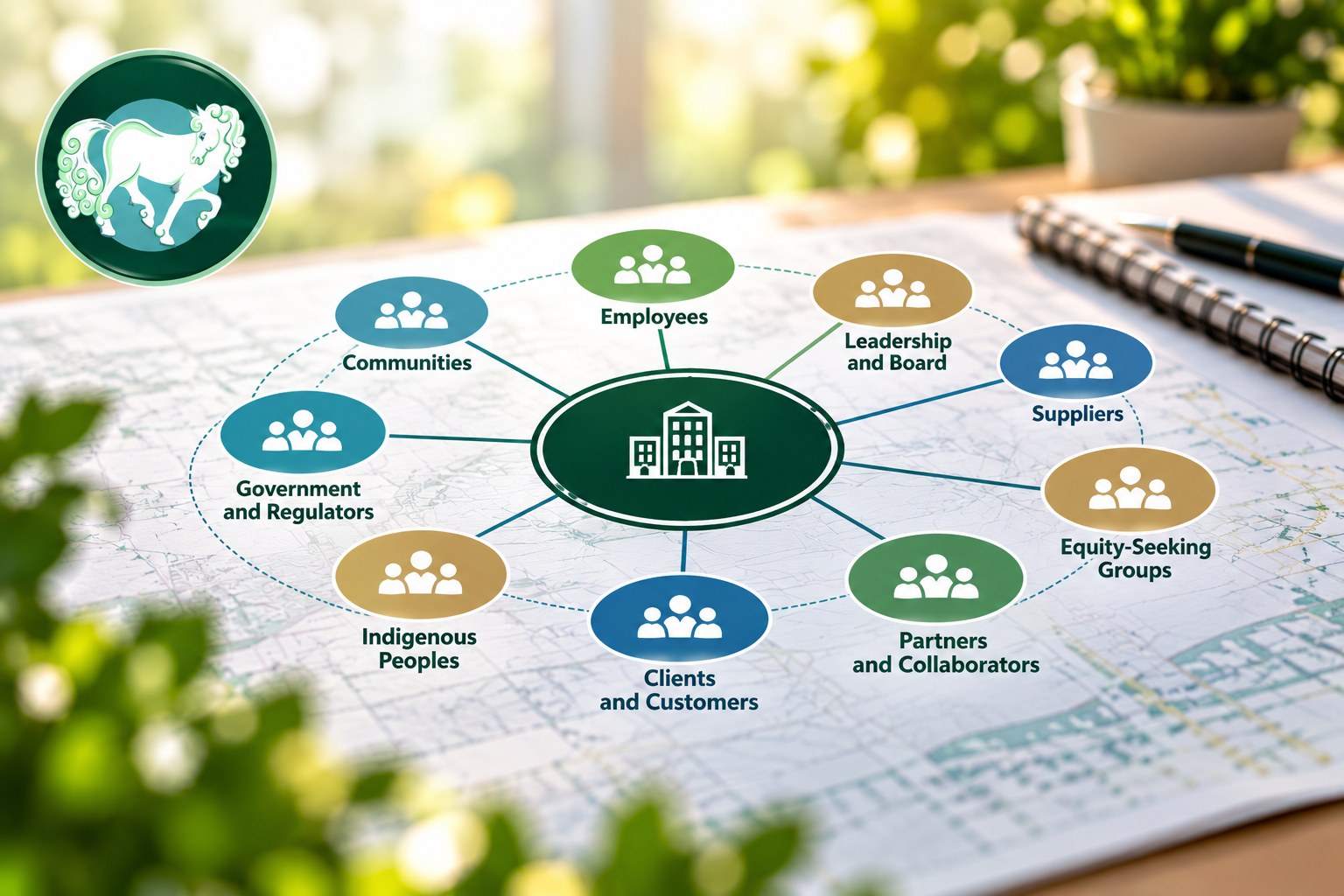
Magate logo, horse on green stone, stakeholder map, notebook and pen (partial view), plants.

Strategic planning is not an exercise that organizations should undertake in isolation. The effectiveness of a strategic plan depends, in part, on how well an organization understands the people, groups and institutions that influence its success, contribute to its operations, or are affected by its decisions.

Stakeholder engagement, assessment and analysis are therefore important components of the strategic planning process. Although closely related, they serve distinct but complementary purposes. Stakeholder assessment helps organizations evaluate relationships, experiences and outcomes associated with the implementation of an existing strategic plan. Stakeholder analysis helps identify and understand the interests, influence and potential impact of stakeholders as an organization prepares its next plan. Stakeholder engagement provides opportunities for dialogue, consultation, collaboration and the development of shared understanding.

Stakeholder Assessment: Learning from the Existing Strategic Plan

As an organization approaches the end of its strategic planning cycle, evaluating the implementation and results of the expiring plan is essential.

Stakeholder assessment forms part of this evaluation and the broader organizational or current-state assessment. It examines who contributed to, influenced or was affected by the strategic plan and how effectively the organization responded to their needs and expectations.

Important questions include:

  • Which stakeholder groups participated in implementing the plan, and what contributions did they make?
  • To what extent were stakeholder needs and expectations met?
  • How effective were the organization’s relationships and communication with stakeholders?
  • What challenges, conflicts or unmet expectations emerged?
  • What lessons should inform the next strategic planning cycle?

Stakeholder assessment can reveal gaps between organizational intentions and stakeholder experiences. It can also identify changes in stakeholder relationships, emerging concerns, and opportunities to strengthen organizational performance.

The findings should contribute to the evaluation of the expiring strategic plan and provide evidence for decisions about the organization’s future direction.

Stakeholder Analysis: Understanding Interests, Influence and Impact

Stakeholder analysis is particularly important during preplanning and the environmental scanning process. It helps organizations identify individuals, groups and institutions that can influence, contribute to or be affected by their activities and strategic decisions.

The process begins with stakeholder identification and classification. Stakeholders may be categorized as primary or secondary, internal or external, depending on their relationship with the organization.

Primary stakeholders generally have a direct relationship with, or are directly affected by, organizational activities. Secondary stakeholders may influence the organization’s operating environment or be indirectly affected by its decisions.

Once identified, stakeholders can be mapped and analyzed according to their interests, influence, potential impact, expectations and relationships.

An important objective is to understand the value stakeholders seek from their relationship with the organization. Different groups may have competing priorities, but they may also share interests that create opportunities for cooperation.

The strategic challenge is not simply to identify these interests. It is to discover connections among them and develop solutions that align stakeholder expectations with organizational purpose and strategic objectives.

Tools for Stakeholder Mapping and Analysis

Several analytical tools can support this process.

Stakeholder Interest–Influence–Impact Mapping examines the interests of stakeholder groups, their ability to influence organizational decisions, and the extent to which they may affect or be affected by organizational activities. It helps planners determine appropriate engagement strategies and identify relationships requiring particular attention.

The Power–Interest Grid classifies stakeholders according to their level of influence or power and their interest in organizational activities. It provides a practical framework for determining how different stakeholder groups should be engaged, informed or consulted.

The Stakeholder Issues Matrix identifies the issues, concerns, expectations and priorities associated with different stakeholder groups. It can highlight common interests, conflicting demands and emerging strategic issues requiring organizational attention.

The Stakeholder Salience Model, developed by Mitchell, Agle and Wood, offers another approach to stakeholder prioritization. The model examines three attributes:

  • Power: The stakeholder’s ability to influence the organization or its decisions.
  • Legitimacy: The perceived appropriateness or validity of the stakeholder’s claims or relationship with the organization.
  • Urgency: The extent to which stakeholder claims require immediate attention.

By considering these attributes together, organizations can better understand which stakeholder claims demand attention and how stakeholder priorities may change over time.

However, stakeholder prioritization should not result in the exclusion of groups with limited power. Stakeholders who are significantly affected by organizational decisions may have important perspectives even when they lack the influence to command attention.

Stakeholder Engagement: Moving Beyond Consultation

Stakeholder engagement involves more than collecting opinions. It is a process through which organizations communicate, listen, exchange knowledge, explore competing interests and, where appropriate, collaborate on solutions.

Effective engagement helps organizations test assumptions, identify overlooked issues, build relationships and improve the quality of strategic decisions.

Engagement approaches may combine quantitative, qualitative and collaborative techniques, including:

  • Surveys and questionnaires
  • Individual stakeholder interviews
  • Focus groups and ideation sessions
  • Town halls and open forums
  • Workshops and design charrettes
  • Advisory committees and task forces
  • Stakeholder mapping and analysis exercises
  • Social network analysis

The selection of methods should reflect the purpose of the engagement, the characteristics of stakeholder groups, available resources and the decisions to be informed.

For example, surveys may capture perspectives across a large stakeholder population, while interviews and focus groups can provide deeper insights into experiences, expectations and concerns. Collaborative workshops can help stakeholders explore alternatives and identify areas of common interest.

Engagement should also be inclusive and accessible, providing meaningful opportunities for groups whose perspectives may otherwise be overlooked—such as equity seeking groups.

Integrating Stakeholder Findings into Strategic Decisions

The value of stakeholder assessment, analysis and engagement ultimately depends on how their findings are used.

Information gathered through these processes should inform the organization’s environmental scan, assessment of its current position, identification of strategic issues, and development and evaluation of strategic options.

Stakeholder findings can reveal opportunities for partnerships, changes in service needs, emerging risks, resource constraints and areas where organizational priorities require reconsideration.

They can also help identify tensions between stakeholder expectations and organizational capacity. Such tensions require strategic choices rather than promises that every interest can be accommodated.

Where interests overlap, organizations should explore solutions that create shared value. Where they conflict, transparent decision-making and clear communication become particularly important.

Stakeholder engagement should not end when the strategic plan is approved. Continued engagement during implementation, monitoring and evaluation enables organizations to assess progress, respond to changing circumstances and maintain relationships.

Conclusion

Stakeholder engagement, assessment and analysis are interconnected activities that strengthen strategic planning when applied systematically.

Assessment provides lessons from the implementation of the existing plan. Analysis develops an understanding of stakeholders and their interests, influence and potential impact. Engagement creates opportunities to gather evidence, build understanding and explore solutions.

Together, these processes help organizations move beyond internally driven planning towards strategies that are better informed, more responsive to their operating environments and more capable of generating meaningful results.

Magate Wildhorse Ltd. provides strategic planning, stakeholder engagement, assessment and analysis services to support organizations in developing evidence-informed strategies and strengthening organizational performance.

Share your thoughts on social media or by email at: magate.wildhorse@gmail.com.

Written by Meegan Scott. Copyright © 2026 Meegan Scott and Magate Wildhorse Ltd. All rights reserved.

Organizational Assessment and Current-State Assessment: Informing Strategic Planning

Building an evidence-based understanding of organizational performance, capacity and readiness for strategic change.

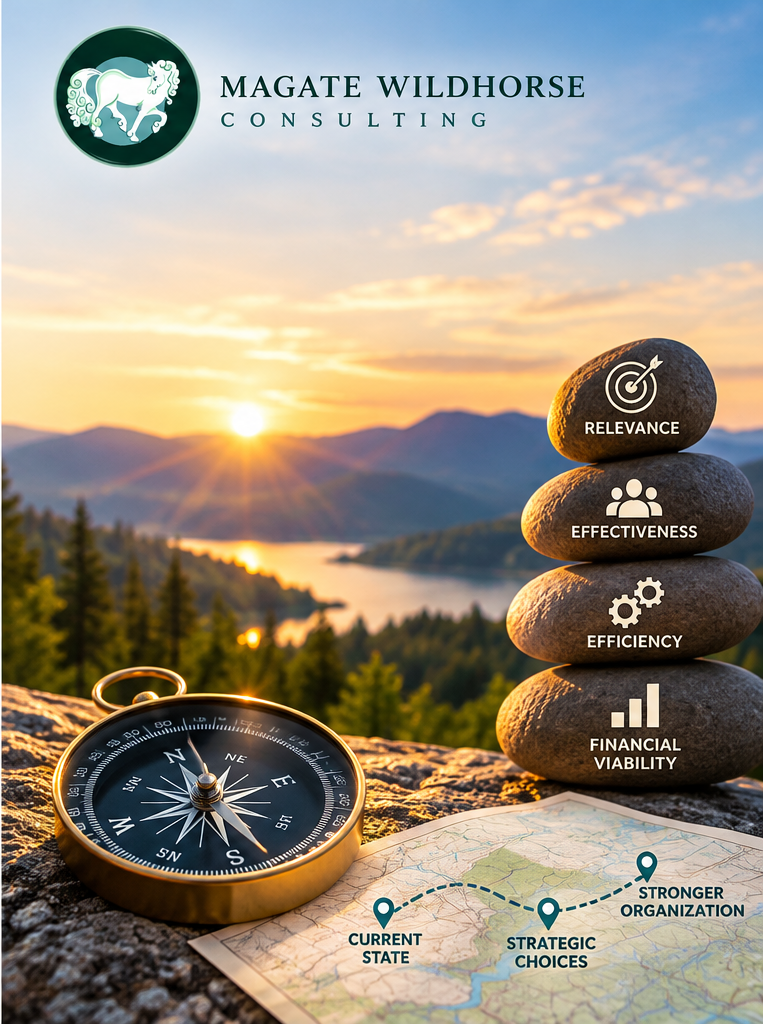
Magate Wildhorse logo, white horse on green moss agate stone. mountains and sunshine in the background, trees, rocks with the words, relevance, effectiveness, efficiency, financial viability stacked in the foreground with a compass and a map with current state, strategic choice and stronger organization mapped.

A strategic plan must be grounded in an accurate understanding of the organization it is intended to guide. Ambitious goals alone do not establish whether an organization has the capacity, resources, systems or readiness to deliver them. Organizational assessments and current-state assessments provide evidence that helps leaders make realistic strategic choices.

Although related, these assessments are not interchangeable. Their scope and purpose differ.

Understanding the Distinction

An organizational assessment is a comprehensive examination of an organization’s performance, capacities and functioning. It can consider governance, leadership, organizational culture, management practices, technical capabilities, financial viability, operating systems and relationships with the external environment. Its applications extend beyond strategic planning to institutional strengthening, organizational development and performance improvement.

A current-state assessment conducted for strategic planning is generally more focused. It establishes a baseline of the organization’s position on matters relevant to the strategic decisions ahead. It may draw selectively on organizational assessment methods, performance evidence, stakeholder perspectives and environmental scanning without examining every dimension of organizational functioning.

In either exercise, the Evaluand—the subject being assessed—is the organization, not individual office holders. Assessing governance and leadership arrangements is not the same as appraising individual board members or executives. The purpose is to understand how organizational functions contribute to results and where improvements are needed.

Four Questions About Organizational Performance

A key reference for Magate Wildhorse Consulting is the Universalia/International Development Research Centre (IDRC) Institutional and Organizational Assessment Framework. It considers organizational performance through four important questions:

Effectiveness: How successfully is the organization fulfilling its mission and achieving intended results?

Efficiency: How well does it use available resources to deliver services and achieve results?

Relevance: Has it adapted to changing needs, stakeholder expectations and conditions in its operating environment?

Financial viability: Can it secure and manage the resources necessary to sustain its work?

The framework also recognizes the influence of organizational capacity, motivation and the external environment. These dimensions help explain not only how an organization is performing but why. The ability to interpret and use assessment results is essential to achieving improvements.

Frameworks and Tools That Deepen the Diagnosis

No single instrument captures every dimension of organizational performance. Magate Wildhorse draws on established approaches, selecting tools according to the assessment’s purpose and the organization’s context.

Universalia/IDRC Institutional and Organizational Assessment Framework: Supports an integrated assessment of performance and its underlying influences.

McKinsey Organizational Capacity Assessment Tool (OCAT): Supports structured consideration of organizational capacities, strengths and areas for development.

McKinsey 7-S Framework: Examines alignment among strategy, structure, systems, shared values, skills, style and staff. A strategy may be sound but difficult to implement when these elements are misaligned.

Governing Good Board Self-Evaluation Questionnaire: Supports reflection on governance practices, board effectiveness and opportunities to strengthen oversight and strategic stewardship.

TCC Group’s Core Capacity Assessment Tool (CCAT): Identifies leadership, adaptive, management and technical capacities, alongside organizational culture. Magate Wildhorse draws on selected questions relating to these dimensions when assessing organizational leadership, board-related practices and capacity. Using selected questions does not mean administering the full CCAT instrument.

Other methods may include document and policy reviews, interviews, surveys, facilitated discussions, stakeholder analysis, process mapping, SWOT analysis, gap analysis, financial review and examination of performance indicators. The choice of methods should follow the assessment questions, not the other way around.

Why the Assessments Matter for Strategic Planning

They establish an evidence-based baseline. Leaders can distinguish demonstrated strengths and constraints from assumptions and compare future performance with an informed starting point.

They reveal strategic capacity gaps. An organization may wish to expand services but lack sufficient staffing, funding, technology or management systems. An assessment makes those limitations visible before commitments are made.

They improve strategic prioritization. Findings help leaders distinguish immediate operational problems from issues that require longer-term strategic responses. They also reveal opportunities to build on existing capabilities.

They strengthen organizational learning and accountability. Evidence about performance, governance and stakeholder needs can support more constructive dialogue about change, provided findings are used to improve the organization rather than assign personal blame.

They connect organizational realities with environmental change. A current-state assessment for strategic planning should consider relevant external developments alongside internal evidence, so that strategic choices respond to both capability and context.

From Evidence to Strategic Choices

A useful assessment does more than catalogue strengths and weaknesses. It examines patterns, tests findings across multiple sources and identifies implications for action.

An example from Magate Wildhorse’s consulting experience illustrates the value of evidence-based assessment. During an organizational assessment, some members expressed the view that the organization’s mission had become outdated. However, the assessment found that the mission remained highly relevant. This finding demonstrated the importance of testing perceptions against evidence before making decisions about an organization’s strategic direction.

The lesson is significant: organizational assessment does not necessarily establish a need to change an organization’s mission. It may instead confirm that the mission remains appropriate while identifying other aspects of organizational performance or capacity that require attention.

Consider also a nonprofit experiencing growing demand for services. An assessment may reveal strong community trust but limited unrestricted funding and overextended staff. A plan promising rapid expansion without addressing those constraints would be unrealistic. A stronger strategy might prioritize funding diversification, operational improvements and partnerships.

These examples demonstrate why assessment findings must be translated into strategic decisions, resource implications, implementation priorities and measures of progress.

A Credible Starting Point

Organizational assessment offers a comprehensive understanding of institutional performance and capacity. A strategically focused current-state assessment provides the targeted baseline needed to inform the next planning cycle. Either can strengthen strategic planning when its scope is appropriate, its evidence is credible and its findings are put to use.

Magate Wildhorse Consulting helps nonprofits, government departments and international development organizations connect organizational assessment, current-state analysis, environmental scanning and stakeholder engagement with evidence-informed, participatory strategic planning. The objective is not simply to produce a plan, but to develop a strategy grounded in organizational reality and capable of guiding meaningful change.

Share your thoughts on social media or by email at: magate.wildhorse@gmail.com.

Written by Meegan Scott. Copyright © 2026 Meegan Scott and Magate Wildhorse Ltd. All rights reserved.

Environmental Scanning: Building an Evidence-Informed Foundation for Strategic Planning

Magate Wildhorse logo, horse on green stone. Binoculars, decision tree, map, compass, books labelled trends, opportunities, risks, insight, tree and skies reflecting world map and sunshine, buildings in the distance.

Strategic planning requires organizations to make choices about the future. But those choices cannot be made effectively by looking inward alone.

Organizations operate within environments shaped by changing government policies, economic conditions, demographic shifts, technological developments, social expectations, funding arrangements, competitors, partners and developments within their industries and sectors. These forces can create opportunities, introduce risks, alter stakeholder expectations and, in some cases, challenge the assumptions underlying an organization’s existing strategy.

An environmental scan helps organizations understand that changing landscape before determining where they should go next.

At Magate Wildhorse, environmental scanning is an important component of our approach to strategic planning and organizational strategy. Our methodology is founded on an evidence-informed, participatory, collaborative and systems-based approach that integrates organizational assessment, environmental analysis, stakeholder engagement and strategic analysis.

The objective is not simply to collect information about trends. It is to determine what developments in the operating environment mean for the organization and how they should influence strategic choices.

What Is an Environmental Scan?

An environmental scan is a structured process for gathering, examining and interpreting information about the forces and developments that may affect an organization and its ability to achieve its mission.

A strong environmental scan examines both the environment surrounding the organization and the implications of changes occurring within it.

For strategic planning, the scan can help answer questions such as:

  • What is changing in our operating environment?
  • Which developments are most likely to affect our organization?
  • What emerging opportunities should we be preparing to pursue?
  • What threats or pressures could affect our ability to deliver?
  • How are the needs and expectations of our stakeholders changing?
  • What are comparable or competing organizations doing?
  • Which assumptions underlying our current strategy may no longer hold?
  • What capabilities might we need to strengthen for the future?

These questions help move strategic planning beyond assumptions and internal perspectives toward decisions informed by evidence.

Going Beyond Traditional PESTLE Analysis

PESTLE analysis—examining Political, Economic, Social, Technological, Legal and Environmental factors—is one of the most widely used frameworks for environmental scanning.

It provides an important starting point, but complex organizations often operate within environments that require a broader lens.

At Magate Wildhorse, our environmental scanning approach therefore builds upon and expands the traditional PESTLE framework according to the organization, sector and strategic questions being examined.

Depending on the assignment, the external scan may consider:

Demographic trends. Changes in population size, age, migration, geographic distribution, workforce composition and other demographic characteristics can significantly affect demand for services, labour availability and stakeholder needs.

Policy developments and political-legal pressures. Government priorities, legislation, regulation, public policy changes and political developments can create new requirements, constraints, funding opportunities or strategic openings.

Macroeconomic conditions. Inflation, interest rates, employment conditions, economic growth, labour costs and broader fiscal pressures can influence organizational costs, revenues, demand and investment decisions.

Socio-cultural influences. Changing public expectations, values, behaviours and attitudes can reshape how organizations engage communities, employees, clients and other stakeholders.

Technological developments. Artificial intelligence, automation, digital service delivery, cybersecurity, data systems and emerging technologies can change operating models, stakeholder expectations and competitive conditions.

Global trade and international developments. Supply chains, tariffs, geopolitical developments and international market conditions can have significant implications even for organizations whose primary operations are domestic.

Funding models. Changes in government funding, grants, philanthropy, investment models, reimbursement arrangements or other revenue structures can fundamentally alter organizational sustainability and strategic choices.

Sector transformation. Major reform initiatives—including health system transformation, public-sector modernization or regulatory restructuring—can change roles, relationships and expectations across an entire system.

Jurisdictional comparisons. Examining how other jurisdictions address similar challenges can identify alternative models, emerging practices and potential lessons.

Competitor and comparator analysis. Understanding how comparable organizations are positioning themselves, delivering services or responding to change can reveal strategic gaps, opportunities and areas of differentiation.

Leading and emerging practices. Identifying developments within and beyond the organization’s immediate sector can help leaders consider approaches that may strengthen performance, service delivery or organizational resilience.

The factors selected should never become a mechanical checklist. Their relevance depends on the organization and the decisions the strategic plan must support.

Evidence Matters—but So Does Participation

Environmental scanning should not be based solely on desk research.

Documents, statistics, policies, sector reports, academic and professional literature, economic information and other secondary sources provide essential evidence. However, stakeholders often possess knowledge that cannot be found in published material.

Employees may recognize operational pressures before they appear in formal reports. Clients and service users can identify changing needs. Partners may see emerging system-level challenges. Government and sector stakeholders may provide insight into policy direction, funding conditions or future priorities.

That is why Magate Wildhorse combines research and environmental analysis with stakeholder engagement.

Interviews, surveys, focus groups, facilitated discussions and other engagement methods can be used to test findings, identify emerging issues and understand how external developments are being experienced by those closest to the organization and its work.

This participatory approach strengthens both the quality of the evidence and the relevance of the resulting strategy.

Connecting the External Environment to Organizational Capacity

An environmental scan becomes strategically useful when external findings are considered alongside the organization’s internal realities.

An emerging opportunity may appear attractive, for example, but the organization may lack the people, technology, funding or partnerships required to pursue it. Conversely, an organization may possess capabilities that position it particularly well to respond to a new policy direction, demographic need or market development.

For this reason, our approach integrates environmental scanning with organizational assessment.

Together, these analyses allow us to explore the relationship between external opportunities and threats and internal strengths, weaknesses, resources and capabilities. Strategic tools such as SWOT analysis can then help synthesize the evidence and identify the issues that warrant strategic attention.

From Information to Strategic Insight

One of the greatest risks in environmental scanning is producing an impressive collection of information that never influences strategy.

A 100-page report describing trends is not automatically a useful environmental scan.

The critical step is strategic interpretation.

Which developments matter most? How significant could their impact be? How quickly are they developing? Which issues require immediate attention? Which should be monitored? Where might the organization have an opportunity to lead rather than react?

These questions transform information into strategic intelligence.

The resulting insights should inform strategic priorities, organizational positioning, resource decisions, risk considerations and performance expectations.

Seeing the Environment Before Choosing the Direction

Strategic planning is ultimately about making informed choices under conditions of uncertainty. No organization can predict the future perfectly, but it can develop a much clearer understanding of the forces shaping that future.

A rigorous environmental scan helps leaders challenge assumptions, recognize emerging opportunities, anticipate pressures and make strategic choices grounded in evidence rather than intuition alone.

At Magate Wildhorse, we use environmental scanning as part of a broader strategic planning process that connects evidence, organizational realities, stakeholder perspectives and external developments to strategic decision-making.

Because before an organization decides where it wants to go, it should understand the environment in which it will have to get there.

Magate Wildhorse provides environmental scanning, strategic planning, organizational assessment, stakeholder engagement, performance measurement and related strategy services to organizations seeking evidence-informed approaches to navigating change and planning for the future.

Share your thoughts on social media or by email at: magate.wildhorse@gmail.com.

Written by Meegan Scott. Copyright © 2026 Meegan Scott and Magate Wildhorse Ltd. All rights reserved.

Strong Strategy Development Starts Before the Planning Session

Magate Wildhorse logo, landscape with Fall coloured green and yellow green shrubs, distant background with sunshine and up close puzzle pieces of landscape with a hand holding one puzzle piece.

Organizations often think of strategic planning as the point at which leaders, board members and stakeholders come together to decide priorities for the next three to five years. The planning session is important—but strong strategy development begins well before anyone enters the room.

Organizations operate in constantly changing environments. Government policies shift. Economic conditions change. New technologies emerge. Stakeholder expectations evolve. Funding environments change. Internally, organizations experience changes in leadership, capabilities, resources, performance and priorities.

Developing strategy without understanding these conditions risks making decisions based on assumptions rather than evidence.

At Magate Wildhorse, we approach strategic planning as an evidence-informed process that can take an organization from understanding its environment and current state through stakeholder engagement, strategy development, implementation and performance assessment:

Environmental Scan → Current-State/Organizational Assessment → Stakeholder Engagement → Strategic Planning & Facilitation → Implementation & Performance Framework

These components are not necessarily separate or sequential assignments. An environmental scan, for example, may be commissioned independently or incorporated into a broader current-state or organizational assessment.

Organizations can engage us for the complete process or for individual components according to their needs.

An Approach Tailored to the Organization

How strategy is developed matters.

Depending on the organization, community, assignment and intended results, our consulting approach can incorporate methods that are collaborative, participatory, results-oriented, systems-oriented, community-informed, equity-centered and anti-oppressive.

This can mean working collaboratively with clients throughout the assignment; creating meaningful opportunities for stakeholder participation; considering the broader systems in which the organization operates; incorporating community knowledge and perspectives; examining barriers, power and inequities where relevant; and maintaining a clear focus on the results the strategy is intended to achieve.

The appropriate combination of approaches depends on the purpose, context and needs of each engagement.

1. Environmental Scan: What Is Changing Around You?

Before determining where an organization should go, it is important to understand the environment in which it will be operating.

An environmental scan examines external forces, trends and developments that could affect the organization’s future. Depending on the organization and sector, these may include political, economic, social, technological, environmental, legal, demographic, industry and competitive developments.

A useful environmental scan goes beyond collecting information. It asks:

  • What is changing?
  • Which changes matter to the organization?
  • What opportunities and risks are emerging?
  • What assumptions may no longer hold?
  • What should leadership continue to monitor?

Environmental scanning helps organizations make strategic choices based on the environment they are likely to face rather than the conditions that existed when their previous plans were developed.

It may be undertaken as a standalone assignment or incorporated into a broader current-state or organizational assessment.

2. Current-State and Organizational Assessment: Where Are You Now?

Before deciding where to go, an organization needs a well-grounded understanding of where it is today.

Depending on its purpose and scope, a current-state or organizational assessment may examine both internal organizational conditions and the external operating environment. The external component can therefore incorporate an environmental scan.

Internally, an assessment may consider governance, leadership, organizational structure, programs and services, human resources, operations, financial sustainability, partnerships, communications, organizational culture, systems, performance management and capacity.

The specific areas assessed should be determined by the questions the organization needs answered.

Among those questions might be:

What is working well? What is not? Where are the important gaps, constraints and opportunities? How well are our structures, systems, resources and capabilities aligned with our ambitions? What needs to change?

Rather than simply describing the organization, the assessment should generate evidence and insight that can inform decisions about its future direction.

3. Stakeholder Engagement: What Do the People Who Matter See?

Employees, clients, members, partners, funders, government actors, communities and other stakeholders may see opportunities and challenges from very different perspectives.

Stakeholder engagement can uncover information that is not readily available from documents or management discussions. It can reveal different expectations, identify emerging concerns and provide insight into where stakeholder interests converge or diverge.

Depending on the assignment, engagement may include stakeholder identification and mapping, interviews, surveys, focus groups, facilitated discussions, workshops or other consultation methods.

Stakeholder engagement does not mean that every stakeholder determines the strategy. Strategic decisions remain the responsibility of those charged with governing and leading the organization.

It means ensuring that decision-makers have access to relevant stakeholder intelligence before making those decisions.

4. Strategic Planning and Facilitation: Where Are You Going?

Once the evidence has been assembled, the organization is better positioned to make strategic choices.

Environmental intelligence, organizational evidence and stakeholder perspectives come together to help determine where the organization intends to go, what it will prioritize and—equally importantly—what it will not prioritize.

Depending on the organization’s needs, this may include examining or developing its strategic direction, mission, vision, values, strategic priorities, objectives and intended results.

Effective facilitation helps boards, leadership teams and other participants examine evidence, surface different perspectives, work constructively through disagreement and build sufficient consensus around future direction.

Magate Wildhorse brings competencies in Technology of Participation (ToP) facilitation methods, Workshop Design and Group Process Facilitation to the design and delivery of strategic planning processes. These competencies help us design purposeful participatory sessions and guide groups from discussion toward decisions and agreed strategic direction.

The objective is not simply to produce an attractive strategic plan. It is to make deliberate choices about the organization’s future.

5. Implementation and Performance: How Will Strategy Become Action?

A strategic plan creates little value if it cannot be implemented.

Implementation can falter when priorities are not translated into responsibilities, actions, milestones and measurable results. An implementation and performance framework helps make that connection.

Depending on organizational needs, it may establish:

  • strategic objectives and expected results;
  • initiatives, responsibilities and timelines;
  • milestones and key performance indicators;
  • targets and reporting arrangements; and
  • mechanisms for reviewing progress and adapting when circumstances change.

Magate Wildhorse also brings evaluation competency to this stage. This allows evaluation thinking to be incorporated from the outset by considering intended results, appropriate indicators, evidence requirements and how progress and performance will be assessed.

The question becomes not simply “Did we complete the activities?” but also “Are our actions contributing to the results our strategy was intended to achieve?”

This connects strategy, implementation, performance monitoring, evaluation, learning and accountability.

Strategic Planning Is a Process, Not an Event

A planning retreat can be valuable. But the retreat itself is not the strategy-development process.

Strong strategy development requires organizations to understand their environment and current position, listen intelligently to stakeholders, make deliberate choices and establish mechanisms for turning those choices into results.

Our approach connects:

Environmental Scan → Current-State/Organizational Assessment → Stakeholder Engagement → Strategic Planning & Facilitation → Implementation & Performance Framework

The components can be integrated, adapted or commissioned independently.

Planning for 2027 and Beyond?

Before asking “When should we hold our planning session?”, organizations preparing for their next strategic cycle should also ask:

What has changed within and around us? Where are we now? What are our stakeholders telling us? What strategic choices do we need to make? And how will we know whether our strategy is producing the intended results?

Magate Wildhorse provides strategic and corporate planning, environmental scanning, current-state and organizational assessment, stakeholder engagement and assessment, facilitation, evaluation and performance-monitoring support.

Organizations may engage us for an end-to-end strategic planning process or for individual components tailored to their needs.

Preparing for a new strategic planning cycle—or trying to determine what your organization needs before planning begins? Contact Magate Wildhorse to discuss your organization’s needs and how we can support the process.

To request a solution email us at: magate.wildhorse@gmail.com.

Where We Create Impact By Design.

Written by Meegan Scott. Copyright © 2026 Meegan Scott and Magate Wildhorse Ltd. All rights reserved.

.

News Release: Co-Leader, Decade of Evaluation for Action to Address Jamaican Diaspora Stakeholder Engagement for the National M & E System

blog post banner Event

Green line

TORONTO, Canada – Khalil Bitar, Co-leader, Decade of Evaluation for Action and Chair, EvalYouth Global Network, Johannes (Jan) VOORDOUW, Monitoring and Evaluation Systems Design Consultant and  Andrea “Delcita” Wright, Actress and Guidance Counsellor will be guest speakers at the “Jamaican Diaspora Stakeholder Engagement for the National M & E System”  which will be held today, July 30, 2020 at 2:00 pm.

Mr. Bitar will bring greetings on behalf of the Co-leaders for the Decade of EVALUATION for Action, also known as the Eval4Action campaign. “The campaign is aligned with the UN Secretary-General’s Decade of Action to deliver the Global Goals (UN Sustainable Development Goals, also known as the SDGs).

The Eval4Action campaign “seeks to promote widespread recognition on evaluation being critical to, and a key accelerator for achieving the SDGs. It will mobilize commitments by different stakeholders – parliaments, governments, and evaluation associations – to invest in stronger evaluation systems to inform public policies, ensuring no one is left behind” (https://www.eval4action.org/). 

The campaign also raises awareness about the lack of evaluation evidence in the Voluntary National Reviews presented to the United Nations High Level Political Forum by developed and developing countries.  It also champions the need for building evaluation capacity— including monitoring and evaluation systems, which are critical to the delivery of the goals.

Columbia, Mexico, and Venezuela were among the first 17 countries to present Voluntary National Reviews in 2016, and the only Latin American countries to do so (UN ECLAC). Canada, Jamaica, The Bahamas, and The Dominican Republic reported in 2018, the third round of reporting. While the United Kingdom submitted their first report in 2019. Fifty-one countries were preparing their reports in February 2020.

“Eval4Action is envisaged as a highly inclusive campaign that is led by civil society for the achievement of these objectives, with global coordination and support by the co-leaders”. UNFPA Evaluation Office, EvalYouth Global Network and Global Parliamentarians Forum for Evaluation are the co-leaders. Local action for delivering the goals as well as for ensuring issues unique to countries and their citizenries such as unique challenges faced by Jamaica, and its diaspora both mutually and independently require actions and commitment by individual diasporans, businesses and diaspora organizations says, Meegan Scott of Magate Wildhorse Consulting event host and Eval4Action campaign partners.

Eval4Action aims to “revitalize global engagement and commitment on national evaluation capacities for timely delivery of the SDGs”. Today’s event aims to ensure all Jamaicans can own, contribute, and benefit from the process.

Diaspora organizations public and private must generate data and engage in evaluation so Jamaica and host countries can meet the “the key UN principles for constructing national reviews”. That requires “rigorous evaluations based on evidence,  and informed by data which is high-quality, accessible, timely, reliable and disaggregated by income, sex, age, race, ethnicity, migration status, disability and geographic location and other characteristics relevant to the context of the diaspora and beneficiaries of programmes it funds in Jamaica.

Johannes (Jan) VOORDOUW, the consultant engaged by the Government of Jamaica for delivering the M & E System will facilitate the stakeholder engagement session. He is also a Director of the Board of Caribbean Evaluators International (CEI), an international partner in the Eval4Action campaign.  The CEI is registered in Jamaica with chapters in other Caribbean countries.

Andrea “Delcita” Wright will bring humour as well as serious conversation through her session “ “Genderation Revue” . She will address Jamaica’s unique context and manifestations of the challenges related SDG 4: Ensure inclusive and equitable quality education and promote lifelong learning opportunities for all”; and SDG 5: Achieve gender equality and empower all women and girls.

Results-based strategy planning that is grounded in systems thinking and informed by evidence is also crucial to the delivering the goals. Dr. Karren Dunkley will present, North East Diaspora Strategic Planning: Ensuring Productivity & Success in a “ Soon Come” Mindset and Mentality Frame.

With just 10 years for fixing some of world’s most “wicked problems” , when both developed and developing countries were off target to varying degrees before and now dangerously off  track as a result of the COVID _19 pandemic the need for action is urgent.

Delivering the SDGs are crucial to improving the wellbeing of people, planet, and prosperity, but it requires  partnerships like we have never needed it before― if “no one is to be left behind”.

The event is hosted by Magate Wildhorse Consulting and The Community of Practice for Caribbean Immigrant Entrepreneurs. Today’s event partners are the Co-leaders of Eval4Action,  the Jamaica Diaspora Northeast USA, Windsor West Indian Association, the Jamaican Canadian Association Alberta as well as several ethnic media outfits.

Magate Wildhorse is committed to partnering and delivering influential evaluations for the goals.

There is no charge for participating in the event. Individuals with no Jamaican roots but who identify as Jamaicans are welcome to participate in the event.

Pre-registration is required via the following link: https://forms.gle/5CWkWZyUekRcDAr28

For questions, email: magate.wildhorse@gmail.com

Or visit the event links at:

https://magatewildhorse.ca/jamaican-diaspora-stakeholder-engagement-for-national-m-e-system

https://www.facebook.com/events/317139716007839/

https://www.instagram.com/p/CDKtzxXh5xx/?utm_source=ig_web_copy_link

https://twitter.com/MagateWildhorse/status/1287922436890132480?s=20

Event flyer

Event participants are being ask to pre-register at the link included in the release above.

PDF Version of Release


Programme and Speakers: COVID 19 Opportunities — SDGs, Evaluation, Performance & Your Pivot

Programme Series 9 COVID 19 Opportunities — SDGs, Evaluation, Performance & Your Pivot


Proof in pudding Infevaluations


COVID 19 Opportunities — SDGs, Evaluation, Performance & Your Pivot

Header for Series 9 revised date

Notice of misprint: Series 9 was held on Friday June 12, 2020 instead of Thursday the 11th.

Outride: COVID 19 Business Threat Seminar

“Embracing risk for driving vision and growth”

The series is grounded in risk intelligence (RI). RI is that process of embracing risks and putting it to work for ensuring your business can survive or thrive during a crisis and beyond. It is also about value creation and protection. About delivering your vision and mission in the face of crisis as well as during the “normal”.

We were delighted to present series nine (9) in the Outride: COVID 19 Business Threat Seminar series yesterday.  Originally scheduled for Thursday the 11, 2020, heavy rains in the USA, Internet woes in Jamaica and Canada sought to outride our participants.

We empathize with those who were still experiencing challenges and had to join by phone or to missed the session.

While we wanted to wait for you; we had to make the week’s delivery timeline, so we did yesterday, June 12, 2020. Nothing would stop our special edition in support of our commitment to The Decade of Evaluation for Action.   And we were richly rewarded by the responses and ease with which attendees stayed  for the event which was held 3:00 PM – 6:00 PM, on a Friday evening.  For that we promise you workshops and discussions that expand on some of the topics touched on as you rollout plans and execute your COVID 19 recovery strategy and actions. Those sessions will also help those who joined the series in the later half,thus making it more difficult for them to complete the series assignment for strenghten their organizations because of the sessions missed.

When: June 11, 2020  |  Time: 3:00 PM EST  | Toronto & New York

Where: Online  | Registration detail below

Cost: Free

Event Programme: Click here to view.

Featured Sessions: 

The Decade of Evaluation for Action – What’s in It for Caribbean Communities presented by Meegan Scott. 

The Marathoner

Biography

Shared in that session were the campaign messages for the observation that were provided by conveners– UNFPA, EvalYouth and the Global Parliamentarians Forum for Evaluation.  In addition, the what, whys, who, and how for delivering the intended and desires results of the Decade of was presented.

Meegan shared how evaluation helped to tell where we were in delivering the Sustainable Development Goals (SDGs) 1, 5 and 8 (No Poverty, Gender Equality, and Decent Work and Economic Growth).  The gathering examined why those goals were important and reflected on some of the associated indicators and targets. With greater success in delivering those goals globally the Black, Caribbean, Asian and other Minority Ethnic Groups (BCAME) would not  have been hit so hard by the Coronavirus pandemic.

Attendees found answers to the questions:

  • What is evaluation?
  • How it differs from data analysis?
  • How evaluation provides evidence for informing decision making versus data analysis by itself (especially as borrowed from research for another purpose)?
  • Why evaluation is critical to delivering the SDGs, pathways of transformation (broad and contextual).

Ten (10) evaluation approaches were presented; and of the ten, seven (7) were highlighted for significant increase in demand and use by community service organizations in the Jamaican and Caribbean diasporic markets.

Among the ten listed were utilization-focused evaluations, randomized control trials, gender-based, humanitarian and empowerment evaluations.  Types of evaluation generally applied at various stages in the life of an intervention, evaluation questions associated with each; the need for better evaluations and capacity building in evaluation was also shared.  Meegan, also shared the Magate Wildhorse commitment related to influential evaluations— facilitating the use of evaluations, partnerships for evaluation, accelerating the SDGs through evaluation, strategic planning, and critical friend evaluation support.

Also shared were four types of influential evaluations, features, utility and impacts of good influential evaluations.  Attendees were encouraged to join and commit to the Decade of Evaluation for Action. We are pleased to note that one attendee is in high gear with planning for the delivery of one action by next week; and another is moving to establish a supporting business..

That session was the second action delivered by Magate Wildhorse as a  committed North America organizational partner in the delivery of the global goals and expected results of the Decade for Evaluation for Action.

Theo Chambers

Biography

Theo Chambers delivered another laughter extracting power treat, Joy Spot Motivational Session. He reminded participants that “knowledge was not power, but that power was what you do with knowledge”.  “Thank you Theo, Great reminder of how to live life” and  ” well said” were among the comments participants share in response to Theo’s message.

Andrew Sharpe 3

Biography

Andrew Sharpe gifted us with “Bun and Cheese” for life in the session A Moment with Miss Lou.  Participants had the following comments for Andrew, “Enjoyable Love Ms. LOU”, “Great work Andrew”,  “ Nice piece of Jamaica culture @Andrew” and “He’s good, am sorry he did not pursue it as a career”. “I loved it”.  Andrew we at Magate Wildhorse was hearing “Bun and Cheese” by Miss Lou for the first time. Thank you for that treat.

Meegan Scott also delivered the fourth session, COVID 19 Opportunities — SDGs, Evaluation, Performance & Your Pivot (For profits & Non-profits) .

In this session we took a quick recap of the entrepreneurial skills gap of the Caribbean Immigrant Entrepreneurs (See Fact or Fiction). Following the pre-COVID 19 capacity challenges of both for profit and non-profits, Scott challenged the gathering to become industry influencers. She emphasized the need to conduct needs assessment for entrepreneurship and other community development interventions, experiments, case studies, SMARTER and measurable indicators that would stretch and reward organizations and their leaders as they stepped to the COVID 19 challenge.  She also highlighted the need for capacity building in evaluation for both programme and business operations, for  Caribbean communities and the rest of BCAME.  The need to “do it ourselves” when it comes to business recovery as well as purpose and profit for driving the delivery of the SDGs in host and home countries was also stressed. The need for more and better evaluation, advocacy,  grey literature, and community finance was hammered home.

Could You become an Industry Influencer

From Session 4 , Getting ready for re-opened markets

Session four is where for-profit leaders got a deep dive into why BCAME did not benefit from stimulus monies and the fact that the writting was on the wall before the funding became available. The 5C’s and 5P’s methods of evaluating credit risk;  periodic cashflow red flag; indicators, results trees and how they were used to track changes in beneficiary outcomes and validate resilience or transformation was covered.  Given, the interest of several participants in the agriculture and food business sector the Making Markets Work for the Poor (M4P) guidelines and examples referenced since the start of series  was expounded on in greater depth yesterday.

Not All Doom and Gloom – Pent Up Demand– Get Ready for Re-Opened Markets

Socio-economic trends globally, sustainable ocean economy (blue economy) opportunities by way of home countries were discussed as was tactics for tapping the COVID 19 BCAME legacy.  Meegan shared that many BCAME businesses thought to be dead in the service sectors will have significant opportunities for filling pent up demand; the need for new inventory by retailers; and heightened demand for variety, plus willingness to bargain shop and to try new things. She cautioned entrepreneurs to get ready to meet the demand, protect health and provide reassurance to clients related to the protection of their health. She left them with  ten tactics for seizing the opportunities presented by COVID 19. And a reminder to plan, execute, monitor, conduct ongoing environmental scans, evaluate, adjust, and update strategy and plans if they are to attain increased risk intelligence and resilience.

What participants had to say about the two sessions presented by Meegan Scott:

“The session was an informative one and there was valuable information shared that a I think that the Caribbean Diaspora could benefit from especially the group that is involved in non-profit organizations”.

“Excellent information”, “Informative session”, “Great presentation Meegan”, “Awesome presentation.  I felt like I was in a PHD class.  Thanks”

“Great point about able to do higher level analysis @ Meegan”.

As always the session ended with the gathering and chit chat among attendees.

Event Rapporteur, Dania Sammott will provide notes from the session report for attendees.

Dania Headshot

Biography

Join us next Thursday at 2:00 PM Eastern for series 10.

If you’ve never been to one of the sessions and would like to join us, please pre-register at the link below.

https://forms.gle/PtpZAT8czWYExWpZ7

We commit to facilitate


Outride: COVID 19 Business Threat Seminar is a global disapora entrepreneurs affair!                                                                                                                            Leaders of mainstream businesses with an interest in doing business with diaspora entrepreneurs are welcome to register for the match making and networking sessions.

Please note that this event is not just for small and micro-businesses, big businesses and big nonprofits can benefit also.

Brought to you by Magate Wildhorse Consulting, and The Community of Practise for Caribbean Immigrant Entrepreneurs (Home of BIDEM Conference & Trade Show)

Advance or maintain the progress.

You can’t spell BAME without the C.  The contribution of the Caribbean has been too significant.  The impact on the Caribbean community is significant and different BCAME (Black, Caribbean, Asian and Minority Ethnic Groups) #BCAME    #BAME

Footer sustainable develop seminar


Save The Date: COVID 19 Opportunities — SDGs, Evaluation, Performance & Your Pivot

Evaluation Session in 9 Save the Date

Mark your calendars!

Coming to you Thursday, June 11, 2020                                                                  COVID 19 Opportunities — SDGs, Evaluation, Performance & Your Pivot

Time: 2:00 PM EST [Toronto & New York] | 1:00 PM Jamaica                                                      7:00 PM UK  | 8:00 PM Zambia

Rescheduled:  To be held,  Friday, June 12, 2020  @ 2:00 PM EST.

Registration: Free  | New participants pre-register at the link below 

https://forms.gle/PtpZAT8czWYExWpZ7

About the series:

https://magatewildhorse.ca/outride-covid-19-business-threat-seminar-2/

Watch this space for session topics and speaker details!

We are proud partners in the Eval4Action Movement and Campaign.

Programme & Speakers — COVID 19 and Beyond —Old Markets, New Markets, Different Results

Be with us for COVID 19 and Beyond —Old Markets, New Markets, Different Results, this Thursday, June 4, 2020 at 2:00 PM EST.

See the programme and speaker lineup below.

Programme Speaks Outride COVID 19 Market Ready.v.2