Strong Strategy Development Starts Before the Planning Session

Magate Wildhorse logo, landscape with Fall coloured green and yellow green shrubs, distant background with sunshine and up close puzzle pieces of landscape with a hand holding one puzzle piece.

Organizations often think of strategic planning as the point at which leaders, board members and stakeholders come together to decide priorities for the next three to five years. The planning session is important—but strong strategy development begins well before anyone enters the room.

Organizations operate in constantly changing environments. Government policies shift. Economic conditions change. New technologies emerge. Stakeholder expectations evolve. Funding environments change. Internally, organizations experience changes in leadership, capabilities, resources, performance and priorities.

Developing strategy without understanding these conditions risks making decisions based on assumptions rather than evidence.

At Magate Wildhorse, we approach strategic planning as an evidence-informed process that can take an organization from understanding its environment and current state through stakeholder engagement, strategy development, implementation and performance assessment:

Environmental Scan → Current-State/Organizational Assessment → Stakeholder Engagement → Strategic Planning & Facilitation → Implementation & Performance Framework

These components are not necessarily separate or sequential assignments. An environmental scan, for example, may be commissioned independently or incorporated into a broader current-state or organizational assessment.

Organizations can engage us for the complete process or for individual components according to their needs.

An Approach Tailored to the Organization

How strategy is developed matters.

Depending on the organization, community, assignment and intended results, our consulting approach can incorporate methods that are collaborative, participatory, results-oriented, systems-oriented, community-informed, equity-centered and anti-oppressive.

This can mean working collaboratively with clients throughout the assignment; creating meaningful opportunities for stakeholder participation; considering the broader systems in which the organization operates; incorporating community knowledge and perspectives; examining barriers, power and inequities where relevant; and maintaining a clear focus on the results the strategy is intended to achieve.

The appropriate combination of approaches depends on the purpose, context and needs of each engagement.

1. Environmental Scan: What Is Changing Around You?

Before determining where an organization should go, it is important to understand the environment in which it will be operating.

An environmental scan examines external forces, trends and developments that could affect the organization’s future. Depending on the organization and sector, these may include political, economic, social, technological, environmental, legal, demographic, industry and competitive developments.

A useful environmental scan goes beyond collecting information. It asks:

  • What is changing?
  • Which changes matter to the organization?
  • What opportunities and risks are emerging?
  • What assumptions may no longer hold?
  • What should leadership continue to monitor?

Environmental scanning helps organizations make strategic choices based on the environment they are likely to face rather than the conditions that existed when their previous plans were developed.

It may be undertaken as a standalone assignment or incorporated into a broader current-state or organizational assessment.

2. Current-State and Organizational Assessment: Where Are You Now?

Before deciding where to go, an organization needs a well-grounded understanding of where it is today.

Depending on its purpose and scope, a current-state or organizational assessment may examine both internal organizational conditions and the external operating environment. The external component can therefore incorporate an environmental scan.

Internally, an assessment may consider governance, leadership, organizational structure, programs and services, human resources, operations, financial sustainability, partnerships, communications, organizational culture, systems, performance management and capacity.

The specific areas assessed should be determined by the questions the organization needs answered.

Among those questions might be:

What is working well? What is not? Where are the important gaps, constraints and opportunities? How well are our structures, systems, resources and capabilities aligned with our ambitions? What needs to change?

Rather than simply describing the organization, the assessment should generate evidence and insight that can inform decisions about its future direction.

3. Stakeholder Engagement: What Do the People Who Matter See?

Employees, clients, members, partners, funders, government actors, communities and other stakeholders may see opportunities and challenges from very different perspectives.

Stakeholder engagement can uncover information that is not readily available from documents or management discussions. It can reveal different expectations, identify emerging concerns and provide insight into where stakeholder interests converge or diverge.

Depending on the assignment, engagement may include stakeholder identification and mapping, interviews, surveys, focus groups, facilitated discussions, workshops or other consultation methods.

Stakeholder engagement does not mean that every stakeholder determines the strategy. Strategic decisions remain the responsibility of those charged with governing and leading the organization.

It means ensuring that decision-makers have access to relevant stakeholder intelligence before making those decisions.

4. Strategic Planning and Facilitation: Where Are You Going?

Once the evidence has been assembled, the organization is better positioned to make strategic choices.

Environmental intelligence, organizational evidence and stakeholder perspectives come together to help determine where the organization intends to go, what it will prioritize and—equally importantly—what it will not prioritize.

Depending on the organization’s needs, this may include examining or developing its strategic direction, mission, vision, values, strategic priorities, objectives and intended results.

Effective facilitation helps boards, leadership teams and other participants examine evidence, surface different perspectives, work constructively through disagreement and build sufficient consensus around future direction.

Magate Wildhorse brings competencies in Technology of Participation (ToP) facilitation methods, Workshop Design and Group Process Facilitation to the design and delivery of strategic planning processes. These competencies help us design purposeful participatory sessions and guide groups from discussion toward decisions and agreed strategic direction.

The objective is not simply to produce an attractive strategic plan. It is to make deliberate choices about the organization’s future.

5. Implementation and Performance: How Will Strategy Become Action?

A strategic plan creates little value if it cannot be implemented.

Implementation can falter when priorities are not translated into responsibilities, actions, milestones and measurable results. An implementation and performance framework helps make that connection.

Depending on organizational needs, it may establish:

  • strategic objectives and expected results;
  • initiatives, responsibilities and timelines;
  • milestones and key performance indicators;
  • targets and reporting arrangements; and
  • mechanisms for reviewing progress and adapting when circumstances change.

Magate Wildhorse also brings evaluation competency to this stage. This allows evaluation thinking to be incorporated from the outset by considering intended results, appropriate indicators, evidence requirements and how progress and performance will be assessed.

The question becomes not simply “Did we complete the activities?” but also “Are our actions contributing to the results our strategy was intended to achieve?”

This connects strategy, implementation, performance monitoring, evaluation, learning and accountability.

Strategic Planning Is a Process, Not an Event

A planning retreat can be valuable. But the retreat itself is not the strategy-development process.

Strong strategy development requires organizations to understand their environment and current position, listen intelligently to stakeholders, make deliberate choices and establish mechanisms for turning those choices into results.

Our approach connects:

Environmental Scan → Current-State/Organizational Assessment → Stakeholder Engagement → Strategic Planning & Facilitation → Implementation & Performance Framework

The components can be integrated, adapted or commissioned independently.

Planning for 2027 and Beyond?

Before asking “When should we hold our planning session?”, organizations preparing for their next strategic cycle should also ask:

What has changed within and around us? Where are we now? What are our stakeholders telling us? What strategic choices do we need to make? And how will we know whether our strategy is producing the intended results?

Magate Wildhorse provides strategic and corporate planning, environmental scanning, current-state and organizational assessment, stakeholder engagement and assessment, facilitation, evaluation and performance-monitoring support.

Organizations may engage us for an end-to-end strategic planning process or for individual components tailored to their needs.

Preparing for a new strategic planning cycle—or trying to determine what your organization needs before planning begins? Contact Magate Wildhorse to discuss your organization’s needs and how we can support the process.

To request a solution fill our service request form below:

https://forms.gle/Gr1eaDuCb3KbX1YC6

Email us at: magate.wildhorse@gmail.com.

Where We Create Impact By Design.

Written by Meegan Scott. Copyright © 2026 Meegan Scott and Magate Wildhorse Ltd. All rights reserved.

.
Outride: COVID 19 — Old Markets, New Markets, Different Results

Header for series with Rodney 8

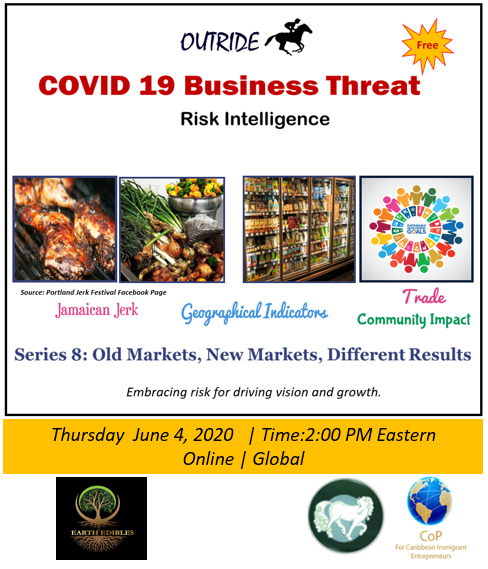
Outride: COVID 19 Business Threat Seminar

“Embracing risk for driving vision and growth”

The series is grounded in risk intelligence (RI). RI is that process of embracing risks and putting it to work for ensuring your business can survive or thrive during a crisis and beyond. It is also about value creation and protection. About delivering your vision and mission in the face of crisis as well as during the “normal”.

You are invited to join us for series eight in the Outride: COVID 19 Business Threat Seminar.

Edition title: Outride: COVID 19 — Old Markets, New Markets, Different Results

We are now in the action planning and execution phase of this Caribbean diaspora entrepreneurs business continuity initiative which also caters to and welcomes Caribbeans at home, other members of the BAME community as well as mainstream entrepreneurs, development and community service organizations worldwide.

When: June 4, 2020  |  Time: 2:00 PM EST  | Toronto & New York

Where: Online  | Registration detail below

Cost: Free

Featured Sessions include:

Strategic Alliances between GI Producers & Diaspora presented by Massimo Vittori  This session addresses the subject of geograhical indicators and international trade.

Vittori_safe_image_2

Massimo Vittori is the Managing Director of oriGIn.                                                            He is in charge of the Organization’s strategic planning and overall management. Massimo previously worked as legal advisor at the International Trade Center (ITC) – a technical assistance agency of the World Trade Organization and the United Nations – where he was in charge of several projects in the field of intellectual property, trade law harmonization, model contacts for SMEs and alternative business dispute resolution mechanisms. Massimo also worked at the United Nations Conference for Trade and Development (UNCTAD) on the improvement of developing countries’ investment climate through regulatory reforms.

Following his Bachelor’s degree in international Relations, Massimo obtained a Master’s Degree in International Law at the Graduate Institute of International and Development Studies of Geneva and an LL.M. in Intellectual Property at the University of Turin. Massimo regularly delivers seminars on GIs, trademarks, and trade related issues in several European Universities.

The Joy Spot Motivation Talk with Theo Chambers

Theo Chambers

Theo Chambers, Motivational Speaker and Business Coach Consultant, at CaribAcademy and Co-founder of Positive Tourism News (Jamaica). He is also the author of Theo’s Theory on Marketing and Management Strategies.

COVID 19 and Beyond — The Food Trade (An Overview) by Meegan Scott

10 Steps – to Resilience & Risk Intelligence Competent Assignment                         (Action, Not a Bag a Mouth!) by Meegan Scott

The Marathoner

Meegan Scott, is the Principal at Magate Wildhorse Consulting. For almost two decades Meegan has helped organizational leaders across industries and geographical borders to get better results from their strategy development, planning, and execution processes.  She is the founder and owner of Magate Wildhorse Ltd. Her most recent in Caribbean engagements includes Climate Finance Strategy Planning, The First Ever Outsource to the Caribbean Conference (2017), business incubation, and  corporate strategy planner to the National Environment and Planning Agency of Jamaica.

Event Rapporteur — Dania Sammott

Dania Headshot

Dania Sammott, is an experienced Retail Merchandizer and Travel Counsellor. Her experience include serving in the hypermarket sub-sector as well as in retail, pharmacy, food and household departments.  She is the Director, Public Relations for the Manchester High Alumni, Toronto, Chapter.

Event features: Joy Spot activity, Mouth and Mind discussion, COVID 19 business community experiences (open mic―diaspora, in Caribbean, other representatives of BAME or mainstream peers), Elevator pitches & network, review of prior topics in context of the assignment and action planning for helping individual businesses (entrepreneurs) get the best from the assignment. It is also aimed at helping those joining the series late to better understand the assignment, plan and execute their pivots.

Programme and Speakers (Click the link to view)

Registration Options

New to the series?

To receive your access link to the seminar please register at the link below.

https://forms.gle/PtpZAT8czWYExWpZ7

Returning attendees

Email us at magate.wildhorse (at)gmail.com  or click here.                                                Copy and paste the following in the subject line and body of your Email                          “Register me for Outride: COVID 19 — Old Markets, New Markets, Different Results”  please include your name.

All attendee must click the join meeting link provided before the start of the meeting to receive your unique log in credentials.

Procurement officers and buyers in search of COVID 19 and other supplies are welcome to participate.

Caribbean producers of geograghical Indicators (GI) are welcome to attend.

Outride: COVID 19 Business Threat Seminar is a global disapora entrepreneurs affair!                                                                                                                            Leaders of mainstream businesses with an interest in doing business with diaspora entrepreneurs are welcome to register for the match making and networking sessions.

Please note that this event is not just for small and micro-businesses, big businesses and big nonprofits can benefit also.

Commit to Evaluation for SDGs Prevent COVID

Brought to you by Magate Wildhorse Consulting, and The Community of Practise for Caribbean Immigrant Entrepreneurs (Home of BIDEM Conference & Trade Show)

Advance or maintain the progress.

You can’t spell BAME without the C.  The contribution of the Caribbean has been too significant.  The impact on the Caribbean community is significant and different BCAME (Black, Caribbean, Asian and Minority Ethnic Groups) #BCAME    #BAME

Footer sustainable develop seminar

Tie Strategy to Execution – Balanced Scorecard Help

Balanced Scorecard, corporate strategy planning, strategic planning, performance management, performance reporting, results based management Magate Wildhorse Solution

Need help with strategy planning or performance reporting?

Excited about the Balanced Scorecard approach?

Ever thought about twinning Logical Framework Approach (LFA) and the Balanced Scorecard for that perfect solution, that meets your government or donor planning need, while satisfying your results-based performance and capacity management and measurement need?

Then you’ve come to the right place!

We come with expertise in government corporate strategy planning; planning for the private, NGO, as well as the international development sectors.  We will integrate the Balanced Scorecard approach with your choice of approaches for example― LFA, Civicus, Haines System Thinking, our 8-9 step planning approach, or other to deliver a results-based performance management solution that drives execution and strategy success.

But if you just want Balanced Scorecard across the board― from planning through to performance monitoring, measurement, and reporting we’ll be glad to help you develop the plan, or performance solution that is right for your organization.

Ask about our organizational assessment solution. Our assessment is comprehensive and designed to bring information to the planning process that powers up informed strategy development.

It drives commitment and learning through stakeholder engagement, research, and the management response process, not to mention the support it gives to resource mobilization.

Our solution is backed by MBA level training in Strategy, specialist training and experience in corporate strategy planning for government, international development programmes, balanced scorecard, result-based approaches, participatory planning, facilitation skills, research, organizational assessment, programme evaluation, programme design, project management, marketing, communication, LFA, planning for market systems development programmes, insurance, finance, accounts, and trade.

We can bring a team of experts or a single consultant to your solution.

One-on-one help and strategic executive coaching for new strategy planners, managers, and seasoned executives available.

At Magate Wildhorse Ltd value for money, comes at a price you can afford!

Made possible by our business model that was designed with you in mind.

Email: magatewildhorse@gmail.com | Message us via Facebook, Instagram, Twitter, or LinkedIn.

Let’s get the conversation going! Contact us today!

Available internationally!

The Big Question of the Week ― What is a Corporate Strategy Plan?

On Thursday, February 28th we’ll be hosting a free Corporate Strategy Planning  webinar at Magate Wildhorse.

Many curious about the event had the following questions.

What is a corporate strategy plan?
Is it the same as a business plan?

Here are the differences between them.

While both plans are used for guiding organizations, they differ in scope, who, when, and how they are used.

Let’s start with the business plan.

The business plan is typically what a small or micro-business uses during its start-up phase. A large organization might also use a business plan for getting a new line of business or initiative off the ground. It supports the period of executing, testing and adjusting for viability at the start.

In a small nutshell, start-ups use their Business Plans to articulate, help them organize, and guide them in relation to why, how, who, and what they will do to produce their solution, market it, sell it, and make a profit.

 How they put the business plan to use:
  • To say what business, they are in;                                                                              The business you are in does not necessarily wear the same name as the products or services that you produce and sell.
  • To articulate how they will bring their solution from concept to a profit-making product or service, as well as the resources and actions that are needed to make that happen;
  • To define their customers, and say how they’ll reach them;
  • To say how they differ from the competition;
  • To highlight barriers, challenges, constraints and how they will work around them or remove them;
  • To help convince funders to invest in their businesses;
  • To tie a budget to delivering the planned solutions to the market and customers identified in that plan;
  • To highlight their strengths, weaknesses, opportunities, and threats;
  • To say what success should like including― the amount of money they intend to earn that year; and projections for another year or two; and
  • To say how they will wrap up the business in the most painless and beneficial if not profitable manner should there be the need to do so.

Now, let’s look at the corporate strategy plan.

The Corporate Strategy Plan is used by larger organizations with multiply programs and business units, or both. It is also used by entrepreneurs who have exited or is preparing to exit the start-up stage. Typical examples of such organizations are government departments, non-profit organizations, development programs, and larger private sector entities.

Big difference 1: The corporate strategy plan is used by organizations who are already in existence and who are looking to grow and improve.

How they use the Corporate Strategy Plan:     

  • To articulate the organizational strategy, the strategic direction, and for allocating resources in order to deliver the strategy.
  • To focus on agility, gaining the competitive edge over time, and incrementally, or completely within the plan period depending on how that edge is to be achieved.    It focuses on new capabilities and positioning to seize future opportunities.
  • To answer the question “where are we today?”                                                          The answer to which includes a focus on the organization’s results (including the financials), position in the market, etc.
  • To answer the question “where do we want to be?”                                             Here the answer focuses on the ambitions of the organization, the big problem(s) to be solved and for whom, objectives, and goals etc. It is in answer to this question that organizations arrive at what Jim Collins call BHAGs (Big Hairy Audacious Goals —pronounced Bee Hags). 
  • To answer the question, “What could prevent us from getting there?”
  • To answer the question, “How will we get there?”,                                              here is where priorities must be made and guide for tactics comes into play.
  • To answer the questions, “What should success look like?”, and “Are we on the same page?”, “Who is responsible for what?”
  • To guide execution.
  • To schedule time to step back analyze and reflect on the results, gather, and share learning (monitor, evaluate, assess), adjust the strategy, and improve.
  • It is also used is securing funding by government departments, development programs, and negotiating deals.

The Corporate Strategy Plan is usually elaborated into a 1-year Strategic Operational Plan asl known as the SOP or Operations Plan. The SOP contains details of what and how the first, second, third, fourth, or fifth year of the Corporate Strategy Plan is to be executed (Some entities use a 3-yr, 5-yr, and less frequently a 10-yr Corporate Strategy Plan)..

Corporate Strategy Planning, also known as long range planning should not start at the Board Retreat or the Strategic planning workshop.

Register here: https://www.facebook.com/events/2162653983818368/

To learn more you are invited to join us this Thursday, February 28, 2019 for a webinar on Corporate Strategy Planning.   Please visit the following link for details as well as to complete the registration form in order to receive a link to the webinar.

top question of the week strategy feb 26 smart


    Magate Wildhorse Instagram button


Marketing Change: Climate Resilience & Green Fund Programs

Marketing Change Climate Resilience

Be with us

for the webinar

“Marketing Change: Climate Resilience & Climate Fund Programs”

Join us on Wednesday, April 17, 2019 at 10:00 AM

Presenter: Meegan Scott

Duration: 45 mins. (Including Q & A).

You are welcome to submit challenges and concerns you have regarding the topic prior to the event.

Get on the early birds list. 

Request your invitation to the webinar now, click here.

Looking forward to sharing with you!

The event is brought to you by Magate Wildhorse Ltd.

Magate Wildhorse Instagram button

Don Your CEO’s Hat ― Keynotes

Don Your CEO's Hat Keynotes speaker session


You’re running a business and you are an entrepreneur.

So, what if you’re not the CEO of the business you lead?

Why should you care about being the CEO, when you are already the entrepreneur behind the business?

Join us on Thursday, March 14, 2019 at 7:00 PM

For the speaker session: Don Your CEO’s Hat―Keynotes

Presenter: Meegan Scott

Duration: 45 mins. (Including post session networking).

You are welcome to submit challenges you have faced with owning both roles ahead of the session.

To book your seat, please complete and submit the registration form at the “Book my seat”  link below.

Book my seat, please!

Registration deadline: Sunday, March 10, 2019
Looking forward to sharing with you!

The event is brought to you by Magate Wildhorse Ltd.

Magate Wildhorse Instagram button

Corporate Strategy Planning Solution ― Preview Webinar


presenter Meegan Scott, Corporate Strategy Solution Preview Webinar

Corporate Strategy Planning at Magate Wildhorse Ltd., find out what it all means.

,Join us on Thursday, February 28, 2019, at 1:00 PM for a lunch hour preview webinar on Corporate Strategy Planning at Magate Wildhorse Ltd.

Format:

  • The Connect & Clarify Session ― Questions & Answers (Case of an Architecture Firm)
  • Journey of a typical solution
  • Answers to your pre-submitted questions
  • Session Q & A

Presenter: Meegan Scott

Duration: 45 mins.

Please submit your registration form at the link below to receive link to webinar.

https://goo.gl/forms/1e09iPSqYYH2IAU83

Registration deadline: Tuesday, February 26, 2019
Looking forward to sharing with you!

Magate Wildhorse Instagram button

Corporate Strategy Planning ― with Heart & Fun

Corporate Strategy Planning Solution Magate Wildhorse Ltd Serious Business with heart

Corporate Strategy Planning at Magate Wildhorse Ltd., means
serious business with heart.

The journey

  1.  connect and clarify meeting
  2. a strategic organizational assessment
  3. organizational assessment & development proposal
  4. strategic review w Board & ED/CEO
  5. facilitated strategic planning meeting(s) & training workshop
  6. strategy communication session (s)

Every step is sandwiched by stakeholder engagement

Plus

  • We’ll help translate your Corporate Plan to a 1 yr. Operational Plan.
  • We’ll help develop your Performance Management tools.

Serious business with heart and care for your pocket!

Available internationally: face-to-face, virtual, remote, blended face-to-face & online!

Request your connect & clarify meeting now!

Or send a request for proposal (RFP).
Click here.

Preview Webinar

Of interest to government departments, entrepreneurs, non-profit leaders, leaders of international development projects, cluster managers, leaders of private sector development agencies, economic development agencies, & other third sector managers & leaders.

Join us on Thursday, February 28, 2019, at 1:00 PM for a lunch hour preview webinar on Corporate Strategy Planning at Magate Wildhorse Ltd.


Please submit your registration form at the link below to receive link to webinar.

https://goo.gl/forms/1e09iPSqYYH2IAU83

Registration deadline: Tuesday, February 26, 2019
Looking forward to sharing with you!

Magate Wildhorse Instagram button

Scoop on Magate Wildhorse Ltd ― get it here!

With just a click.Magate Wildhorse Ltd  Strategic Management & International Development Practise  Instagram  Follow Magate Wildhorse Ltd on Instagram Corporate Strategy Plans, Evaluations, Organizational Assessments, Market Research, Environmental Scans, Strategic Executive Coaching, Strategic Executive Coaching, Critical Friend Evaluation Solutions

The Minute Book Saved The Day! Tell Us About Your Experience.


View this post on Instagram

The minute book saved the day! Tell us about your experience. 1. Tell us about a time when your Minute Book saved the day. 2. What are some novel ways in which you have used your Corporate Minute Book? Thanks for sharing! Give, receive, and grow a stronger business in 2019. This challenge is brought to you by Magate Wildhorse Ltd. Your performance catalyst, strategy expert, and scale-up coach. We bring urgency, accountability, fun, reflection, learning, and flexibility to helping you deliver your strategy! We will help you find your performance one drop! Find your success rhythm today! Find out how we can help you to improve the results of your organization today! Click that message button and drop us a line. Have a Wonderful Wednesday! #businesssuccess #strategysuccess #minutebook #savedtheday #scaleupcoach #strategyexperts #performancecatalyst #youronedrop #successrhythm

A post shared by Magate Wildhorse Ltd (@magate.wildhorse_ltd) on

Minutebook challenge scale up coach black history month business tip accountability