
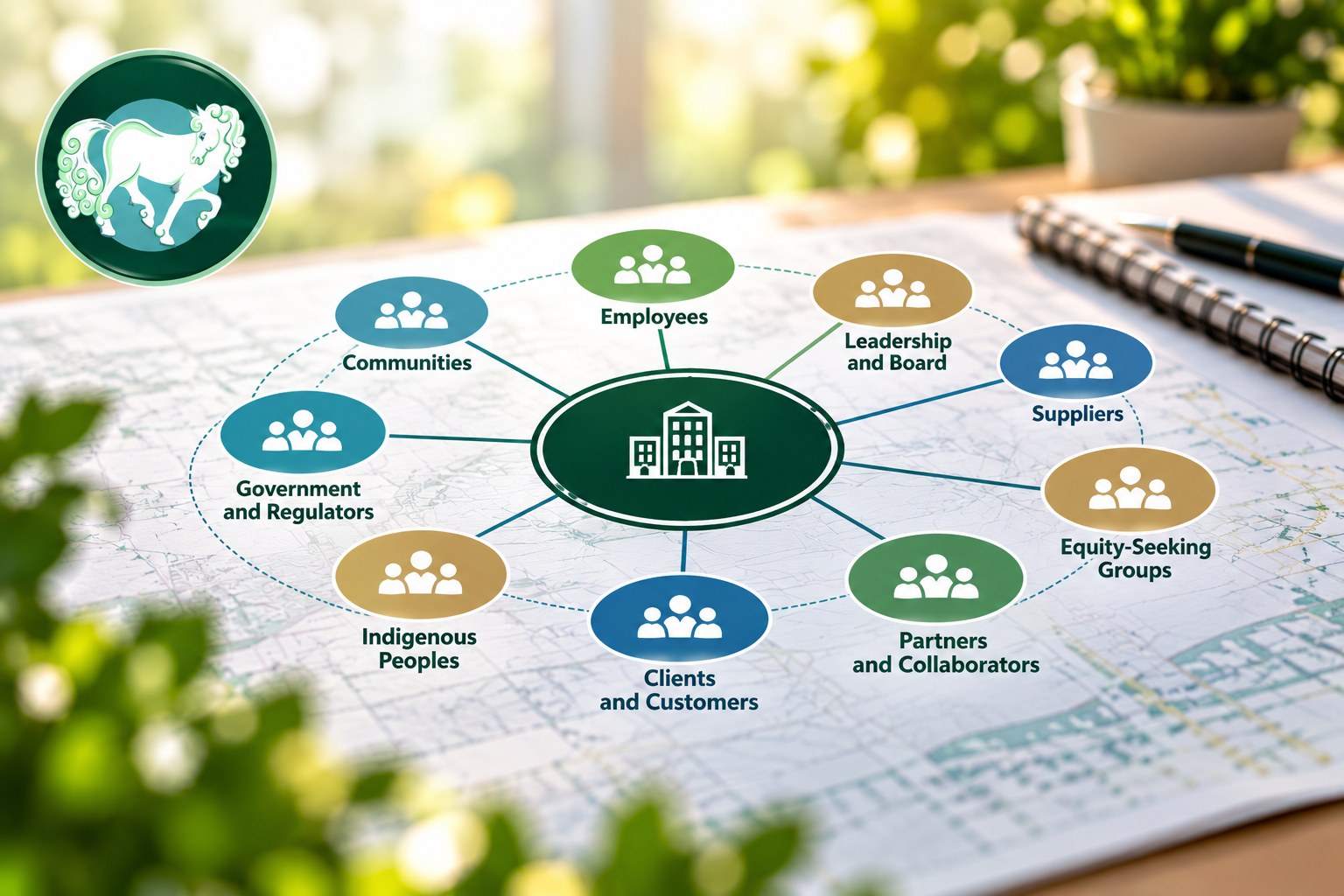
Stakeholder Engagement, Assessment & Analysis: Strengthening the Strategic Planning Process

Magate logo, horse on green stone, stakeholder map, notebook and pen (partial view), plants.

Strategic planning is not an exercise that organizations should undertake in isolation. The effectiveness of a strategic plan depends, in part, on how well an organization understands the people, groups and institutions that influence its success, contribute to its operations, or are affected by its decisions.

Stakeholder engagement, assessment and analysis are therefore important components of the strategic planning process. Although closely related, they serve distinct but complementary purposes. Stakeholder assessment helps organizations evaluate relationships, experiences and outcomes associated with the implementation of an existing strategic plan. Stakeholder analysis helps identify and understand the interests, influence and potential impact of stakeholders as an organization prepares its next plan. Stakeholder engagement provides opportunities for dialogue, consultation, collaboration and the development of shared understanding.

Stakeholder Assessment: Learning from the Existing Strategic Plan

As an organization approaches the end of its strategic planning cycle, evaluating the implementation and results of the expiring plan is essential.

Stakeholder assessment forms part of this evaluation and the broader organizational or current-state assessment. It examines who contributed to, influenced or was affected by the strategic plan and how effectively the organization responded to their needs and expectations.

Important questions include:

  • Which stakeholder groups participated in implementing the plan, and what contributions did they make?
  • To what extent were stakeholder needs and expectations met?
  • How effective were the organization’s relationships and communication with stakeholders?
  • What challenges, conflicts or unmet expectations emerged?
  • What lessons should inform the next strategic planning cycle?

Stakeholder assessment can reveal gaps between organizational intentions and stakeholder experiences. It can also identify changes in stakeholder relationships, emerging concerns, and opportunities to strengthen organizational performance.

The findings should contribute to the evaluation of the expiring strategic plan and provide evidence for decisions about the organization’s future direction.

Stakeholder Analysis: Understanding Interests, Influence and Impact

Stakeholder analysis is particularly important during preplanning and the environmental scanning process. It helps organizations identify individuals, groups and institutions that can influence, contribute to or be affected by their activities and strategic decisions.

The process begins with stakeholder identification and classification. Stakeholders may be categorized as primary or secondary, internal or external, depending on their relationship with the organization.

Primary stakeholders generally have a direct relationship with, or are directly affected by, organizational activities. Secondary stakeholders may influence the organization’s operating environment or be indirectly affected by its decisions.

Once identified, stakeholders can be mapped and analyzed according to their interests, influence, potential impact, expectations and relationships.

An important objective is to understand the value stakeholders seek from their relationship with the organization. Different groups may have competing priorities, but they may also share interests that create opportunities for cooperation.

The strategic challenge is not simply to identify these interests. It is to discover connections among them and develop solutions that align stakeholder expectations with organizational purpose and strategic objectives.

Tools for Stakeholder Mapping and Analysis

Several analytical tools can support this process.

Stakeholder Interest–Influence–Impact Mapping examines the interests of stakeholder groups, their ability to influence organizational decisions, and the extent to which they may affect or be affected by organizational activities. It helps planners determine appropriate engagement strategies and identify relationships requiring particular attention.

The Power–Interest Grid classifies stakeholders according to their level of influence or power and their interest in organizational activities. It provides a practical framework for determining how different stakeholder groups should be engaged, informed or consulted.

The Stakeholder Issues Matrix identifies the issues, concerns, expectations and priorities associated with different stakeholder groups. It can highlight common interests, conflicting demands and emerging strategic issues requiring organizational attention.

The Stakeholder Salience Model, developed by Mitchell, Agle and Wood, offers another approach to stakeholder prioritization. The model examines three attributes:

  • Power: The stakeholder’s ability to influence the organization or its decisions.
  • Legitimacy: The perceived appropriateness or validity of the stakeholder’s claims or relationship with the organization.
  • Urgency: The extent to which stakeholder claims require immediate attention.

By considering these attributes together, organizations can better understand which stakeholder claims demand attention and how stakeholder priorities may change over time.

However, stakeholder prioritization should not result in the exclusion of groups with limited power. Stakeholders who are significantly affected by organizational decisions may have important perspectives even when they lack the influence to command attention.

Stakeholder Engagement: Moving Beyond Consultation

Stakeholder engagement involves more than collecting opinions. It is a process through which organizations communicate, listen, exchange knowledge, explore competing interests and, where appropriate, collaborate on solutions.

Effective engagement helps organizations test assumptions, identify overlooked issues, build relationships and improve the quality of strategic decisions.

Engagement approaches may combine quantitative, qualitative and collaborative techniques, including:

  • Surveys and questionnaires
  • Individual stakeholder interviews
  • Focus groups and ideation sessions
  • Town halls and open forums
  • Workshops and design charrettes
  • Advisory committees and task forces
  • Stakeholder mapping and analysis exercises
  • Social network analysis

The selection of methods should reflect the purpose of the engagement, the characteristics of stakeholder groups, available resources and the decisions to be informed.

For example, surveys may capture perspectives across a large stakeholder population, while interviews and focus groups can provide deeper insights into experiences, expectations and concerns. Collaborative workshops can help stakeholders explore alternatives and identify areas of common interest.

Engagement should also be inclusive and accessible, providing meaningful opportunities for groups whose perspectives may otherwise be overlooked—such as equity seeking groups.

Integrating Stakeholder Findings into Strategic Decisions

The value of stakeholder assessment, analysis and engagement ultimately depends on how their findings are used.

Information gathered through these processes should inform the organization’s environmental scan, assessment of its current position, identification of strategic issues, and development and evaluation of strategic options.

Stakeholder findings can reveal opportunities for partnerships, changes in service needs, emerging risks, resource constraints and areas where organizational priorities require reconsideration.

They can also help identify tensions between stakeholder expectations and organizational capacity. Such tensions require strategic choices rather than promises that every interest can be accommodated.

Where interests overlap, organizations should explore solutions that create shared value. Where they conflict, transparent decision-making and clear communication become particularly important.

Stakeholder engagement should not end when the strategic plan is approved. Continued engagement during implementation, monitoring and evaluation enables organizations to assess progress, respond to changing circumstances and maintain relationships.

Conclusion

Stakeholder engagement, assessment and analysis are interconnected activities that strengthen strategic planning when applied systematically.

Assessment provides lessons from the implementation of the existing plan. Analysis develops an understanding of stakeholders and their interests, influence and potential impact. Engagement creates opportunities to gather evidence, build understanding and explore solutions.

Together, these processes help organizations move beyond internally driven planning towards strategies that are better informed, more responsive to their operating environments and more capable of generating meaningful results.

Magate Wildhorse Ltd. provides strategic planning, stakeholder engagement, assessment and analysis services to support organizations in developing evidence-informed strategies and strengthening organizational performance.

Share your thoughts on social media or by email at: magate.wildhorse@gmail.com.

To request a service, fill our service request form below:

https://forms.gle/Gr1eaDuCb3KbX1YC6

Written by Meegan Scott. Copyright © 2026 Meegan Scott and Magate Wildhorse Ltd. All rights reserved.

Strong Strategy Development Starts Before the Planning Session

Magate Wildhorse logo, landscape with Fall coloured green and yellow green shrubs, distant background with sunshine and up close puzzle pieces of landscape with a hand holding one puzzle piece.

Organizations often think of strategic planning as the point at which leaders, board members and stakeholders come together to decide priorities for the next three to five years. The planning session is important—but strong strategy development begins well before anyone enters the room.

Organizations operate in constantly changing environments. Government policies shift. Economic conditions change. New technologies emerge. Stakeholder expectations evolve. Funding environments change. Internally, organizations experience changes in leadership, capabilities, resources, performance and priorities.

Developing strategy without understanding these conditions risks making decisions based on assumptions rather than evidence.

At Magate Wildhorse, we approach strategic planning as an evidence-informed process that can take an organization from understanding its environment and current state through stakeholder engagement, strategy development, implementation and performance assessment:

Environmental Scan → Current-State/Organizational Assessment → Stakeholder Engagement → Strategic Planning & Facilitation → Implementation & Performance Framework

These components are not necessarily separate or sequential assignments. An environmental scan, for example, may be commissioned independently or incorporated into a broader current-state or organizational assessment.

Organizations can engage us for the complete process or for individual components according to their needs.

An Approach Tailored to the Organization

How strategy is developed matters.

Depending on the organization, community, assignment and intended results, our consulting approach can incorporate methods that are collaborative, participatory, results-oriented, systems-oriented, community-informed, equity-centered and anti-oppressive.

This can mean working collaboratively with clients throughout the assignment; creating meaningful opportunities for stakeholder participation; considering the broader systems in which the organization operates; incorporating community knowledge and perspectives; examining barriers, power and inequities where relevant; and maintaining a clear focus on the results the strategy is intended to achieve.

The appropriate combination of approaches depends on the purpose, context and needs of each engagement.

1. Environmental Scan: What Is Changing Around You?

Before determining where an organization should go, it is important to understand the environment in which it will be operating.

An environmental scan examines external forces, trends and developments that could affect the organization’s future. Depending on the organization and sector, these may include political, economic, social, technological, environmental, legal, demographic, industry and competitive developments.

A useful environmental scan goes beyond collecting information. It asks:

  • What is changing?
  • Which changes matter to the organization?
  • What opportunities and risks are emerging?
  • What assumptions may no longer hold?
  • What should leadership continue to monitor?

Environmental scanning helps organizations make strategic choices based on the environment they are likely to face rather than the conditions that existed when their previous plans were developed.

It may be undertaken as a standalone assignment or incorporated into a broader current-state or organizational assessment.

2. Current-State and Organizational Assessment: Where Are You Now?

Before deciding where to go, an organization needs a well-grounded understanding of where it is today.

Depending on its purpose and scope, a current-state or organizational assessment may examine both internal organizational conditions and the external operating environment. The external component can therefore incorporate an environmental scan.

Internally, an assessment may consider governance, leadership, organizational structure, programs and services, human resources, operations, financial sustainability, partnerships, communications, organizational culture, systems, performance management and capacity.

The specific areas assessed should be determined by the questions the organization needs answered.

Among those questions might be:

What is working well? What is not? Where are the important gaps, constraints and opportunities? How well are our structures, systems, resources and capabilities aligned with our ambitions? What needs to change?

Rather than simply describing the organization, the assessment should generate evidence and insight that can inform decisions about its future direction.

3. Stakeholder Engagement: What Do the People Who Matter See?

Employees, clients, members, partners, funders, government actors, communities and other stakeholders may see opportunities and challenges from very different perspectives.

Stakeholder engagement can uncover information that is not readily available from documents or management discussions. It can reveal different expectations, identify emerging concerns and provide insight into where stakeholder interests converge or diverge.

Depending on the assignment, engagement may include stakeholder identification and mapping, interviews, surveys, focus groups, facilitated discussions, workshops or other consultation methods.

Stakeholder engagement does not mean that every stakeholder determines the strategy. Strategic decisions remain the responsibility of those charged with governing and leading the organization.

It means ensuring that decision-makers have access to relevant stakeholder intelligence before making those decisions.

4. Strategic Planning and Facilitation: Where Are You Going?

Once the evidence has been assembled, the organization is better positioned to make strategic choices.

Environmental intelligence, organizational evidence and stakeholder perspectives come together to help determine where the organization intends to go, what it will prioritize and—equally importantly—what it will not prioritize.

Depending on the organization’s needs, this may include examining or developing its strategic direction, mission, vision, values, strategic priorities, objectives and intended results.

Effective facilitation helps boards, leadership teams and other participants examine evidence, surface different perspectives, work constructively through disagreement and build sufficient consensus around future direction.

Magate Wildhorse brings competencies in Technology of Participation (ToP) facilitation methods, Workshop Design and Group Process Facilitation to the design and delivery of strategic planning processes. These competencies help us design purposeful participatory sessions and guide groups from discussion toward decisions and agreed strategic direction.

The objective is not simply to produce an attractive strategic plan. It is to make deliberate choices about the organization’s future.

5. Implementation and Performance: How Will Strategy Become Action?

A strategic plan creates little value if it cannot be implemented.

Implementation can falter when priorities are not translated into responsibilities, actions, milestones and measurable results. An implementation and performance framework helps make that connection.

Depending on organizational needs, it may establish:

  • strategic objectives and expected results;
  • initiatives, responsibilities and timelines;
  • milestones and key performance indicators;
  • targets and reporting arrangements; and
  • mechanisms for reviewing progress and adapting when circumstances change.

Magate Wildhorse also brings evaluation competency to this stage. This allows evaluation thinking to be incorporated from the outset by considering intended results, appropriate indicators, evidence requirements and how progress and performance will be assessed.

The question becomes not simply “Did we complete the activities?” but also “Are our actions contributing to the results our strategy was intended to achieve?”

This connects strategy, implementation, performance monitoring, evaluation, learning and accountability.

Strategic Planning Is a Process, Not an Event

A planning retreat can be valuable. But the retreat itself is not the strategy-development process.

Strong strategy development requires organizations to understand their environment and current position, listen intelligently to stakeholders, make deliberate choices and establish mechanisms for turning those choices into results.

Our approach connects:

Environmental Scan → Current-State/Organizational Assessment → Stakeholder Engagement → Strategic Planning & Facilitation → Implementation & Performance Framework

The components can be integrated, adapted or commissioned independently.

Planning for 2027 and Beyond?

Before asking “When should we hold our planning session?”, organizations preparing for their next strategic cycle should also ask:

What has changed within and around us? Where are we now? What are our stakeholders telling us? What strategic choices do we need to make? And how will we know whether our strategy is producing the intended results?

Magate Wildhorse provides strategic and corporate planning, environmental scanning, current-state and organizational assessment, stakeholder engagement and assessment, facilitation, evaluation and performance-monitoring support.

Organizations may engage us for an end-to-end strategic planning process or for individual components tailored to their needs.

Preparing for a new strategic planning cycle—or trying to determine what your organization needs before planning begins? Contact Magate Wildhorse to discuss your organization’s needs and how we can support the process.

To request a solution fill our service request form below:

https://forms.gle/Gr1eaDuCb3KbX1YC6

Email us at: magate.wildhorse@gmail.com.

Where We Create Impact By Design.

Written by Meegan Scott. Copyright © 2026 Meegan Scott and Magate Wildhorse Ltd. All rights reserved.

.

Marketing Change: Climate Resilience & Green Fund Programs

Marketing Change Climate Resilience

Be with us

for the webinar

“Marketing Change: Climate Resilience & Climate Fund Programs”

Join us on Wednesday, April 17, 2019 at 10:00 AM

Presenter: Meegan Scott

Duration: 45 mins. (Including Q & A).

You are welcome to submit challenges and concerns you have regarding the topic prior to the event.

Get on the early birds list. 

Request your invitation to the webinar now, click here.

Looking forward to sharing with you!

The event is brought to you by Magate Wildhorse Ltd.

Magate Wildhorse Instagram button

Corporate Strategy Planning Solution ― Preview Webinar


presenter Meegan Scott, Corporate Strategy Solution Preview Webinar

Corporate Strategy Planning at Magate Wildhorse Ltd., find out what it all means.

,Join us on Thursday, February 28, 2019, at 1:00 PM for a lunch hour preview webinar on Corporate Strategy Planning at Magate Wildhorse Ltd.

Format:

  • The Connect & Clarify Session ― Questions & Answers (Case of an Architecture Firm)
  • Journey of a typical solution
  • Answers to your pre-submitted questions
  • Session Q & A

Presenter: Meegan Scott

Duration: 45 mins.

Please submit your registration form at the link below to receive link to webinar.

https://goo.gl/forms/1e09iPSqYYH2IAU83

Registration deadline: Tuesday, February 26, 2019
Looking forward to sharing with you!

Magate Wildhorse Instagram button

Corporate Strategy Planning ― with Heart & Fun

Corporate Strategy Planning Solution Magate Wildhorse Ltd Serious Business with heart

Corporate Strategy Planning at Magate Wildhorse Ltd., means
serious business with heart.

The journey

  1.  connect and clarify meeting
  2. a strategic organizational assessment
  3. organizational assessment & development proposal
  4. strategic review w Board & ED/CEO
  5. facilitated strategic planning meeting(s) & training workshop
  6. strategy communication session (s)

Every step is sandwiched by stakeholder engagement

Plus

  • We’ll help translate your Corporate Plan to a 1 yr. Operational Plan.
  • We’ll help develop your Performance Management tools.

Serious business with heart and care for your pocket!

Available internationally: face-to-face, virtual, remote, blended face-to-face & online!

Request your connect & clarify meeting now!

Or send a request for proposal (RFP).
Click here.

Preview Webinar

Of interest to government departments, entrepreneurs, non-profit leaders, leaders of international development projects, cluster managers, leaders of private sector development agencies, economic development agencies, & other third sector managers & leaders.

Join us on Thursday, February 28, 2019, at 1:00 PM for a lunch hour preview webinar on Corporate Strategy Planning at Magate Wildhorse Ltd.


Please submit your registration form at the link below to receive link to webinar.

https://goo.gl/forms/1e09iPSqYYH2IAU83

Registration deadline: Tuesday, February 26, 2019
Looking forward to sharing with you!

Magate Wildhorse Instagram button

Public Announcement: “ZA Women-led Born Global & Born-Again Global Business Survey”

take south africa women-led born and born-again global survey and win

Magate Wildhorse Ltd., wishes to inform stakeholders and women entrepreneurs in South Africa, namely management consultants and providers of professional services about the “South Africa Women-led Born Global and Born-Again Global Consulting Business Survey”

South African women who own or manage women-led businesses (that is entities in which women make up the majority at the highest level of leadership and decision-making). Womenpreneurs and solopreneurs for all provinces in South Africa are invited to share by way of the survey.

Your answers along with that of other respondents will help decision-makers, you, and entrepreneurs to better understand what drives the decision to export and the best approaches for accelerating scale-up of your businesses in foreign markets. Thank you for sharing by completing the survey by Monday, December 31, 2018!

Deadline for all extended to January 25, 2019.

Complete the survey by December 20, 2018 for a chance to win!

Please click the following link to take the survey: https://goo.gl/forms/YJMXU1U5XBo3E3Dm1

Thank you for the time taken to share.   Thanks also for sharing appropriately with your networks.

Happening also ― is are focus group discussions related to the research.

Deadline for all extended to January 25, 2019

These discussions will end on December 29. There will be no discussions between December 24th and 26th.   To participate in a session please see the information at the following link: https://goo.gl/FZYY8q

Thanks again for sharing.

For further information: Please Email us at magatewildhorse@gmail.com
Or visit: https://goo.gl/NgKTNJ

Research team: Meegan Scott (Magate Wildhorse Ltd.), Dr. Daniel Maposa (lecturer in the Department of Statistics and Operations Research in the School of Mathematical & Computer Sciences, University of Limpopo & Magate Wildhorse Ltd.), and Dr. Zakaria Sorgho (Economist-in-Chief at African Centre for International Trade and Development – ACITD).


focus group women-led management consulting businesses South Africa SMEs small medium sized enterprisesborn global and born-again global South African Women-led Online Survey