Strategic Planning & Facilitation: Turning Evidence into a Strategic Plan

Magate logo - white horse on green moss agate stone. A black man, a white woman, a missed woman and a white man in a strategic planning session led by a black woman facilitator with a strategic planning flowchart on a flipchart stand.

Effective strategic planning requires more than a well-designed workshop, a collection of analytical tools, or agreement on organizational priorities. It requires a structured, participatory process through which evidence is interpreted, strategic choices are made, and organizational commitment is secured.

The preceding articles in this series examined the foundations of strategic planning: preparation, environmental scanning, organizational and current-state assessment, and stakeholder engagement, assessment and analysis. These activities provide the evidence and insights needed to inform strategy development.

The strategic planning exercise brings these elements together, enabling participants to move from understanding their organization’s circumstances to determining its future direction.

Understanding the Strategic Planning Process

Strategic planning establishes an organization’s long-term direction, priorities, intended results, and approaches to achieving them. It connects organizational purpose and aspirations with strategic choices, resource allocation, implementation, and performance measurement.

An effective planning workshop begins by establishing workshop norms, objectives and a common understanding of strategic planning terminology, concepts, and processes. Participants should understand the distinctions between corporate strategic planning and strategic operational planning, including how organizational priorities translate into departmental, functional, team, and individual responsibilities.

The five levels of strategic planning should also be clarified within the organization’s planning framework, ensuring participants understand how decisions and responsibilities connect across organizational levels.

The proposed strategy formulation approach, workshop objectives, expected outputs, and decision-making arrangements should be explained before substantive deliberations begin.

The Role of Strategic Planning Facilitation

A strategic planning facilitator does more than manage an agenda or encourage participation. The facilitator creates the conditions for constructive discussion, thoughtful examination of alternatives, shared understanding, and collective decisions about organizational direction.

Four competencies are particularly important:

  • Active listening: Understanding participants’ perspectives, identifying underlying concerns, and ensuring contributions are accurately interpreted.
  • Effective communication: Explaining complex concepts clearly, asking purposeful questions, summarizing discussions, and maintaining a common understanding.
  • Group dynamics management: Encouraging balanced participation, managing dominant voices, and helping participants navigate different stages of group development.
  • Conflict resolution: Managing disagreements constructively, distinguishing competing interests from substantive strategic differences, and facilitating acceptable resolutions.

At Magate Wildhorse Ltd., strategic planning is led by a trained facilitator with additional training in workshop design, corporate strategy planning for government, and the Balanced Scorecard approach.

Our facilitation methodology incorporates group process techniques that help participants navigate the forming and storming stages of group development while progressing toward productive collaboration and consensus.

Techniques such as brainstorming, clustering, naming, and consensus-setting support the identification, organization, interpretation, and prioritization of ideas. Participants are guided through processes of codification, elaboration, and conversion, transforming contributions into clearly articulated strategic choices and actionable commitments.

Establishing Strategic Direction

An important component of the strategic planning exercise is developing agreement on the organization’s desired future.

Participants examine the organization’s vision, mission, and values, considering whether these remain appropriate in light of changing circumstances and emerging aspirations.

Facilitated discussions support consensus on the vision, clarification or revision of the mission, and affirmation or refinement of organizational culture and values.

Where preliminary strategic directions have been developed through earlier assessments or leadership deliberations such as the board visioning exercise, these are presented for examination and expanded through participants’ contributions.

Potential growth and development options are explored, including opportunities for organizational expansion, service innovation, partnerships, market development, operational improvement, or institutional strengthening.

The objective is not simply to generate ideas but to make informed choices about where the organization should concentrate its efforts.

Connecting Strategic Choices to Organizational Reality

Although environmental scanning and organizational assessment precede the workshop, their findings must be actively integrated into strategy formulation.

Participants revisit relevant PESTLE findings, examining political, economic, social, technological, legal, and environmental influences. SWOT analysis helps consolidate organizational strengths, weaknesses, opportunities, and threats.

These discussions test whether proposed strategic directions are realistic, responsive, and aligned with organizational capabilities.

Additional tools, including force field analysis, may be used to identify forces supporting or resisting proposed changes.

Through facilitated dialogue, participants examine assumptions, strategic risks, competing priorities, resource constraints, and the implications of alternative courses of action.

Translating Strategy into Action

Strategic direction must eventually become an organized programme of action.

Participants identify strategic priorities, desired outcomes, critical initiatives, and the actions necessary to achieve them.

Related activities are clustered into task arenas, which are organized and named to establish clear areas of responsibility and implementation.

Planning templates are introduced to support Consistency in documenting objectives, initiatives, responsibilities, resources, performance indicators, and timelines.

Participants review SMART performance indicators—specific, measurable, achievable, relevant, and time-bound—to strengthen accountability and establish measurable expectations.

Working groups may then be formed, with participants volunteering responsibility for developing specific components of the plan or advancing priority initiatives.

Participants identify the financial, human, technological and other resources required to implement proposed strategic initiatives. Potential funding sources and financing options are explored, alongside existing budgetary allocations, resource gaps and opportunities for partnerships or resource mobilization. This helps ensure that strategic priorities are financially realistic and supported by appropriate resource planning.

Next, participants assess the Feasibility of proposed strategic initiatives, considering available resources, organizational capacity, potential risks and implementation constraints. Where competing priorities exceed available resources, strategic trade-offs are examined to determine which initiatives should be prioritized, deferred, modified or discontinued. These deliberations help ensure that strategic choices are realistic, sustainable and aligned with the organization’s mission and long-term objectives.

Commitments, timelines, milestones, and immediate next steps are agreed upon before the workshop concludes.

Selecting Appropriate Strategy and Performance Frameworks

Different organizations require different tools for articulating and implementing strategy.

Government organizations may employ logic models, theories of change, and strategy maps to connect policy objectives, interventions, outputs, outcomes, and public value.

Nonprofit organizations frequently use theories of change and strategy maps to explain how their activities contribute to intended social outcomes.

Private sector organizations may use the Business Model Canvas, Balanced Scorecard, strategy maps, or Objectives and Key Results (OKRs) to articulate their business models, strategic objectives, performance priorities, and desired results.

These approaches are not exclusive to particular sectors. Their selection should reflect organizational purpose, operating context, planning maturity, and performance management needs.

The workshop should also introduce the proposed performance monitoring and evaluation framework, including how progress will be tracked, results evaluated, and strategic adjustments informed.

Consolidating the Strategic Plan

As the workshop progresses toward closure, participants review planned tasks, agreed actions, responsibilities, and timelines.

The outcomes provide the basis for preparing the draft strategic plan, which should capture strategic direction, priorities, objectives, implementation arrangements, and performance expectations.

Participants reflect on the emerging plan, considering its coherence, feasibility, organizational alignment, and potential implementation challenges.

Critical success factors are identified to clarify the conditions necessary for effective execution. Where appropriate, participants may also develop a guiding slogan that captures the strategic ambition and helps sustain commitment throughout the planning cycle.

A final review confirms outstanding matters, follow-up responsibilities, and arrangements for completing and validating the draft plan.

The workshop concludes with participant reflection, session evaluation, and formal closure.

Beyond the Planning Workshop

A successful strategic planning workshop is not measured solely by the volume of ideas generated or the completion of a planning document.

Its value lies in the quality of strategic choices, the extent of shared understanding, the strength of organizational commitment, and the readiness to translate decisions into action.

Effective facilitation helps organizations navigate complexity, engage diverse perspectives, resolve competing priorities, and establish a common direction.

However, the workshop is a critical milestone rather than the conclusion of strategic planning. Strategy must subsequently be refined, documented, communicated, implemented, monitored, evaluated, and adapted.

At Magate Wildhorse Ltd., we approach strategic planning and facilitation as an integrated process that connects evidence, participation, strategic decision-making, and implementation readiness. Our objective is to help organizations develop strategies that are not only credible and ambitious but also practical, measurable, and supported by those responsible for delivering results.

Magate Wildhorse Ltd. provides strategic planning, stakeholder engagement, assessment and analysis, as well as environmental scanning services to support organizations in developing evidence-informed strategies and strengthening organizational performance.

Share your thoughts on social media or by email at: magate.wildhorse@gmail.com.

To request a solution, fill our service request form below:

https://forms.gle/Gr1eaDuCb3KbX1YC6

Written by Meegan Scott. Copyright © 2026 Meegan Scott and Magate Wildhorse Ltd. All rights reserved.

Stakeholder Engagement, Assessment & Analysis: Strengthening the Strategic Planning Process

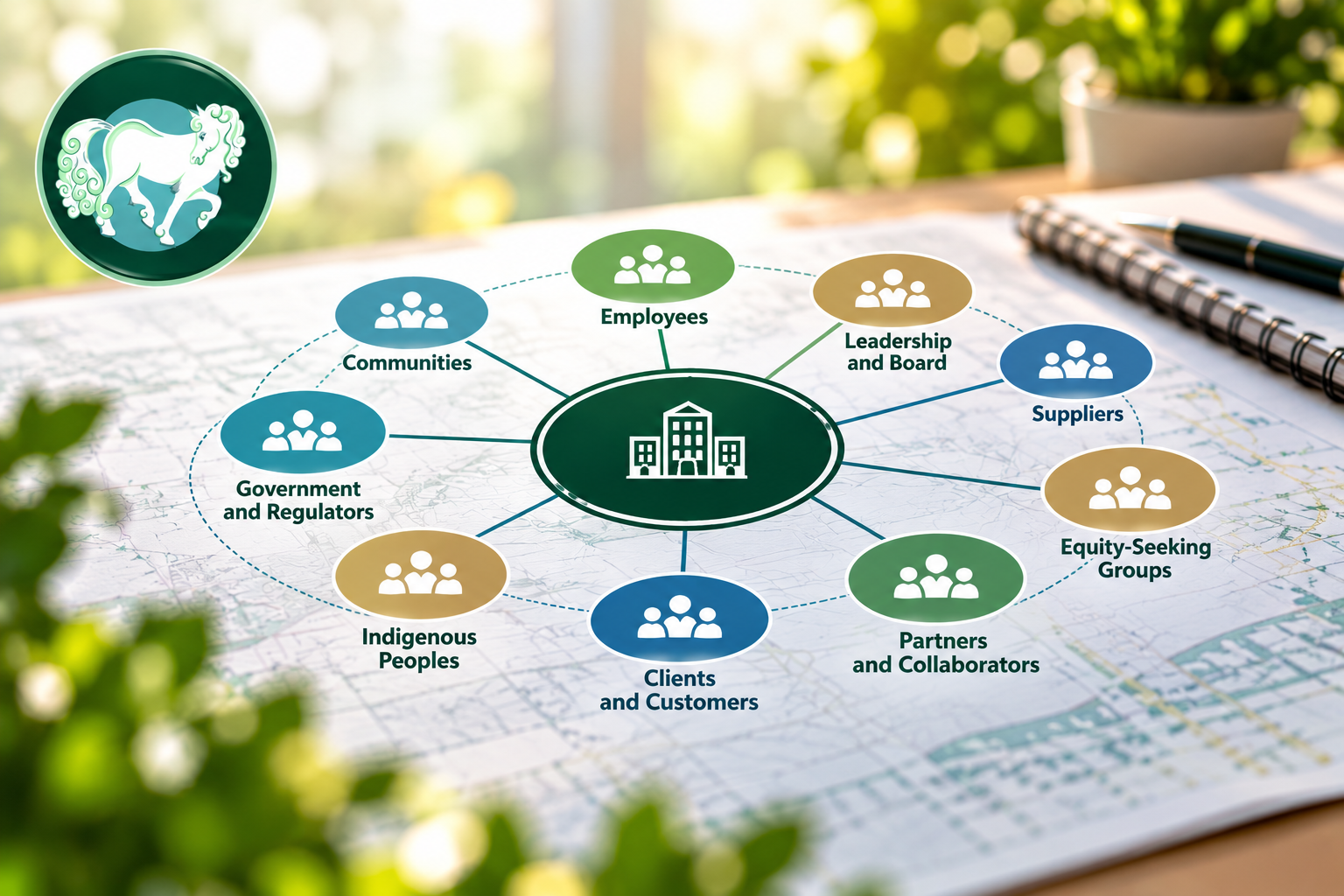
Magate logo, horse on green stone, stakeholder map, notebook and pen (partial view), plants.

Strategic planning is not an exercise that organizations should undertake in isolation. The effectiveness of a strategic plan depends, in part, on how well an organization understands the people, groups and institutions that influence its success, contribute to its operations, or are affected by its decisions.

Stakeholder engagement, assessment and analysis are therefore important components of the strategic planning process. Although closely related, they serve distinct but complementary purposes. Stakeholder assessment helps organizations evaluate relationships, experiences and outcomes associated with the implementation of an existing strategic plan. Stakeholder analysis helps identify and understand the interests, influence and potential impact of stakeholders as an organization prepares its next plan. Stakeholder engagement provides opportunities for dialogue, consultation, collaboration and the development of shared understanding.

Stakeholder Assessment: Learning from the Existing Strategic Plan

As an organization approaches the end of its strategic planning cycle, evaluating the implementation and results of the expiring plan is essential.

Stakeholder assessment forms part of this evaluation and the broader organizational or current-state assessment. It examines who contributed to, influenced or was affected by the strategic plan and how effectively the organization responded to their needs and expectations.

Important questions include:

  • Which stakeholder groups participated in implementing the plan, and what contributions did they make?
  • To what extent were stakeholder needs and expectations met?
  • How effective were the organization’s relationships and communication with stakeholders?
  • What challenges, conflicts or unmet expectations emerged?
  • What lessons should inform the next strategic planning cycle?

Stakeholder assessment can reveal gaps between organizational intentions and stakeholder experiences. It can also identify changes in stakeholder relationships, emerging concerns, and opportunities to strengthen organizational performance.

The findings should contribute to the evaluation of the expiring strategic plan and provide evidence for decisions about the organization’s future direction.

Stakeholder Analysis: Understanding Interests, Influence and Impact

Stakeholder analysis is particularly important during preplanning and the environmental scanning process. It helps organizations identify individuals, groups and institutions that can influence, contribute to or be affected by their activities and strategic decisions.

The process begins with stakeholder identification and classification. Stakeholders may be categorized as primary or secondary, internal or external, depending on their relationship with the organization.

Primary stakeholders generally have a direct relationship with, or are directly affected by, organizational activities. Secondary stakeholders may influence the organization’s operating environment or be indirectly affected by its decisions.

Once identified, stakeholders can be mapped and analyzed according to their interests, influence, potential impact, expectations and relationships.

An important objective is to understand the value stakeholders seek from their relationship with the organization. Different groups may have competing priorities, but they may also share interests that create opportunities for cooperation.

The strategic challenge is not simply to identify these interests. It is to discover connections among them and develop solutions that align stakeholder expectations with organizational purpose and strategic objectives.

Tools for Stakeholder Mapping and Analysis

Several analytical tools can support this process.

Stakeholder Interest–Influence–Impact Mapping examines the interests of stakeholder groups, their ability to influence organizational decisions, and the extent to which they may affect or be affected by organizational activities. It helps planners determine appropriate engagement strategies and identify relationships requiring particular attention.

The Power–Interest Grid classifies stakeholders according to their level of influence or power and their interest in organizational activities. It provides a practical framework for determining how different stakeholder groups should be engaged, informed or consulted.

The Stakeholder Issues Matrix identifies the issues, concerns, expectations and priorities associated with different stakeholder groups. It can highlight common interests, conflicting demands and emerging strategic issues requiring organizational attention.

The Stakeholder Salience Model, developed by Mitchell, Agle and Wood, offers another approach to stakeholder prioritization. The model examines three attributes:

  • Power: The stakeholder’s ability to influence the organization or its decisions.
  • Legitimacy: The perceived appropriateness or validity of the stakeholder’s claims or relationship with the organization.
  • Urgency: The extent to which stakeholder claims require immediate attention.

By considering these attributes together, organizations can better understand which stakeholder claims demand attention and how stakeholder priorities may change over time.

However, stakeholder prioritization should not result in the exclusion of groups with limited power. Stakeholders who are significantly affected by organizational decisions may have important perspectives even when they lack the influence to command attention.

Stakeholder Engagement: Moving Beyond Consultation

Stakeholder engagement involves more than collecting opinions. It is a process through which organizations communicate, listen, exchange knowledge, explore competing interests and, where appropriate, collaborate on solutions.

Effective engagement helps organizations test assumptions, identify overlooked issues, build relationships and improve the quality of strategic decisions.

Engagement approaches may combine quantitative, qualitative and collaborative techniques, including:

  • Surveys and questionnaires
  • Individual stakeholder interviews
  • Focus groups and ideation sessions
  • Town halls and open forums
  • Workshops and design charrettes
  • Advisory committees and task forces
  • Stakeholder mapping and analysis exercises
  • Social network analysis

The selection of methods should reflect the purpose of the engagement, the characteristics of stakeholder groups, available resources and the decisions to be informed.

For example, surveys may capture perspectives across a large stakeholder population, while interviews and focus groups can provide deeper insights into experiences, expectations and concerns. Collaborative workshops can help stakeholders explore alternatives and identify areas of common interest.

Engagement should also be inclusive and accessible, providing meaningful opportunities for groups whose perspectives may otherwise be overlooked—such as equity seeking groups.

Integrating Stakeholder Findings into Strategic Decisions

The value of stakeholder assessment, analysis and engagement ultimately depends on how their findings are used.

Information gathered through these processes should inform the organization’s environmental scan, assessment of its current position, identification of strategic issues, and development and evaluation of strategic options.

Stakeholder findings can reveal opportunities for partnerships, changes in service needs, emerging risks, resource constraints and areas where organizational priorities require reconsideration.

They can also help identify tensions between stakeholder expectations and organizational capacity. Such tensions require strategic choices rather than promises that every interest can be accommodated.

Where interests overlap, organizations should explore solutions that create shared value. Where they conflict, transparent decision-making and clear communication become particularly important.

Stakeholder engagement should not end when the strategic plan is approved. Continued engagement during implementation, monitoring and evaluation enables organizations to assess progress, respond to changing circumstances and maintain relationships.

Conclusion

Stakeholder engagement, assessment and analysis are interconnected activities that strengthen strategic planning when applied systematically.

Assessment provides lessons from the implementation of the existing plan. Analysis develops an understanding of stakeholders and their interests, influence and potential impact. Engagement creates opportunities to gather evidence, build understanding and explore solutions.

Together, these processes help organizations move beyond internally driven planning towards strategies that are better informed, more responsive to their operating environments and more capable of generating meaningful results.

Magate Wildhorse Ltd. provides strategic planning, stakeholder engagement, assessment and analysis services to support organizations in developing evidence-informed strategies and strengthening organizational performance.

Share your thoughts on social media or by email at: magate.wildhorse@gmail.com.

To request a service, fill our service request form below:

https://forms.gle/Gr1eaDuCb3KbX1YC6

Written by Meegan Scott. Copyright © 2026 Meegan Scott and Magate Wildhorse Ltd. All rights reserved.

Environmental Scanning: Building an Evidence-Informed Foundation for Strategic Planning

Magate Wildhorse logo, horse on green stone. Binoculars, decision tree, map, compass, books labelled trends, opportunities, risks, insight, tree and skies reflecting world map and sunshine, buildings in the distance.

Strategic planning requires organizations to make choices about the future. But those choices cannot be made effectively by looking inward alone.

Organizations operate within environments shaped by changing government policies, economic conditions, demographic shifts, technological developments, social expectations, funding arrangements, competitors, partners and developments within their industries and sectors. These forces can create opportunities, introduce risks, alter stakeholder expectations and, in some cases, challenge the assumptions underlying an organization’s existing strategy.

An environmental scan helps organizations understand that changing landscape before determining where they should go next.

At Magate Wildhorse, environmental scanning is an important component of our approach to strategic planning and organizational strategy. Our methodology is founded on an evidence-informed, participatory, collaborative and systems-based approach that integrates organizational assessment, environmental analysis, stakeholder engagement and strategic analysis.

The objective is not simply to collect information about trends. It is to determine what developments in the operating environment mean for the organization and how they should influence strategic choices.

What Is an Environmental Scan?

An environmental scan is a structured process for gathering, examining and interpreting information about the forces and developments that may affect an organization and its ability to achieve its mission.

A strong environmental scan examines both the environment surrounding the organization and the implications of changes occurring within it.

For strategic planning, the scan can help answer questions such as:

  • What is changing in our operating environment?
  • Which developments are most likely to affect our organization?
  • What emerging opportunities should we be preparing to pursue?
  • What threats or pressures could affect our ability to deliver?
  • How are the needs and expectations of our stakeholders changing?
  • What are comparable or competing organizations doing?
  • Which assumptions underlying our current strategy may no longer hold?
  • What capabilities might we need to strengthen for the future?

These questions help move strategic planning beyond assumptions and internal perspectives toward decisions informed by evidence.

Going Beyond Traditional PESTLE Analysis

PESTLE analysis—examining Political, Economic, Social, Technological, Legal and Environmental factors—is one of the most widely used frameworks for environmental scanning.

It provides an important starting point, but complex organizations often operate within environments that require a broader lens.

At Magate Wildhorse, our environmental scanning approach therefore builds upon and expands the traditional PESTLE framework according to the organization, sector and strategic questions being examined.

Depending on the assignment, the external scan may consider:

Demographic trends. Changes in population size, age, migration, geographic distribution, workforce composition and other demographic characteristics can significantly affect demand for services, labour availability and stakeholder needs.

Policy developments and political-legal pressures. Government priorities, legislation, regulation, public policy changes and political developments can create new requirements, constraints, funding opportunities or strategic openings.

Macroeconomic conditions. Inflation, interest rates, employment conditions, economic growth, labour costs and broader fiscal pressures can influence organizational costs, revenues, demand and investment decisions.

Socio-cultural influences. Changing public expectations, values, behaviours and attitudes can reshape how organizations engage communities, employees, clients and other stakeholders.

Technological developments. Artificial intelligence, automation, digital service delivery, cybersecurity, data systems and emerging technologies can change operating models, stakeholder expectations and competitive conditions.

Global trade and international developments. Supply chains, tariffs, geopolitical developments and international market conditions can have significant implications even for organizations whose primary operations are domestic.

Funding models. Changes in government funding, grants, philanthropy, investment models, reimbursement arrangements or other revenue structures can fundamentally alter organizational sustainability and strategic choices.

Sector transformation. Major reform initiatives—including health system transformation, public-sector modernization or regulatory restructuring—can change roles, relationships and expectations across an entire system.

Jurisdictional comparisons. Examining how other jurisdictions address similar challenges can identify alternative models, emerging practices and potential lessons.

Competitor and comparator analysis. Understanding how comparable organizations are positioning themselves, delivering services or responding to change can reveal strategic gaps, opportunities and areas of differentiation.

Leading and emerging practices. Identifying developments within and beyond the organization’s immediate sector can help leaders consider approaches that may strengthen performance, service delivery or organizational resilience.

The factors selected should never become a mechanical checklist. Their relevance depends on the organization and the decisions the strategic plan must support.

Evidence Matters—but So Does Participation

Environmental scanning should not be based solely on desk research.

Documents, statistics, policies, sector reports, academic and professional literature, economic information and other secondary sources provide essential evidence. However, stakeholders often possess knowledge that cannot be found in published material.

Employees may recognize operational pressures before they appear in formal reports. Clients and service users can identify changing needs. Partners may see emerging system-level challenges. Government and sector stakeholders may provide insight into policy direction, funding conditions or future priorities.

That is why Magate Wildhorse combines research and environmental analysis with stakeholder engagement.

Interviews, surveys, focus groups, facilitated discussions and other engagement methods can be used to test findings, identify emerging issues and understand how external developments are being experienced by those closest to the organization and its work.

This participatory approach strengthens both the quality of the evidence and the relevance of the resulting strategy.

Connecting the External Environment to Organizational Capacity

An environmental scan becomes strategically useful when external findings are considered alongside the organization’s internal realities.

An emerging opportunity may appear attractive, for example, but the organization may lack the people, technology, funding or partnerships required to pursue it. Conversely, an organization may possess capabilities that position it particularly well to respond to a new policy direction, demographic need or market development.

For this reason, our approach integrates environmental scanning with organizational assessment.

Together, these analyses allow us to explore the relationship between external opportunities and threats and internal strengths, weaknesses, resources and capabilities. Strategic tools such as SWOT analysis can then help synthesize the evidence and identify the issues that warrant strategic attention.

From Information to Strategic Insight

One of the greatest risks in environmental scanning is producing an impressive collection of information that never influences strategy.

A 100-page report describing trends is not automatically a useful environmental scan.

The critical step is strategic interpretation.

Which developments matter most? How significant could their impact be? How quickly are they developing? Which issues require immediate attention? Which should be monitored? Where might the organization have an opportunity to lead rather than react?

These questions transform information into strategic intelligence.

The resulting insights should inform strategic priorities, organizational positioning, resource decisions, risk considerations and performance expectations.

Seeing the Environment Before Choosing the Direction

Strategic planning is ultimately about making informed choices under conditions of uncertainty. No organization can predict the future perfectly, but it can develop a much clearer understanding of the forces shaping that future.

A rigorous environmental scan helps leaders challenge assumptions, recognize emerging opportunities, anticipate pressures and make strategic choices grounded in evidence rather than intuition alone.

At Magate Wildhorse, we use environmental scanning as part of a broader strategic planning process that connects evidence, organizational realities, stakeholder perspectives and external developments to strategic decision-making.

Because before an organization decides where it wants to go, it should understand the environment in which it will have to get there.

Magate Wildhorse provides environmental scanning, strategic planning, organizational assessment, stakeholder engagement, performance measurement and related strategy services to organizations seeking evidence-informed approaches to navigating change and planning for the future.

Share your thoughts on social media or by email at: magate.wildhorse@gmail.com.

To request a solution fill our service request form below:

https://forms.gle/Gr1eaDuCb3KbX1YC6

Written by Meegan Scott. Copyright © 2026 Meegan Scott and Magate Wildhorse Ltd. All rights reserved.
Strong Strategy Development Starts Before the Planning Session

Magate Wildhorse logo, landscape with Fall coloured green and yellow green shrubs, distant background with sunshine and up close puzzle pieces of landscape with a hand holding one puzzle piece.

Organizations often think of strategic planning as the point at which leaders, board members and stakeholders come together to decide priorities for the next three to five years. The planning session is important—but strong strategy development begins well before anyone enters the room.

Organizations operate in constantly changing environments. Government policies shift. Economic conditions change. New technologies emerge. Stakeholder expectations evolve. Funding environments change. Internally, organizations experience changes in leadership, capabilities, resources, performance and priorities.

Developing strategy without understanding these conditions risks making decisions based on assumptions rather than evidence.

At Magate Wildhorse, we approach strategic planning as an evidence-informed process that can take an organization from understanding its environment and current state through stakeholder engagement, strategy development, implementation and performance assessment:

Environmental Scan → Current-State/Organizational Assessment → Stakeholder Engagement → Strategic Planning & Facilitation → Implementation & Performance Framework

These components are not necessarily separate or sequential assignments. An environmental scan, for example, may be commissioned independently or incorporated into a broader current-state or organizational assessment.

Organizations can engage us for the complete process or for individual components according to their needs.

An Approach Tailored to the Organization

How strategy is developed matters.

Depending on the organization, community, assignment and intended results, our consulting approach can incorporate methods that are collaborative, participatory, results-oriented, systems-oriented, community-informed, equity-centered and anti-oppressive.

This can mean working collaboratively with clients throughout the assignment; creating meaningful opportunities for stakeholder participation; considering the broader systems in which the organization operates; incorporating community knowledge and perspectives; examining barriers, power and inequities where relevant; and maintaining a clear focus on the results the strategy is intended to achieve.

The appropriate combination of approaches depends on the purpose, context and needs of each engagement.

1. Environmental Scan: What Is Changing Around You?

Before determining where an organization should go, it is important to understand the environment in which it will be operating.

An environmental scan examines external forces, trends and developments that could affect the organization’s future. Depending on the organization and sector, these may include political, economic, social, technological, environmental, legal, demographic, industry and competitive developments.

A useful environmental scan goes beyond collecting information. It asks:

  • What is changing?
  • Which changes matter to the organization?
  • What opportunities and risks are emerging?
  • What assumptions may no longer hold?
  • What should leadership continue to monitor?

Environmental scanning helps organizations make strategic choices based on the environment they are likely to face rather than the conditions that existed when their previous plans were developed.

It may be undertaken as a standalone assignment or incorporated into a broader current-state or organizational assessment.

2. Current-State and Organizational Assessment: Where Are You Now?

Before deciding where to go, an organization needs a well-grounded understanding of where it is today.

Depending on its purpose and scope, a current-state or organizational assessment may examine both internal organizational conditions and the external operating environment. The external component can therefore incorporate an environmental scan.

Internally, an assessment may consider governance, leadership, organizational structure, programs and services, human resources, operations, financial sustainability, partnerships, communications, organizational culture, systems, performance management and capacity.

The specific areas assessed should be determined by the questions the organization needs answered.

Among those questions might be:

What is working well? What is not? Where are the important gaps, constraints and opportunities? How well are our structures, systems, resources and capabilities aligned with our ambitions? What needs to change?

Rather than simply describing the organization, the assessment should generate evidence and insight that can inform decisions about its future direction.

3. Stakeholder Engagement: What Do the People Who Matter See?

Employees, clients, members, partners, funders, government actors, communities and other stakeholders may see opportunities and challenges from very different perspectives.

Stakeholder engagement can uncover information that is not readily available from documents or management discussions. It can reveal different expectations, identify emerging concerns and provide insight into where stakeholder interests converge or diverge.

Depending on the assignment, engagement may include stakeholder identification and mapping, interviews, surveys, focus groups, facilitated discussions, workshops or other consultation methods.

Stakeholder engagement does not mean that every stakeholder determines the strategy. Strategic decisions remain the responsibility of those charged with governing and leading the organization.

It means ensuring that decision-makers have access to relevant stakeholder intelligence before making those decisions.

4. Strategic Planning and Facilitation: Where Are You Going?

Once the evidence has been assembled, the organization is better positioned to make strategic choices.

Environmental intelligence, organizational evidence and stakeholder perspectives come together to help determine where the organization intends to go, what it will prioritize and—equally importantly—what it will not prioritize.

Depending on the organization’s needs, this may include examining or developing its strategic direction, mission, vision, values, strategic priorities, objectives and intended results.

Effective facilitation helps boards, leadership teams and other participants examine evidence, surface different perspectives, work constructively through disagreement and build sufficient consensus around future direction.

Magate Wildhorse brings competencies in Technology of Participation (ToP) facilitation methods, Workshop Design and Group Process Facilitation to the design and delivery of strategic planning processes. These competencies help us design purposeful participatory sessions and guide groups from discussion toward decisions and agreed strategic direction.

The objective is not simply to produce an attractive strategic plan. It is to make deliberate choices about the organization’s future.

5. Implementation and Performance: How Will Strategy Become Action?

A strategic plan creates little value if it cannot be implemented.

Implementation can falter when priorities are not translated into responsibilities, actions, milestones and measurable results. An implementation and performance framework helps make that connection.

Depending on organizational needs, it may establish:

  • strategic objectives and expected results;
  • initiatives, responsibilities and timelines;
  • milestones and key performance indicators;
  • targets and reporting arrangements; and
  • mechanisms for reviewing progress and adapting when circumstances change.

Magate Wildhorse also brings evaluation competency to this stage. This allows evaluation thinking to be incorporated from the outset by considering intended results, appropriate indicators, evidence requirements and how progress and performance will be assessed.

The question becomes not simply “Did we complete the activities?” but also “Are our actions contributing to the results our strategy was intended to achieve?”

This connects strategy, implementation, performance monitoring, evaluation, learning and accountability.

Strategic Planning Is a Process, Not an Event

A planning retreat can be valuable. But the retreat itself is not the strategy-development process.

Strong strategy development requires organizations to understand their environment and current position, listen intelligently to stakeholders, make deliberate choices and establish mechanisms for turning those choices into results.

Our approach connects:

Environmental Scan → Current-State/Organizational Assessment → Stakeholder Engagement → Strategic Planning & Facilitation → Implementation & Performance Framework

The components can be integrated, adapted or commissioned independently.

Planning for 2027 and Beyond?

Before asking “When should we hold our planning session?”, organizations preparing for their next strategic cycle should also ask:

What has changed within and around us? Where are we now? What are our stakeholders telling us? What strategic choices do we need to make? And how will we know whether our strategy is producing the intended results?

Magate Wildhorse provides strategic and corporate planning, environmental scanning, current-state and organizational assessment, stakeholder engagement and assessment, facilitation, evaluation and performance-monitoring support.

Organizations may engage us for an end-to-end strategic planning process or for individual components tailored to their needs.

Preparing for a new strategic planning cycle—or trying to determine what your organization needs before planning begins? Contact Magate Wildhorse to discuss your organization’s needs and how we can support the process.

To request a solution fill our service request form below:

https://forms.gle/Gr1eaDuCb3KbX1YC6

Email us at: magate.wildhorse@gmail.com.

Where We Create Impact By Design.

Written by Meegan Scott. Copyright © 2026 Meegan Scott and Magate Wildhorse Ltd. All rights reserved.

.

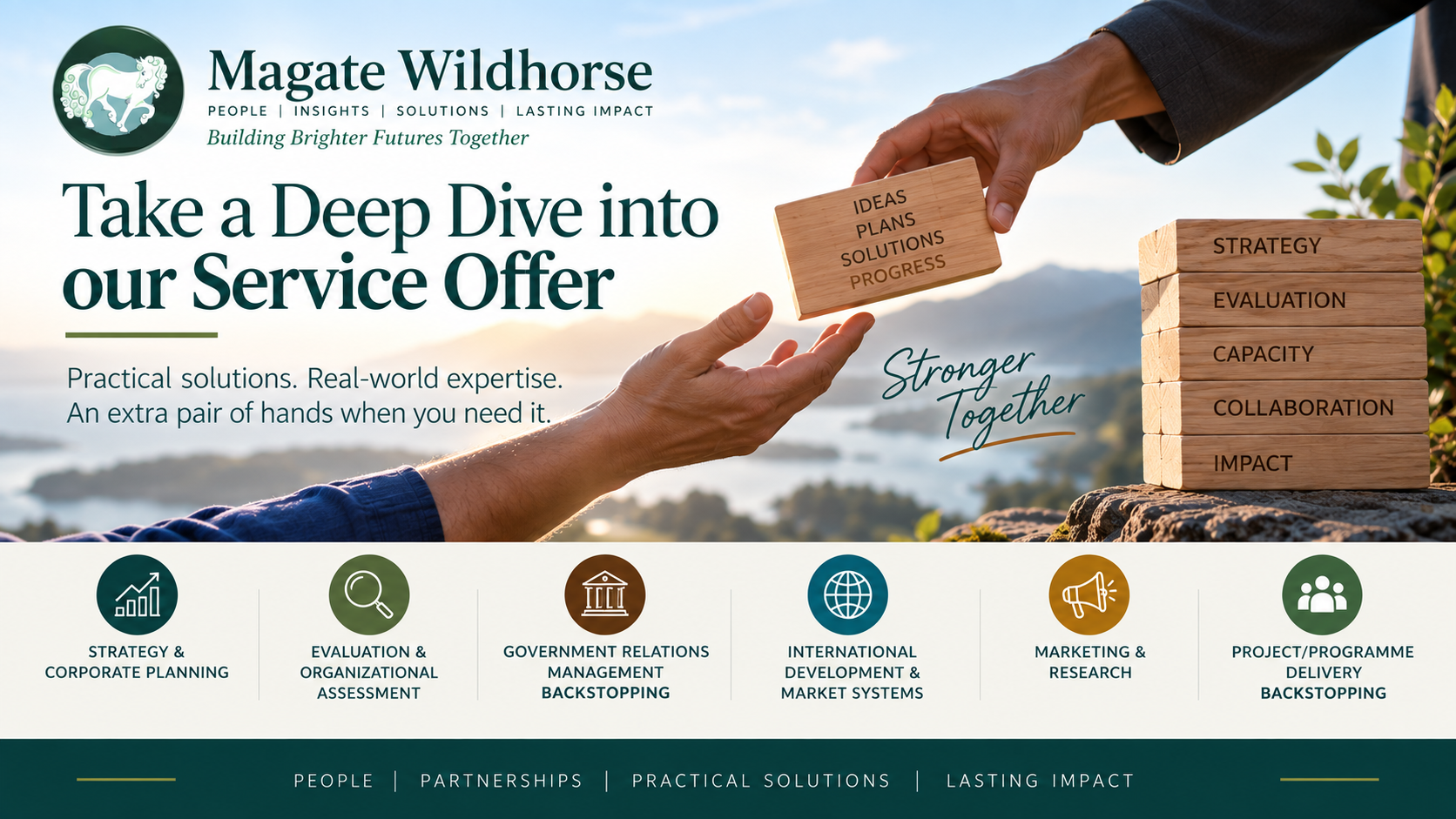
Take a Deep Dive into Magate Wildhorse’s Service Offer

Whether you need a critical friend, specialized expertise, temporary additional capacity or hands-on support to move an assignment forward, Magate Wildhorse can tailor its solutions to the needs of your organization, consulting team or project, including providing backstopping solutions.

Our service offer includes:

  • Strategy & Corporate Planning — environmental scanning, research, analysis, facilitation preparation, strategy development, plan preparation, implementation and performance monitoring.
  • Evaluation & Organizational Assessment — evaluation planning, research, data collection/analysis, organizational assessments, performance measurement, reporting and learning.
  • Government Relations Management Backstopping — research, environmental scanning, stakeholder mapping and analysis, issue monitoring, briefing materials, engagement planning and advocacy-strategy support.
  • International Development & Market Systems Backstopping — program design and management, market systems research and analysis, monitoring and evaluation, stakeholder engagement and reporting.
  • Marketing & Research — market research, strategic marketing, communications research and related analysis.
  • Project/Programme Delivery — an experienced extra pair of hands when a consultant, consulting firm or organization needs additional capacity to complete an assignment.

Available in-person, by remote or hybrid to organizations and consultants in Canada, the Caribbean, the U.S.A, Africa and internationally.

To request a solution fill our service request form below:

https://forms.gle/Gr1eaDuCb3KbX1YC6

To contact us, email: magate.wildhorse@gmail.com

Or phone: 1(647) 854-5323

All rights reserved ─ Copyright © 2026 by Magate Wildhorse ™

News Release: Co-Leader, Decade of Evaluation for Action to Address Jamaican Diaspora Stakeholder Engagement for the National M & E System

blog post banner Event

Green line

TORONTO, Canada – Khalil Bitar, Co-leader, Decade of Evaluation for Action and Chair, EvalYouth Global Network, Johannes (Jan) VOORDOUW, Monitoring and Evaluation Systems Design Consultant and  Andrea “Delcita” Wright, Actress and Guidance Counsellor will be guest speakers at the “Jamaican Diaspora Stakeholder Engagement for the National M & E System”  which will be held today, July 30, 2020 at 2:00 pm.

Mr. Bitar will bring greetings on behalf of the Co-leaders for the Decade of EVALUATION for Action, also known as the Eval4Action campaign. “The campaign is aligned with the UN Secretary-General’s Decade of Action to deliver the Global Goals (UN Sustainable Development Goals, also known as the SDGs).

The Eval4Action campaign “seeks to promote widespread recognition on evaluation being critical to, and a key accelerator for achieving the SDGs. It will mobilize commitments by different stakeholders – parliaments, governments, and evaluation associations – to invest in stronger evaluation systems to inform public policies, ensuring no one is left behind” (https://www.eval4action.org/). 

The campaign also raises awareness about the lack of evaluation evidence in the Voluntary National Reviews presented to the United Nations High Level Political Forum by developed and developing countries.  It also champions the need for building evaluation capacity— including monitoring and evaluation systems, which are critical to the delivery of the goals.

Columbia, Mexico, and Venezuela were among the first 17 countries to present Voluntary National Reviews in 2016, and the only Latin American countries to do so (UN ECLAC). Canada, Jamaica, The Bahamas, and The Dominican Republic reported in 2018, the third round of reporting. While the United Kingdom submitted their first report in 2019. Fifty-one countries were preparing their reports in February 2020.

“Eval4Action is envisaged as a highly inclusive campaign that is led by civil society for the achievement of these objectives, with global coordination and support by the co-leaders”. UNFPA Evaluation Office, EvalYouth Global Network and Global Parliamentarians Forum for Evaluation are the co-leaders. Local action for delivering the goals as well as for ensuring issues unique to countries and their citizenries such as unique challenges faced by Jamaica, and its diaspora both mutually and independently require actions and commitment by individual diasporans, businesses and diaspora organizations says, Meegan Scott of Magate Wildhorse Consulting event host and Eval4Action campaign partners.

Eval4Action aims to “revitalize global engagement and commitment on national evaluation capacities for timely delivery of the SDGs”. Today’s event aims to ensure all Jamaicans can own, contribute, and benefit from the process.

Diaspora organizations public and private must generate data and engage in evaluation so Jamaica and host countries can meet the “the key UN principles for constructing national reviews”. That requires “rigorous evaluations based on evidence,  and informed by data which is high-quality, accessible, timely, reliable and disaggregated by income, sex, age, race, ethnicity, migration status, disability and geographic location and other characteristics relevant to the context of the diaspora and beneficiaries of programmes it funds in Jamaica.

Johannes (Jan) VOORDOUW, the consultant engaged by the Government of Jamaica for delivering the M & E System will facilitate the stakeholder engagement session. He is also a Director of the Board of Caribbean Evaluators International (CEI), an international partner in the Eval4Action campaign.  The CEI is registered in Jamaica with chapters in other Caribbean countries.

Andrea “Delcita” Wright will bring humour as well as serious conversation through her session “ “Genderation Revue” . She will address Jamaica’s unique context and manifestations of the challenges related SDG 4: Ensure inclusive and equitable quality education and promote lifelong learning opportunities for all”; and SDG 5: Achieve gender equality and empower all women and girls.

Results-based strategy planning that is grounded in systems thinking and informed by evidence is also crucial to the delivering the goals. Dr. Karren Dunkley will present, North East Diaspora Strategic Planning: Ensuring Productivity & Success in a “ Soon Come” Mindset and Mentality Frame.

With just 10 years for fixing some of world’s most “wicked problems” , when both developed and developing countries were off target to varying degrees before and now dangerously off  track as a result of the COVID _19 pandemic the need for action is urgent.

Delivering the SDGs are crucial to improving the wellbeing of people, planet, and prosperity, but it requires  partnerships like we have never needed it before― if “no one is to be left behind”.

The event is hosted by Magate Wildhorse Consulting and The Community of Practice for Caribbean Immigrant Entrepreneurs. Today’s event partners are the Co-leaders of Eval4Action,  the Jamaica Diaspora Northeast USA, Windsor West Indian Association, the Jamaican Canadian Association Alberta as well as several ethnic media outfits.

Magate Wildhorse is committed to partnering and delivering influential evaluations for the goals.

There is no charge for participating in the event. Individuals with no Jamaican roots but who identify as Jamaicans are welcome to participate in the event.

Pre-registration is required via the following link: https://forms.gle/5CWkWZyUekRcDAr28

For questions, email: magate.wildhorse@gmail.com

Or visit the event links at:

https://magatewildhorse.ca/jamaican-diaspora-stakeholder-engagement-for-national-m-e-system

https://www.facebook.com/events/317139716007839/

https://www.instagram.com/p/CDKtzxXh5xx/?utm_source=ig_web_copy_link

https://twitter.com/MagateWildhorse/status/1287922436890132480?s=20

Event flyer

Event participants are being ask to pre-register at the link included in the release above.

PDF Version of Release


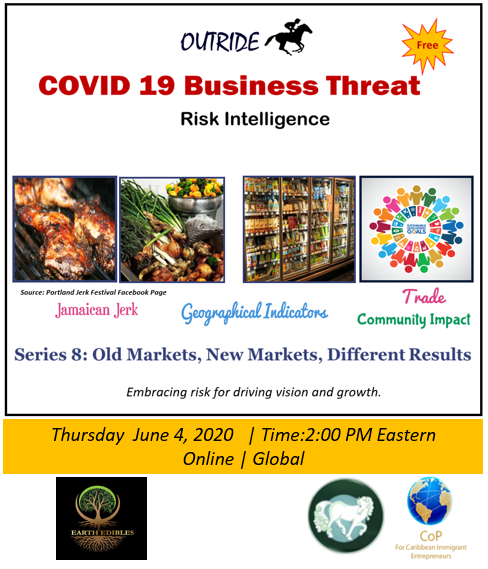
Outride: COVID 19 — Old Markets, New Markets, Different Results

Header for series with Rodney 8

Outride: COVID 19 Business Threat Seminar

“Embracing risk for driving vision and growth”

The series is grounded in risk intelligence (RI). RI is that process of embracing risks and putting it to work for ensuring your business can survive or thrive during a crisis and beyond. It is also about value creation and protection. About delivering your vision and mission in the face of crisis as well as during the “normal”.

You are invited to join us for series eight in the Outride: COVID 19 Business Threat Seminar.

Edition title: Outride: COVID 19 — Old Markets, New Markets, Different Results

We are now in the action planning and execution phase of this Caribbean diaspora entrepreneurs business continuity initiative which also caters to and welcomes Caribbeans at home, other members of the BAME community as well as mainstream entrepreneurs, development and community service organizations worldwide.

When: June 4, 2020  |  Time: 2:00 PM EST  | Toronto & New York

Where: Online  | Registration detail below

Cost: Free

Featured Sessions include:

Strategic Alliances between GI Producers & Diaspora presented by Massimo Vittori  This session addresses the subject of geograhical indicators and international trade.

Vittori_safe_image_2

Massimo Vittori is the Managing Director of oriGIn.                                                            He is in charge of the Organization’s strategic planning and overall management. Massimo previously worked as legal advisor at the International Trade Center (ITC) – a technical assistance agency of the World Trade Organization and the United Nations – where he was in charge of several projects in the field of intellectual property, trade law harmonization, model contacts for SMEs and alternative business dispute resolution mechanisms. Massimo also worked at the United Nations Conference for Trade and Development (UNCTAD) on the improvement of developing countries’ investment climate through regulatory reforms.

Following his Bachelor’s degree in international Relations, Massimo obtained a Master’s Degree in International Law at the Graduate Institute of International and Development Studies of Geneva and an LL.M. in Intellectual Property at the University of Turin. Massimo regularly delivers seminars on GIs, trademarks, and trade related issues in several European Universities.

The Joy Spot Motivation Talk with Theo Chambers

Theo Chambers

Theo Chambers, Motivational Speaker and Business Coach Consultant, at CaribAcademy and Co-founder of Positive Tourism News (Jamaica). He is also the author of Theo’s Theory on Marketing and Management Strategies.

COVID 19 and Beyond — The Food Trade (An Overview) by Meegan Scott

10 Steps – to Resilience & Risk Intelligence Competent Assignment                         (Action, Not a Bag a Mouth!) by Meegan Scott

The Marathoner

Meegan Scott, is the Principal at Magate Wildhorse Consulting. For almost two decades Meegan has helped organizational leaders across industries and geographical borders to get better results from their strategy development, planning, and execution processes.  She is the founder and owner of Magate Wildhorse Ltd. Her most recent in Caribbean engagements includes Climate Finance Strategy Planning, The First Ever Outsource to the Caribbean Conference (2017), business incubation, and  corporate strategy planner to the National Environment and Planning Agency of Jamaica.

Event Rapporteur — Dania Sammott

Dania Headshot

Dania Sammott, is an experienced Retail Merchandizer and Travel Counsellor. Her experience include serving in the hypermarket sub-sector as well as in retail, pharmacy, food and household departments.  She is the Director, Public Relations for the Manchester High Alumni, Toronto, Chapter.

Event features: Joy Spot activity, Mouth and Mind discussion, COVID 19 business community experiences (open mic―diaspora, in Caribbean, other representatives of BAME or mainstream peers), Elevator pitches & network, review of prior topics in context of the assignment and action planning for helping individual businesses (entrepreneurs) get the best from the assignment. It is also aimed at helping those joining the series late to better understand the assignment, plan and execute their pivots.

Programme and Speakers (Click the link to view)

Registration Options

New to the series?

To receive your access link to the seminar please register at the link below.

https://forms.gle/PtpZAT8czWYExWpZ7

Returning attendees

Email us at magate.wildhorse (at)gmail.com  or click here.                                                Copy and paste the following in the subject line and body of your Email                          “Register me for Outride: COVID 19 — Old Markets, New Markets, Different Results”  please include your name.

All attendee must click the join meeting link provided before the start of the meeting to receive your unique log in credentials.

Procurement officers and buyers in search of COVID 19 and other supplies are welcome to participate.

Caribbean producers of geograghical Indicators (GI) are welcome to attend.

Outride: COVID 19 Business Threat Seminar is a global disapora entrepreneurs affair!                                                                                                                            Leaders of mainstream businesses with an interest in doing business with diaspora entrepreneurs are welcome to register for the match making and networking sessions.

Please note that this event is not just for small and micro-businesses, big businesses and big nonprofits can benefit also.

Commit to Evaluation for SDGs Prevent COVID

Brought to you by Magate Wildhorse Consulting, and The Community of Practise for Caribbean Immigrant Entrepreneurs (Home of BIDEM Conference & Trade Show)

Advance or maintain the progress.

You can’t spell BAME without the C.  The contribution of the Caribbean has been too significant.  The impact on the Caribbean community is significant and different BCAME (Black, Caribbean, Asian and Minority Ethnic Groups) #BCAME    #BAME

Footer sustainable develop seminar

SDGs ―How We Help at Work!

#1 No Poverty  SDG # 8 Decent work and economic growthSDG #10 Reduced Inequalities

It’s week two of September and we are fast approaching the last lap for delivering your results for 2019, and for positioning to deliver even greater impact in 2020.

It’s tough, after all you are trying to solve complex problems, in a rapidly changing environment, oftentimes with constraints related to capacity, information, budget, markets, trade, environment etc.

You know even more than us about the challenges you face.

And you know the change that you’d love to see, your vision, your intended destination.

We know how to help you with:

  • Adaptive Management
  • DCED Standards (Results Measurement)
  • Market Systems Development | Making Markets Work for the Poor
  • International Trade, Trade Finance, Trade Compliance
  • Results-based management including Balanced Scorecard
  • Program and Corporate Strategy Planning
  • Monitoring, Evaluation, Assessments
  • Entrepreneur Capacity Development |Private Sector Development
  • Inclusive business
  • Behaviour Change Marketing
  • Environment and Climate Change & WASH

We are committed to helping you deliver results related to Agenda 2030, among them Sustainable Development Goals #1― No Poverty;  # 8― Decent work and economic growth; and #10―Reduced Inequalities.

You’ll find our lead consultant Meegan Scott, competent to help you with those topics―including components of those topics such as value chain analysis, market analysis, both structuring and evaluating your MSD Programme.  We have the capacity to support you with a consulting team or an individual consultant from our team.

We know that international trade is key to scaling up for many entities and market development programmes in the developing world. That is why we bring international trade and trade finance know-how to your MSD solutions when needed.

We’ve got your back for short, medium, and long-term solutions including critical friend evaluation support for your team.

Just in case you’re wondering what Market Systems Development is really about, we invite you to view the Market Facility Development Impact Logic for an MSD Programme below.

M4P , Making Markets Work for the Poor, Market Systems Development, Market Development Facility

Source: Results Measurement Manual: Market Facility Development

We serve clients in the developed world as well.  Perhaps your bank (or other financial institution); business networks such as chambers of commerce; export development agencies; government departments, non-profits, donor; or donor partner, or legal and consulting practice could use some help with related solutions.  Whether you are in Washington DC, Toronto, London, or elsewhere you’ll want to start a conversation today.

Know that you can count on us for top-notch solutions.

Ask about our face-to-face, blended (on-site and remote), as well as virtual or remote solutions.

Get help with planning, monitoring, measuring, and reporting on your initiatives for driving poverty reduction, decent work, and reducing inequalities!

Perhaps your focus is international trade and trade finance, we are here to help you too!

At Magate Wildhorse Ltd value for money, comes at a price you can afford!

Made possible by our business model that was designed with you in mind.

Email: magatewildhorse@gmail.com | Message us via Facebook, Instagram, Twitter, or LinkedIn.

Let’s get the conversation going! Contact us today!

Available internationally!

The Big Question of the Week ― What is a Corporate Strategy Plan?

On Thursday, February 28th we’ll be hosting a free Corporate Strategy Planning  webinar at Magate Wildhorse.

Many curious about the event had the following questions.

What is a corporate strategy plan?
Is it the same as a business plan?

Here are the differences between them.

While both plans are used for guiding organizations, they differ in scope, who, when, and how they are used.

Let’s start with the business plan.

The business plan is typically what a small or micro-business uses during its start-up phase. A large organization might also use a business plan for getting a new line of business or initiative off the ground. It supports the period of executing, testing and adjusting for viability at the start.

In a small nutshell, start-ups use their Business Plans to articulate, help them organize, and guide them in relation to why, how, who, and what they will do to produce their solution, market it, sell it, and make a profit.

 How they put the business plan to use:
  • To say what business, they are in;                                                                              The business you are in does not necessarily wear the same name as the products or services that you produce and sell.
  • To articulate how they will bring their solution from concept to a profit-making product or service, as well as the resources and actions that are needed to make that happen;
  • To define their customers, and say how they’ll reach them;
  • To say how they differ from the competition;
  • To highlight barriers, challenges, constraints and how they will work around them or remove them;
  • To help convince funders to invest in their businesses;
  • To tie a budget to delivering the planned solutions to the market and customers identified in that plan;
  • To highlight their strengths, weaknesses, opportunities, and threats;
  • To say what success should like including― the amount of money they intend to earn that year; and projections for another year or two; and
  • To say how they will wrap up the business in the most painless and beneficial if not profitable manner should there be the need to do so.

Now, let’s look at the corporate strategy plan.

The Corporate Strategy Plan is used by larger organizations with multiply programs and business units, or both. It is also used by entrepreneurs who have exited or is preparing to exit the start-up stage. Typical examples of such organizations are government departments, non-profit organizations, development programs, and larger private sector entities.

Big difference 1: The corporate strategy plan is used by organizations who are already in existence and who are looking to grow and improve.

How they use the Corporate Strategy Plan:     

  • To articulate the organizational strategy, the strategic direction, and for allocating resources in order to deliver the strategy.
  • To focus on agility, gaining the competitive edge over time, and incrementally, or completely within the plan period depending on how that edge is to be achieved.    It focuses on new capabilities and positioning to seize future opportunities.
  • To answer the question “where are we today?”                                                          The answer to which includes a focus on the organization’s results (including the financials), position in the market, etc.
  • To answer the question “where do we want to be?”                                             Here the answer focuses on the ambitions of the organization, the big problem(s) to be solved and for whom, objectives, and goals etc. It is in answer to this question that organizations arrive at what Jim Collins call BHAGs (Big Hairy Audacious Goals —pronounced Bee Hags). 
  • To answer the question, “What could prevent us from getting there?”
  • To answer the question, “How will we get there?”,                                              here is where priorities must be made and guide for tactics comes into play.
  • To answer the questions, “What should success look like?”, and “Are we on the same page?”, “Who is responsible for what?”
  • To guide execution.
  • To schedule time to step back analyze and reflect on the results, gather, and share learning (monitor, evaluate, assess), adjust the strategy, and improve.
  • It is also used is securing funding by government departments, development programs, and negotiating deals.

The Corporate Strategy Plan is usually elaborated into a 1-year Strategic Operational Plan asl known as the SOP or Operations Plan. The SOP contains details of what and how the first, second, third, fourth, or fifth year of the Corporate Strategy Plan is to be executed (Some entities use a 3-yr, 5-yr, and less frequently a 10-yr Corporate Strategy Plan)..

Corporate Strategy Planning, also known as long range planning should not start at the Board Retreat or the Strategic planning workshop.

Register here: https://www.facebook.com/events/2162653983818368/

To learn more you are invited to join us this Thursday, February 28, 2019 for a webinar on Corporate Strategy Planning.   Please visit the following link for details as well as to complete the registration form in order to receive a link to the webinar.

top question of the week strategy feb 26 smart


    Magate Wildhorse Instagram button


First 100 Grab Their Pepper Pot Lunch℠ — Lunch Hour Results Solution

Be among the first 100 to spot and grab a great solution for improving the results of your team and organization.

Pepper Pot Lunch ℠ — made to fit strategic conversations, root cause analysis and problem solving solution for organizations and their champions of change.
Its hot!, Its rich! Its flavourful! Its about your problem and your solution.

Take a Jazz break and find more.

Click on the video below.
Message us to discuss your Pepper Pot Lunch need and order today!
Or phone us at: 1(647) 854-5323

#performanceimprovement #strategicconversations #problemsolvingsessions #value #quality #lunchsessions #problemsolving #pepperpotlunch #PepperPotAct #changemanagement #strategicfacilitation #strategicfacilitator