
This article concludes our series examining the strategy development process, the series commenced with an article on overall strategy development and continued from environmental analysis and strategy formulation to implementation and performance measurement.
Developing a strategic plan is an important achievement, but the true test of strategy lies in its implementation and the results it produces. Organizations may invest considerable time and resources in environmental analysis, stakeholder engagement, strategy formulation and the identification of strategic priorities, yet struggle to translate their plans into meaningful organizational outcomes.
Effective strategic management therefore requires two interconnected frameworks: an implementation framework, which guides how the strategy will be executed, and a performance measurement framework, which establishes how progress, achievements and results will be monitored and evaluated.
Together, these frameworks help organizations move beyond strategic intentions to coordinated action, organizational accountability, continuous learning and measurable results.
Strategy Development and Delivery as a Cyclical Process
Strategy development and delivery can be understood as a four-stage, iterative process comprising environmental analysis, strategy formulation, strategy implementation, and performance monitoring and evaluation, also referred to as strategy evaluation and control.
These stages are interconnected rather than strictly sequential. Information generated through performance monitoring and evaluation may reveal changing circumstances, implementation challenges, emerging opportunities or the need to revisit strategic assumptions. Such findings should inform adjustments to organizational priorities, resource allocations and, where necessary, the strategy itself.
This cyclical approach helps organizations remain responsive to changes in their operating environments while maintaining a clear focus on their mission, strategic objectives and intended results.
Developing the Strategy Implementation Framework
An implementation framework translates strategic goals and objectives into coordinated activities, deliverables, responsibilities, timelines and resource requirements.
It provides the operational structure through which an organization puts its strategy into action. Its development involves action planning, activity coordination, institutional alignment and the establishment of mechanisms for oversight and accountability.
An effective implementation framework should identify:
- Strategic initiatives and activities required to achieve each objective.
- Expected outputs, deliverables and implementation milestones.
- Individuals, departments or teams responsible for execution.
- Timelines and dependencies between activities.
- Financial, human, technological and other resource requirements.
- Funding sources, Feasibility considerations, trade-offs and implementation risks.
- Communication, coordination and reporting arrangements.
These elements are commonly organized into an implementation matrix or action plan that enables managers and teams to understand their responsibilities and track execution.
However, implementation involves more than developing an action plan. It also requires the organizational capabilities, structures, systems and behaviours necessary to deliver the strategy.
The Five Dimensions of Strategy Implementation: The CADAP Framework
The [1]CADAP Framework provides a useful lens for examining five interconnected dimensions of strategy implementation: Capability, Agility, Design, Alignment and People.
Capability: Organizations must possess or develop the resources, competencies, processes and institutional capacity required to execute their strategies. This includes financial resources, technical expertise, leadership capability, technology and operational systems. Capability gaps may require training, recruitment, partnerships, investment or adjustments to implementation priorities.
Agility: Effective implementation requires the ability to respond to emerging risks, opportunities and changes in the operating environment. Agility enables organizations to make timely decisions, reallocate resources and adapt implementation approaches without losing sight of their strategic direction.
Design: Organizational design concerns the structures, processes, governance arrangements and decision-making mechanisms through which work is organized and coordinated. Implementation may require changes to reporting relationships, workflows, departmental responsibilities or operating systems to support strategic priorities.
Alignment: Strategic objectives must be reflected in organizational policies, budgets, departmental plans, operational priorities and performance expectations. Alignment reduces competing priorities, duplication and fragmentation while helping different parts of the organization work toward shared results.
People: Employees, managers, executives and other stakeholders are central to successful strategy execution. Their understanding, commitment, competencies and participation influence implementation effectiveness. Leadership, meaningful engagement, clear responsibilities, incentives and timely communication help build ownership and sustain commitment.
The five dimensions reinforce one another. For example, an organization may have adequate financial resources and technical capability but still experience implementation difficulties because of poorly designed processes, conflicting departmental priorities or limited employee commitment.
Consequently, effective strategy implementation requires cultural, structural and systems alignment, supported by clear, consistent and well-timed communication.
Developing the Performance Measurement Framework
While the implementation framework establishes how strategic initiatives will be executed, the performance measurement framework determines whether implementation is progressing as intended and contributing to desired organizational results.
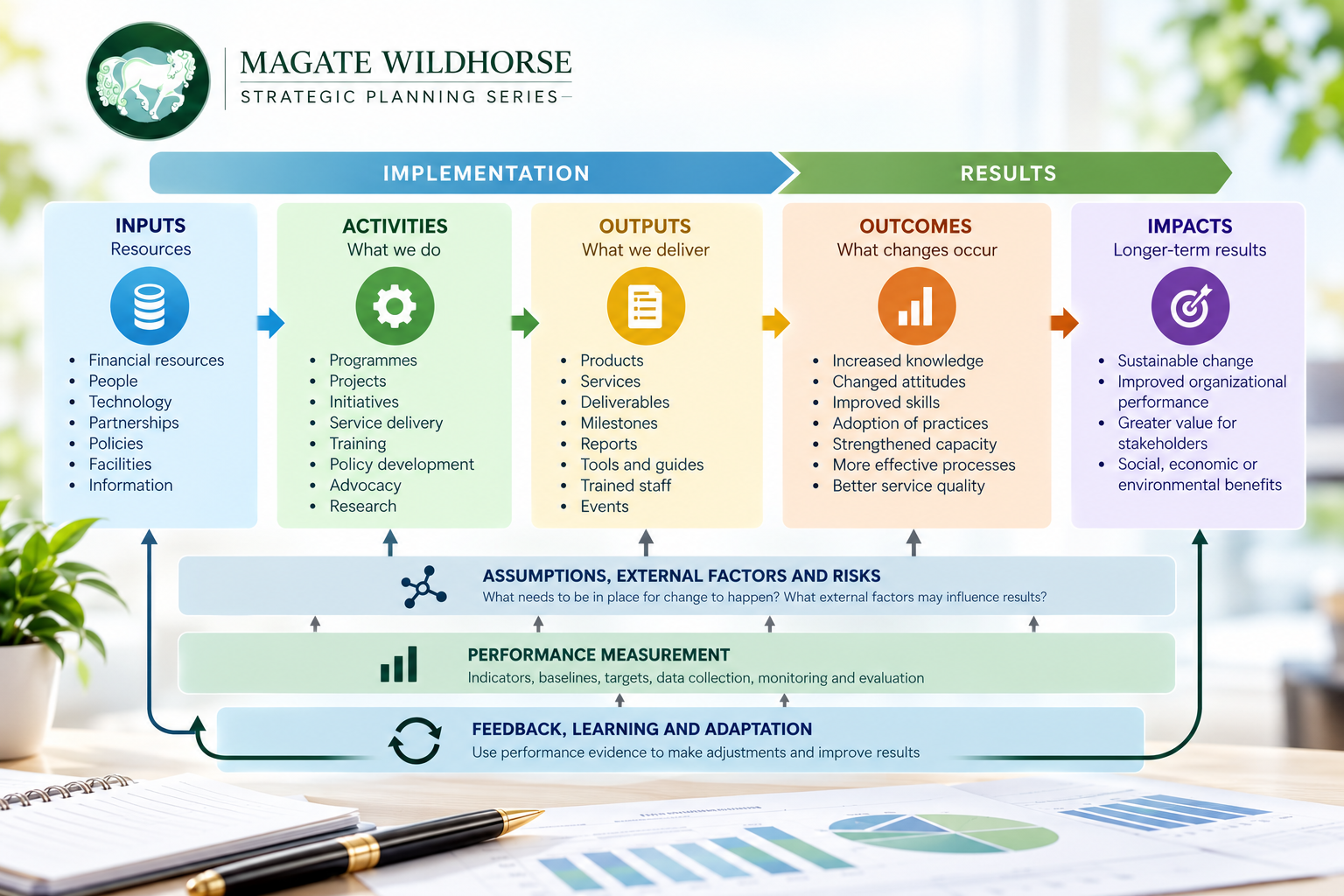
Performance monitoring and evaluation involves comparing actual performance against planned objectives, targets and expected results. It draws on both financial and non-financial indicators to assess efficiency, effectiveness, progress and outcomes.
A performance measurement framework should establish clear performance indicators, baseline values, targets, data sources, collection methods, measurement frequency and reporting responsibilities.
Financial indicators may include revenue growth, profitability, expenditure, cost efficiency and return on investment. Nonfinancial indicators may address service quality, customer satisfaction, stakeholder engagement, employee performance, organizational capacity, innovation and social or environmental outcomes.
Importantly, completing planned activities does not necessarily mean that strategic objectives have been achieved. An organization may successfully deliver a training programme, for example, without achieving the intended improvements in employee competencies or organizational performance.
Performance measurement must therefore extend beyond tracking activities and outputs to examining outcomes and, where appropriate, longer-term impacts.
Tools for Linking Strategy, Implementation and Results
Organizations can use several complementary tools to establish the relationships between strategic activities, expected results and performance measures.
Theory of Change (ToC): A Theory of Change explains how and why particular activities and interventions are expected to produce desired outcomes and longer-term impacts. It identifies the causal pathways, assumptions and external conditions that influence whether change occurs. This helps organizations examine the underlying logic of their strategies and determine what evidence is needed to assess progress.
Logic Model: A logic model provides a structured, often visual representation of the relationship between resources or inputs, activities, outputs, outcomes and impacts. Commonly used in government and nonprofit organizations, it supports programme planning, performance measurement, monitoring and evaluation by clarifying what an intervention is expected to achieve and how results will be assessed.
Private-sector organizations also use tools such as:
Business Model Canvas (BMC): Which maps the key components of an organization’s business model, including its value proposition, customers, resources, activities, partnerships, revenue streams and cost structure. Although primarily a business modelling tool rather than a performance measurement framework, it can inform strategic implementation and the selection of relevant performance measures.
Objectives and Key Results (OKRs): Connects clearly defined objectives with measurable key results. OKRs help translate strategic priorities into focused, time-bound performance commitments and enable teams to assess progress toward desired outcomes.
Objectives, Goals, Strategies and Measures (OGSM): Provides a structured approach for translating strategic direction into specific goals, supporting strategies and measurable indicators. It helps connect organizational aspirations with execution and performance accountability.
The selection of tools should reflect an organization’s mandate, strategic objectives, operating environment and performance information needs. These tools are not necessarily mutually exclusive and may be combined where appropriate.
Monitoring, Evaluation and Strategic Learning
Performance monitoring and evaluation should be embedded throughout strategy implementation rather than treated as an exercise conducted only at the end of the plan cycle.
Monitoring provides ongoing information about activities, milestones, resource utilization and progress toward targets. Evaluation examines the relevance, effectiveness, efficiency and results of strategic interventions, including why intended outcomes were or were not achieved.
Together, they establish structured feedback loops that replace vague intentions with operational accountability.
Regular performance reviews should enable organizational leaders and implementation teams to identify deviations from planned results, investigate their causes, assess emerging risks and determine corrective actions.
Performance information should also inform budgeting, operational planning, resource allocation and strategic decision-making. Where results indicate that assumptions are no longer valid or circumstances have changed significantly, organizations may need to revise their implementation approaches or strategic priorities.
Governance, Accountability and Communication
Successful implementation and performance management require clear governance and reporting arrangements.
Boards and governing bodies provide strategic oversight, while executive leadership ensures organizational alignment, allocates resources and addresses significant implementation challenges. Managers and implementation teams coordinate activities, monitor progress and report results.
Clearly assigned responsibilities, reporting schedules, decision-making authority and escalation procedures help ensure that performance findings lead to action.
Communication is equally important. Employees and stakeholders should understand the strategic direction, their contributions to its achievement and the results being realized. Timely communication of progress, challenges and adjustments strengthens transparency, coordination and organizational commitment.
Conclusion: Turning Strategic Intent into Measurable Results
A strategic plan provides direction, but implementation and performance measurement frameworks provide the mechanisms for translating that direction into action and assessing whether the desired results are being achieved.
Effective implementation requires more than a schedule of activities. It demands organizational capability, agility, appropriate design, institutional alignment, engaged people and adequate resources.
Similarly, effective performance management requires more than collecting data. It involves using credible evidence to strengthen accountability, support organizational learning, inform decisions and improve results.
Strategic planning achieves its greatest value when organizations establish the capacity to execute their strategies, measure what matters and use performance evidence to adapt and improve.
For organizations seeking to strengthen their strategic planning, implementation and performance management practices, Magate Wildhorse Ltd. provides strategic management consulting services to support the development of practical, results-oriented approaches.
Written by Meegan Scott. Copyright © 2026 Meegan Scott and Magate Wildhorse Ltd. All rights reserved.
[1] Choudhury, A., Ram Kumar, P. N., & Krishnan, R. (2026). A comprehensive framework for strategy execution: CADAP strategy execution framework. IIM Kozhikode Society & Management Review, 15(1), 96–113. [Online] Available at:< https://doi.org/10.1177/22779752241312312>
