Does Your Organization Understand Its Current Position?
Is your organization struggling to achieve its goals, experiencing operational inefficiencies, facing resource constraints, or preparing for strategic change?
Are you confident that your organizational structures, systems, processes, capabilities and resources are aligned with your mission and strategic priorities?
Magate Wildhorse Ltd. can help you find the answers.
We help organizations assess their current state, including organizational performance, internal capabilities, resources, structures, systems, processes, culture, stakeholder relationships and external operating conditions.
How We Help
We help organizations gain an evidence-based understanding of organizational performance, capacity and readiness for strategic change.
Our organizational assessment solutions combine established assessment frameworks with research, analysis and stakeholder engagement. Depending on your organization’s needs, our approach may include:
Organizational performance assessment: Examining effectiveness, efficiency, relevance and financial viability.
Organizational capacity assessment: Reviewing leadership, governance, human resources, technical capabilities, financial resources, systems and organizational culture.
Stakeholder analysis and engagement: Understanding stakeholder needs, expectations, relationships and their implications for organizational performance.
External environmental assessment: Identifying political, economic, social, technological, regulatory and other developments affecting your organization.
Competitor analysis: Examining competing organizations, their strengths, capabilities, services, positioning and strategies. Understanding the competitive environment helps your organization identify its comparative advantages, service gaps, opportunities for differentiation, potential partnerships and threats to its sustainability and growth.
Gap and risk analysis: Identifying weaknesses, performance gaps, organizational vulnerabilities and barriers to achieving strategic objectives.
We use appropriate combinations of document reviews, interviews, surveys, facilitated discussions, performance analysis, organizational assessment frameworks and diagnostic tools to develop a credible understanding of your organization’s current position.
From Assessment to Action
An organizational assessment should do more than identify problems.
Magate Wildhorse analyzes and validates findings to identify organizational strengths, weaknesses, gaps, risks and opportunities. We translate the evidence into practical recommendations that support:
Better-informed strategic decisions and priorities.
Improved organizational performance and operational efficiency.
Stronger governance and institutional capacity.
More effective allocation of resources.
Greater responsiveness to stakeholder needs and changes in the operating environment.
Realistic strategic planning and organizational improvement.
Whether you need a comprehensive organizational assessment, a focused current-state assessment to inform strategic planning, or an assessment to guide institutional strengthening, Magate Wildhorse can help you move from understanding your current position to making informed decisions about your future.
Ready to understand where your organization stands and what needs to improve?
Contact Magate Wildhorse Ltd. to discuss your organizational assessment needs.
Is your nonprofit facing resource constraints, operational challenges or increasing demands?
Magate Wildhorse Ltd. offers discounted organizational assessment solutions for small nonprofits, helping you identify strengths, gaps, risks and opportunities, and develop practical recommendations for improving performance and sustainability.
Our focused assessments are tailored to your organization’s needs, priorities and resources.
Magate Wildhorse offers evidence-based strategic planning, expert facilitation and practical solutions for organizations.
How Magate Wildhorse Can Help You Move from Uncertainty to Strategic Direction
Is your organization struggling with unclear priorities, competing demands, limited resources or uncertainty about its future?
Has your organization outgrown its current strategic plan? Are changes in your operating environment creating new challenges and opportunities? Or do you need a clear roadmap to guide decisions, strengthen performance and achieve your mission?
Magate Wildhorse Ltd. can help.
Our Strategic Planning Solutions
We help organizations establish clear strategic direction, priorities and actionable plans grounded in evidence, stakeholder perspectives and organizational realities.
Whether you are developing your first strategic plan, reviewing an existing plan or preparing for a new planning cycle, our strategic planning solutions are tailored to your organization’s needs, size, resources and operating environment.
How We Help You Develop an Effective Strategic Plan
We examine organizational performance, capabilities, governance, structures, systems, resources and existing strategies to establish a sound understanding of where your organization stands today.
2. Environmental Scanning and Competitor Analysis
We assess the external forces shaping your organization’s future, including political, economic, social, technological, regulatory and competitive developments.
Competitor analysis helps identify your organization’s comparative advantages, threats, opportunities for differentiation and potential strategic partnerships.
3. Stakeholder Analysis and Engagement
We identify and engage relevant stakeholders to understand their needs, expectations, perspectives and priorities. Through interviews, surveys, consultations and facilitated workshops, we help ensure that strategic decisions are informed by those who influence or are affected by your organization’s work.
4. Strategy Formulation and Priority Setting
We facilitate the review or development of your organization’s vision, mission, values, strategic goals, objectives and priorities.
We help decision-makers examine strategic options, build consensus and establish a coherent direction for the future.
5. Resource Identification, Feasibility and Trade-Off Analysis
A strategic plan must be achievable.
We help organizations identify the financial, human, technological and other resources required to implement their strategies, including potential sources of financing.
We also examine feasibility, competing priorities, risks and trade-offs to support realistic decisions about what can be achieved with available or obtainable resources.
6. Implementation and Action Planning
We help translate strategic priorities into actionable plans with defined activities, responsibilities, timelines, resource requirements and accountability arrangements.
7. Performance Measurement and Evaluation
We support the development of performance indicators, targets, monitoring arrangements and evaluation frameworks to help organizations track progress, assess results and make necessary adjustments.
Expert Facilitation and Strategic Planning Methods
Effective strategic planning requires more than a well-written document. It requires a sound process that supports meaningful participation, informed decisions and organizational commitment.
Magate Wildhorse brings expertise supported by specialized training in:
Group Process Facilitation and Workshop Design
Technology of Participation (ToP) facilitation methods
Balanced Scorecards
Results-Based Management Methods
Corporate Planning for Government
Monitoring and Evaluation
Our facilitation approach helps leadership teams, boards, staff and other stakeholders engage constructively, examine evidence, navigate differing perspectives and build agreement around strategic priorities.
We work to ensure that the planning process is participatory, structured, evidence-based and focused on practical results.
Is your nonprofit overwhelmed by limited resources, increasing demands or competing priorities?
Magate Wildhorse offers discounted strategic planning solutions for eligible small nonprofits.
Our tailored approach helps smaller organizations clarify their direction, establish realistic priorities and develop practical plans that reflect their capacities and resources.
Limited discounted opportunities are available.
Ready to Move from Uncertainty to Strategic Direction?
Whether your organization needs a new strategic plan, a review of its existing strategy or support translating strategic priorities into action, Magate Wildhorse Ltd., can help you plan with confidence and purpose.
Contact us to discuss your strategic planning needs.
Effective strategic planning requires more than a well-designed workshop, a collection of analytical tools, or agreement on organizational priorities. It requires a structured, participatory process through which evidence is interpreted, strategic choices are made, and organizational commitment is secured.
The preceding articles in this series examined the foundations of strategic planning: preparation, environmental scanning, organizational and current-state assessment, and stakeholder engagement, assessment and analysis. These activities provide the evidence and insights needed to inform strategy development.
The strategic planning exercise brings these elements together, enabling participants to move from understanding their organization’s circumstances to determining its future direction.
Understanding the Strategic Planning Process
Strategic planning establishes an organization’s long-term direction, priorities, intended results, and approaches to achieving them. It connects organizational purpose and aspirations with strategic choices, resource allocation, implementation, and performance measurement.
An effective planning workshop begins by establishing workshop norms, objectives and a common understanding of strategic planning terminology, concepts, and processes. Participants should understand the distinctions between corporate strategic planning and strategic operational planning, including how organizational priorities translate into departmental, functional, team, and individual responsibilities.
The five levels of strategic planning should also be clarified within the organization’s planning framework, ensuring participants understand how decisions and responsibilities connect across organizational levels.
The proposed strategy formulation approach, workshop objectives, expected outputs, and decision-making arrangements should be explained before substantive deliberations begin.
The Role of Strategic Planning Facilitation
A strategic planning facilitator does more than manage an agenda or encourage participation. The facilitator creates the conditions for constructive discussion, thoughtful examination of alternatives, shared understanding, and collective decisions about organizational direction.
Four competencies are particularly important:
Active listening: Understanding participants’ perspectives, identifying underlying concerns, and ensuring contributions are accurately interpreted.
Effective communication: Explaining complex concepts clearly, asking purposeful questions, summarizing discussions, and maintaining a common understanding.
Group dynamics management: Encouraging balanced participation, managing dominant voices, and helping participants navigate different stages of group development.
Conflict resolution: Managing disagreements constructively, distinguishing competing interests from substantive strategic differences, and facilitating acceptable resolutions.
At Magate Wildhorse Ltd., strategic planning is led by a trained facilitator with additional training in workshop design, corporate strategy planning for government, and the Balanced Scorecard approach.
Our facilitation methodology incorporates group process techniques that help participants navigate the forming and storming stages of group development while progressing toward productive collaboration and consensus.
Techniques such as brainstorming, clustering, naming, and consensus-setting support the identification, organization, interpretation, and prioritization of ideas. Participants are guided through processes of codification, elaboration, and conversion, transforming contributions into clearly articulated strategic choices and actionable commitments.
Establishing Strategic Direction
An important component of the strategic planning exercise is developing agreement on the organization’s desired future.
Participants examine the organization’s vision, mission, and values, considering whether these remain appropriate in light of changing circumstances and emerging aspirations.
Facilitated discussions support consensus on the vision, clarification or revision of the mission, and affirmation or refinement of organizational culture and values.
Where preliminary strategic directions have been developed through earlier assessments or leadership deliberations such as the board visioning exercise, these are presented for examination and expanded through participants’ contributions.
Potential growth and development options are explored, including opportunities for organizational expansion, service innovation, partnerships, market development, operational improvement, or institutional strengthening.
The objective is not simply to generate ideas but to make informed choices about where the organization should concentrate its efforts.
Connecting Strategic Choices to Organizational Reality
Although environmental scanning and organizational assessment precede the workshop, their findings must be actively integrated into strategy formulation.
These discussions test whether proposed strategic directions are realistic, responsive, and aligned with organizational capabilities.
Additional tools, including force field analysis, may be used to identify forces supporting or resisting proposed changes.
Through facilitated dialogue, participants examine assumptions, strategic risks, competing priorities, resource constraints, and the implications of alternative courses of action.
Translating Strategy into Action
Strategic direction must eventually become an organized programme of action.
Participants identify strategic priorities, desired outcomes, critical initiatives, and the actions necessary to achieve them.
Related activities are clustered into task arenas, which are organized and named to establish clear areas of responsibility and implementation.
Planning templates are introduced to support Consistency in documenting objectives, initiatives, responsibilities, resources, performance indicators, and timelines.
Participants review SMART performance indicators—specific, measurable, achievable, relevant, and time-bound—to strengthen accountability and establish measurable expectations.
Working groups may then be formed, with participants volunteering responsibility for developing specific components of the plan or advancing priority initiatives.
Participants identify the financial, human, technological and other resources required to implement proposed strategic initiatives. Potential funding sources and financing options are explored, alongside existing budgetary allocations, resource gaps and opportunities for partnerships or resource mobilization. This helps ensure that strategic priorities are financially realistic and supported by appropriate resource planning.
Next, participants assess the Feasibility of proposed strategic initiatives, considering available resources, organizational capacity, potential risks and implementation constraints. Where competing priorities exceed available resources, strategic trade-offs are examined to determine which initiatives should be prioritized, deferred, modified or discontinued. These deliberations help ensure that strategic choices are realistic, sustainable and aligned with the organization’s mission and long-term objectives.
Commitments, timelines, milestones, and immediate next steps are agreed upon before the workshop concludes.
Selecting Appropriate Strategy and Performance Frameworks
Different organizations require different tools for articulating and implementing strategy.
Government organizations may employ logic models, theories of change, and strategy maps to connect policy objectives, interventions, outputs, outcomes, and public value.
Nonprofit organizations frequently use theories of change and strategy maps to explain how their activities contribute to intended social outcomes.
Private sector organizations may use the Business Model Canvas, Balanced Scorecard, strategy maps, or Objectives and Key Results (OKRs) to articulate their business models, strategic objectives, performance priorities, and desired results.
These approaches are not exclusive to particular sectors. Their selection should reflect organizational purpose, operating context, planning maturity, and performance management needs.
The workshop should also introduce the proposed performance monitoring and evaluation framework, including how progress will be tracked, results evaluated, and strategic adjustments informed.
Consolidating the Strategic Plan
As the workshop progresses toward closure, participants review planned tasks, agreed actions, responsibilities, and timelines.
The outcomes provide the basis for preparing the draft strategic plan, which should capture strategic direction, priorities, objectives, implementation arrangements, and performance expectations.
Participants reflect on the emerging plan, considering its coherence, feasibility, organizational alignment, and potential implementation challenges.
Critical success factors are identified to clarify the conditions necessary for effective execution. Where appropriate, participants may also develop a guiding slogan that captures the strategic ambition and helps sustain commitment throughout the planning cycle.
A final review confirms outstanding matters, follow-up responsibilities, and arrangements for completing and validating the draft plan.
The workshop concludes with participant reflection, session evaluation, and formal closure.
Beyond the Planning Workshop
A successful strategic planning workshop is not measured solely by the volume of ideas generated or the completion of a planning document.
Its value lies in the quality of strategic choices, the extent of shared understanding, the strength of organizational commitment, and the readiness to translate decisions into action.
Effective facilitation helps organizations navigate complexity, engage diverse perspectives, resolve competing priorities, and establish a common direction.
However, the workshop is a critical milestone rather than the conclusion of strategic planning. Strategy must subsequently be refined, documented, communicated, implemented, monitored, evaluated, and adapted.
At Magate Wildhorse Ltd., we approach strategic planning and facilitation as an integrated process that connects evidence, participation, strategic decision-making, and implementation readiness. Our objective is to help organizations develop strategies that are not only credible and ambitious but also practical, measurable, and supported by those responsible for delivering results.
Magate Wildhorse Ltd. provides strategic planning, stakeholder engagement, assessment and analysis, as well as environmental scanning services to support organizations in developing evidence-informed strategies and strengthening organizational performance.
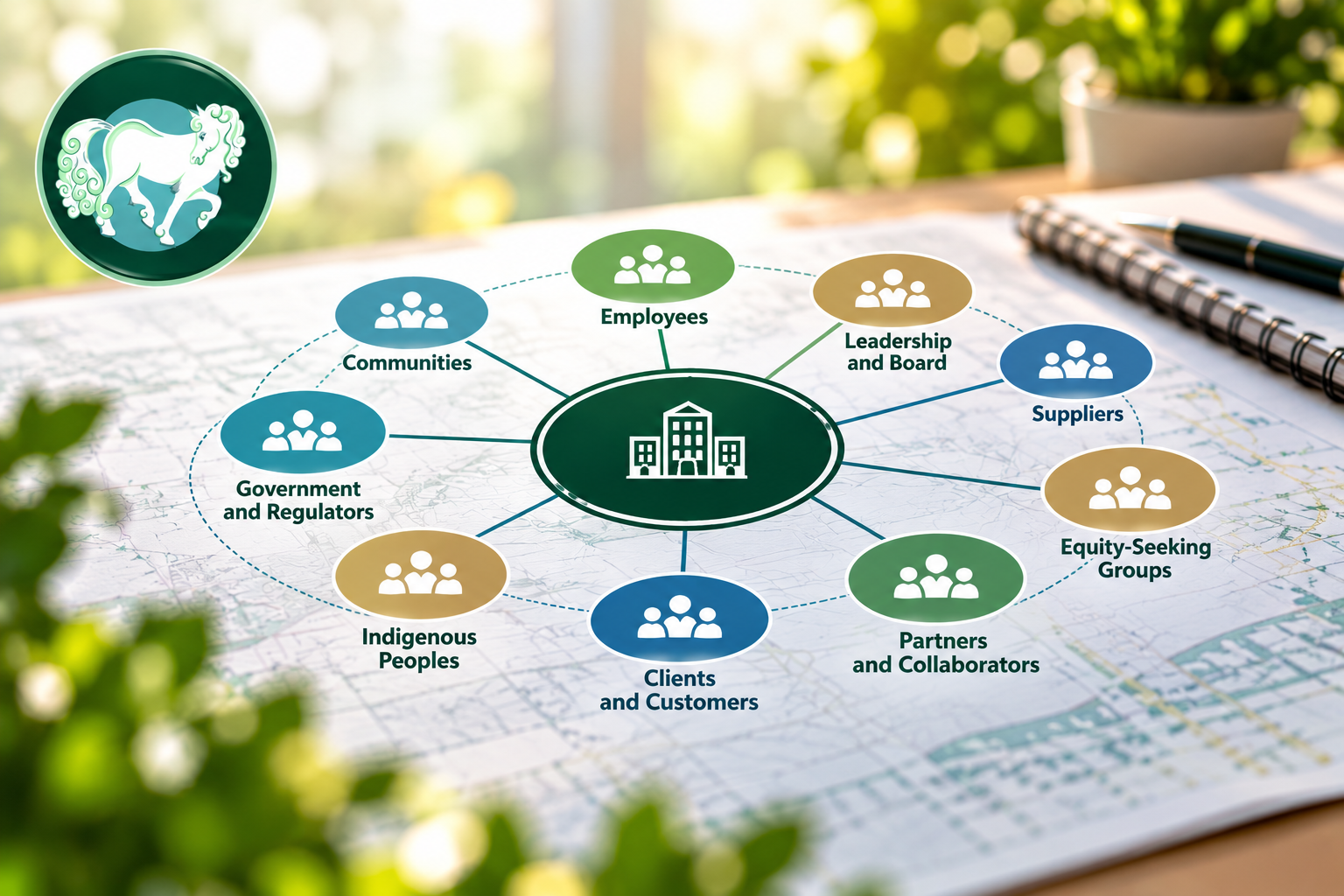
Strategic planning is not an exercise that organizations should undertake in isolation. The effectiveness of a strategic plan depends, in part, on how well an organization understands the people, groups and institutions that influence its success, contribute to its operations, or are affected by its decisions.
Stakeholder engagement, assessment and analysis are therefore important components of the strategic planning process. Although closely related, they serve distinct but complementary purposes. Stakeholder assessment helps organizations evaluate relationships, experiences and outcomes associated with the implementation of an existing strategic plan. Stakeholder analysis helps identify and understand the interests, influence and potential impact of stakeholders as an organization prepares its next plan. Stakeholder engagement provides opportunities for dialogue, consultation, collaboration and the development of shared understanding.
Stakeholder Assessment: Learning from the Existing Strategic Plan
As an organization approaches the end of its strategic planning cycle, evaluating the implementation and results of the expiring plan is essential.
Stakeholder assessment forms part of this evaluation and the broader organizational or current-state assessment. It examines who contributed to, influenced or was affected by the strategic plan and how effectively the organization responded to their needs and expectations.
Important questions include:
Which stakeholder groups participated in implementing the plan, and what contributions did they make?
To what extent were stakeholder needs and expectations met?
How effective were the organization’s relationships and communication with stakeholders?
What challenges, conflicts or unmet expectations emerged?
What lessons should inform the next strategic planning cycle?
Stakeholder assessment can reveal gaps between organizational intentions and stakeholder experiences. It can also identify changes in stakeholder relationships, emerging concerns, and opportunities to strengthen organizational performance.
The findings should contribute to the evaluation of the expiring strategic plan and provide evidence for decisions about the organization’s future direction.
Stakeholder Analysis: Understanding Interests, Influence and Impact
Stakeholder analysis is particularly important during preplanning and the environmental scanning process. It helps organizations identify individuals, groups and institutions that can influence, contribute to or be affected by their activities and strategic decisions.
The process begins with stakeholder identification and classification. Stakeholders may be categorized as primary or secondary, internal or external, depending on their relationship with the organization.
Primary stakeholders generally have a direct relationship with, or are directly affected by, organizational activities. Secondary stakeholders may influence the organization’s operating environment or be indirectly affected by its decisions.
Once identified, stakeholders can be mapped and analyzed according to their interests, influence, potential impact, expectations and relationships.
An important objective is to understand the value stakeholders seek from their relationship with the organization. Different groups may have competing priorities, but they may also share interests that create opportunities for cooperation.
The strategic challenge is not simply to identify these interests. It is to discover connections among them and develop solutions that align stakeholder expectations with organizational purpose and strategic objectives.
Tools for Stakeholder Mapping and Analysis
Several analytical tools can support this process.
Stakeholder Interest–Influence–Impact Mapping examines the interests of stakeholder groups, their ability to influence organizational decisions, and the extent to which they may affect or be affected by organizational activities. It helps planners determine appropriate engagement strategies and identify relationships requiring particular attention.
The Power–Interest Grid classifies stakeholders according to their level of influence or power and their interest in organizational activities. It provides a practical framework for determining how different stakeholder groups should be engaged, informed or consulted.
The Stakeholder Issues Matrix identifies the issues, concerns, expectations and priorities associated with different stakeholder groups. It can highlight common interests, conflicting demands and emerging strategic issues requiring organizational attention.
The Stakeholder Salience Model, developed by Mitchell, Agle and Wood, offers another approach to stakeholder prioritization. The model examines three attributes:
Power: The stakeholder’s ability to influence the organization or its decisions.
Legitimacy: The perceived appropriateness or validity of the stakeholder’s claims or relationship with the organization.
Urgency: The extent to which stakeholder claims require immediate attention.
By considering these attributes together, organizations can better understand which stakeholder claims demand attention and how stakeholder priorities may change over time.
However, stakeholder prioritization should not result in the exclusion of groups with limited power. Stakeholders who are significantly affected by organizational decisions may have important perspectives even when they lack the influence to command attention.
Stakeholder engagement involves more than collecting opinions. It is a process through which organizations communicate, listen, exchange knowledge, explore competing interests and, where appropriate, collaborate on solutions.
Effective engagement helps organizations test assumptions, identify overlooked issues, build relationships and improve the quality of strategic decisions.
Engagement approaches may combine quantitative, qualitative and collaborative techniques, including:
Surveys and questionnaires
Individual stakeholder interviews
Focus groups and ideation sessions
Town halls and open forums
Workshops and design charrettes
Advisory committees and task forces
Stakeholder mapping and analysis exercises
Social network analysis
The selection of methods should reflect the purpose of the engagement, the characteristics of stakeholder groups, available resources and the decisions to be informed.
For example, surveys may capture perspectives across a large stakeholder population, while interviews and focus groups can provide deeper insights into experiences, expectations and concerns. Collaborative workshops can help stakeholders explore alternatives and identify areas of common interest.
Engagement should also be inclusive and accessible, providing meaningful opportunities for groups whose perspectives may otherwise be overlooked—such as equity seeking groups.
Integrating Stakeholder Findings into Strategic Decisions
The value of stakeholder assessment, analysis and engagement ultimately depends on how their findings are used.
Information gathered through these processes should inform the organization’s environmental scan, assessment of its current position, identification of strategic issues, and development and evaluation of strategic options.
Stakeholder findings can reveal opportunities for partnerships, changes in service needs, emerging risks, resource constraints and areas where organizational priorities require reconsideration.
They can also help identify tensions between stakeholder expectations and organizational capacity. Such tensions require strategic choices rather than promises that every interest can be accommodated.
Where interests overlap, organizations should explore solutions that create shared value. Where they conflict, transparent decision-making and clear communication become particularly important.
Stakeholder engagement should not end when the strategic plan is approved. Continued engagement during implementation, monitoring and evaluation enables organizations to assess progress, respond to changing circumstances and maintain relationships.
Conclusion
Stakeholder engagement, assessment and analysis are interconnected activities that strengthen strategic planning when applied systematically.
Assessment provides lessons from the implementation of the existing plan. Analysis develops an understanding of stakeholders and their interests, influence and potential impact. Engagement creates opportunities to gather evidence, build understanding and explore solutions.
Together, these processes help organizations move beyond internally driven planning towards strategies that are better informed, more responsive to their operating environments and more capable of generating meaningful results.
Magate Wildhorse Ltd. provides strategic planning, stakeholder engagement, assessment and analysis services to support organizations in developing evidence-informed strategies and strengthening organizational performance.
Building an evidence-based understanding of organizational performance, capacity and readiness for strategic change.
A strategic plan must be grounded in an accurate understanding of the organization it is intended to guide. Ambitious goals alone do not establish whether an organization has the capacity, resources, systems or readiness to deliver them. Organizational assessments and current-state assessments provide evidence that helps leaders make realistic strategic choices.
Although related, these assessments are not interchangeable. Their scope and purpose differ.
Understanding the Distinction
An organizational assessment is a comprehensive examination of an organization’s performance, capacities and functioning. It can consider governance, leadership, organizational culture, management practices, technical capabilities, financial viability, operating systems and relationships with the external environment. Its applications extend beyond strategic planning to institutional strengthening, organizational development and performance improvement.
A current-state assessment conducted for strategic planning is generally more focused. It establishes a baseline of the organization’s position on matters relevant to the strategic decisions ahead. It may draw selectively on organizational assessment methods, performance evidence, stakeholder perspectives and environmental scanning without examining every dimension of organizational functioning.
In either exercise, the Evaluand—the subject being assessed—is the organization, not individual office holders. Assessing governance and leadership arrangements is not the same as appraising individual board members or executives. The purpose is to understand how organizational functions contribute to results and where improvements are needed.
Four Questions About Organizational Performance
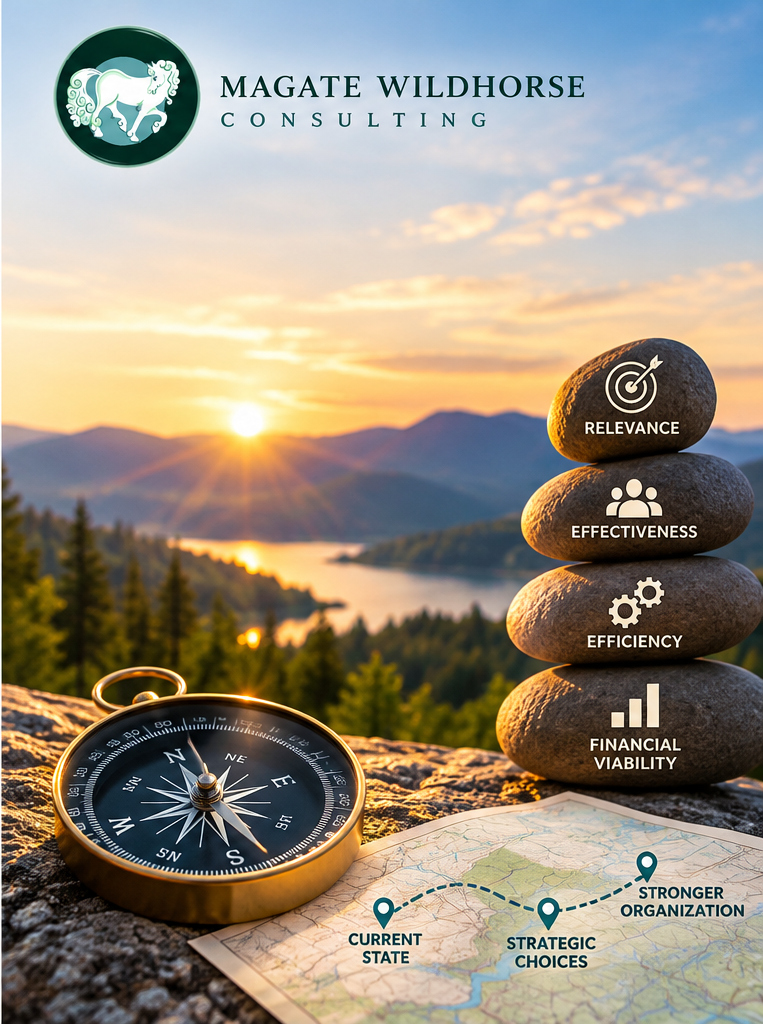
A key reference for Magate Wildhorse Consulting is the Universalia/International Development Research Centre (IDRC) Institutional and Organizational Assessment Framework. It considers organizational performance through four important questions:
Effectiveness: How successfully is the organization fulfilling its mission and achieving intended results?
Efficiency: How well does it use available resources to deliver services and achieve results?
Relevance: Has it adapted to changing needs, stakeholder expectations and conditions in its operating environment?
Financial viability: Can it secure and manage the resources necessary to sustain its work?
The framework also recognizes the influence of organizational capacity, motivation and the external environment. These dimensions help explain not only how an organization is performing but why. The ability to interpret and use assessment results is essential to achieving improvements.
Frameworks and Tools That Deepen the Diagnosis
No single instrument captures every dimension of organizational performance. Magate Wildhorse draws on established approaches, selecting tools according to the assessment’s purpose and the organization’s context.
Universalia/IDRC Institutional and Organizational Assessment Framework: Supports an integrated assessment of performance and its underlying influences.
McKinsey Organizational Capacity Assessment Tool (OCAT): Supports structured consideration of organizational capacities, strengths and areas for development.
McKinsey 7-S Framework: Examines alignment among strategy, structure, systems, shared values, skills, style and staff. A strategy may be sound but difficult to implement when these elements are misaligned.
Governing Good Board Self-Evaluation Questionnaire: Supports reflection on governance practices, board effectiveness and opportunities to strengthen oversight and strategic stewardship.
TCC Group’s Core Capacity Assessment Tool (CCAT): Identifies leadership, adaptive, management and technical capacities, alongside organizational culture. Magate Wildhorse draws on selected questions relating to these dimensions when assessing organizational leadership, board-related practices and capacity. Using selected questions does not mean administering the full CCAT instrument.
Other methods may include document and policy reviews, interviews, surveys, facilitated discussions, stakeholder analysis, process mapping, SWOT analysis, gap analysis, financial review and examination of performance indicators. The choice of methods should follow the assessment questions, not the other way around.
Why the Assessments Matter for Strategic Planning
They establish an evidence-based baseline. Leaders can distinguish demonstrated strengths and constraints from assumptions and compare future performance with an informed starting point.
They reveal strategic capacity gaps. An organization may wish to expand services but lack sufficient staffing, funding, technology or management systems. An assessment makes those limitations visible before commitments are made.
They improve strategic prioritization. Findings help leaders distinguish immediate operational problems from issues that require longer-term strategic responses. They also reveal opportunities to build on existing capabilities.
They strengthen organizational learning and accountability. Evidence about performance, governance and stakeholder needs can support more constructive dialogue about change, provided findings are used to improve the organization rather than assign personal blame.
They connect organizational realities with environmental change. A current-state assessment for strategic planning should consider relevant external developments alongside internal evidence, so that strategic choices respond to both capability and context.
From Evidence to Strategic Choices
A useful assessment does more than catalogue strengths and weaknesses. It examines patterns, tests findings across multiple sources and identifies implications for action.
An example from Magate Wildhorse’s consulting experience illustrates the value of evidence-based assessment. During an organizational assessment, some members expressed the view that the organization’s mission had become outdated. However, the assessment found that the mission remained highly relevant. This finding demonstrated the importance of testing perceptions against evidence before making decisions about an organization’s strategic direction.
The lesson is significant: organizational assessment does not necessarily establish a need to change an organization’s mission. It may instead confirm that the mission remains appropriate while identifying other aspects of organizational performance or capacity that require attention.
Consider also a nonprofit experiencing growing demand for services. An assessment may reveal strong community trust but limited unrestricted funding and overextended staff. A plan promising rapid expansion without addressing those constraints would be unrealistic. A stronger strategy might prioritize funding diversification, operational improvements and partnerships.
These examples demonstrate why assessment findings must be translated into strategic decisions, resource implications, implementation priorities and measures of progress.
A Credible Starting Point
Organizational assessment offers a comprehensive understanding of institutional performance and capacity. A strategically focused current-state assessment provides the targeted baseline needed to inform the next planning cycle. Either can strengthen strategic planning when its scope is appropriate, its evidence is credible and its findings are put to use.
Magate Wildhorse Consulting helps nonprofits, government departments and international development organizations connect organizational assessment, current-state analysis, environmental scanning and stakeholder engagement with evidence-informed, participatory strategic planning. The objective is not simply to produce a plan, but to develop a strategy grounded in organizational reality and capable of guiding meaningful change.
Strategic planning requires organizations to make choices about the future. But those choices cannot be made effectively by looking inward alone.
Organizations operate within environments shaped by changing government policies, economic conditions, demographic shifts, technological developments, social expectations, funding arrangements, competitors, partners and developments within their industries and sectors. These forces can create opportunities, introduce risks, alter stakeholder expectations and, in some cases, challenge the assumptions underlying an organization’s existing strategy.
An environmental scan helps organizations understand that changing landscape before determining where they should go next.
At Magate Wildhorse, environmental scanning is an important component of our approach to strategic planning and organizational strategy. Our methodology is founded on an evidence-informed, participatory, collaborative and systems-based approach that integrates organizational assessment, environmental analysis, stakeholder engagement and strategic analysis.
The objective is not simply to collect information about trends. It is to determine what developments in the operating environment mean for the organization and how they should influence strategic choices.
What Is an Environmental Scan?
An environmental scan is a structured process for gathering, examining and interpreting information about the forces and developments that may affect an organization and its ability to achieve its mission.
A strong environmental scan examines both the environment surrounding the organization and the implications of changes occurring within it.
For strategic planning, the scan can help answer questions such as:
What is changing in our operating environment?
Which developments are most likely to affect our organization?
What emerging opportunities should we be preparing to pursue?
What threats or pressures could affect our ability to deliver?
How are the needs and expectations of our stakeholders changing?
What are comparable or competing organizations doing?
Which assumptions underlying our current strategy may no longer hold?
What capabilities might we need to strengthen for the future?
These questions help move strategic planning beyond assumptions and internal perspectives toward decisions informed by evidence.
Going Beyond Traditional PESTLE Analysis
PESTLE analysis—examining Political, Economic, Social, Technological, Legal and Environmental factors—is one of the most widely used frameworks for environmental scanning.
It provides an important starting point, but complex organizations often operate within environments that require a broader lens.
At Magate Wildhorse, our environmental scanning approach therefore builds upon and expands the traditional PESTLE framework according to the organization, sector and strategic questions being examined.
Depending on the assignment, the external scan may consider:
Demographic trends. Changes in population size, age, migration, geographic distribution, workforce composition and other demographic characteristics can significantly affect demand for services, labour availability and stakeholder needs.
Policy developments and political-legal pressures. Government priorities, legislation, regulation, public policy changes and political developments can create new requirements, constraints, funding opportunities or strategic openings.
Macroeconomic conditions. Inflation, interest rates, employment conditions, economic growth, labour costs and broader fiscal pressures can influence organizational costs, revenues, demand and investment decisions.
Socio-cultural influences. Changing public expectations, values, behaviours and attitudes can reshape how organizations engage communities, employees, clients and other stakeholders.
Technological developments. Artificial intelligence, automation, digital service delivery, cybersecurity, data systems and emerging technologies can change operating models, stakeholder expectations and competitive conditions.
Global trade and international developments. Supply chains, tariffs, geopolitical developments and international market conditions can have significant implications even for organizations whose primary operations are domestic.
Funding models. Changes in government funding, grants, philanthropy, investment models, reimbursement arrangements or other revenue structures can fundamentally alter organizational sustainability and strategic choices.
Sector transformation. Major reform initiatives—including health system transformation, public-sector modernization or regulatory restructuring—can change roles, relationships and expectations across an entire system.
Jurisdictional comparisons. Examining how other jurisdictions address similar challenges can identify alternative models, emerging practices and potential lessons.
Competitor and comparator analysis. Understanding how comparable organizations are positioning themselves, delivering services or responding to change can reveal strategic gaps, opportunities and areas of differentiation.
Leading and emerging practices. Identifying developments within and beyond the organization’s immediate sector can help leaders consider approaches that may strengthen performance, service delivery or organizational resilience.
The factors selected should never become a mechanical checklist. Their relevance depends on the organization and the decisions the strategic plan must support.
Evidence Matters—but So Does Participation
Environmental scanning should not be based solely on desk research.
Documents, statistics, policies, sector reports, academic and professional literature, economic information and other secondary sources provide essential evidence. However, stakeholders often possess knowledge that cannot be found in published material.
Employees may recognize operational pressures before they appear in formal reports. Clients and service users can identify changing needs. Partners may see emerging system-level challenges. Government and sector stakeholders may provide insight into policy direction, funding conditions or future priorities.
That is why Magate Wildhorse combines research and environmental analysis with stakeholder engagement.
Interviews, surveys, focus groups, facilitated discussions and other engagement methods can be used to test findings, identify emerging issues and understand how external developments are being experienced by those closest to the organization and its work.
This participatory approach strengthens both the quality of the evidence and the relevance of the resulting strategy.
Connecting the External Environment to Organizational Capacity
An environmental scan becomes strategically useful when external findings are considered alongside the organization’s internal realities.
An emerging opportunity may appear attractive, for example, but the organization may lack the people, technology, funding or partnerships required to pursue it. Conversely, an organization may possess capabilities that position it particularly well to respond to a new policy direction, demographic need or market development.
For this reason, our approach integrates environmental scanning with organizational assessment.
Together, these analyses allow us to explore the relationship between external opportunities and threats and internal strengths, weaknesses, resources and capabilities. Strategic tools such as SWOT analysis can then help synthesize the evidence and identify the issues that warrant strategic attention.
From Information to Strategic Insight
One of the greatest risks in environmental scanning is producing an impressive collection of information that never influences strategy.
A 100-page report describing trends is not automatically a useful environmental scan.
The critical step is strategic interpretation.
Which developments matter most? How significant could their impact be? How quickly are they developing? Which issues require immediate attention? Which should be monitored? Where might the organization have an opportunity to lead rather than react?
These questions transform information into strategic intelligence.
The resulting insights should inform strategic priorities, organizational positioning, resource decisions, risk considerations and performance expectations.
Seeing the Environment Before Choosing the Direction
Strategic planning is ultimately about making informed choices under conditions of uncertainty. No organization can predict the future perfectly, but it can develop a much clearer understanding of the forces shaping that future.
A rigorous environmental scan helps leaders challenge assumptions, recognize emerging opportunities, anticipate pressures and make strategic choices grounded in evidence rather than intuition alone.
At Magate Wildhorse, we use environmental scanning as part of a broader strategic planning process that connects evidence, organizational realities, stakeholder perspectives and external developments to strategic decision-making.
Because before an organization decides where it wants to go, it should understand the environment in which it will have to get there.
Magate Wildhorse provides environmental scanning, strategic planning, organizational assessment, stakeholder engagement, performance measurement and related strategy services to organizations seeking evidence-informed approaches to navigating change and planning for the future.
Organizations often think of strategic planning as the point at which leaders, board members and stakeholders come together to decide priorities for the next three to five years. The planning session is important—but strong strategy development begins well before anyone enters the room.
Organizations operate in constantly changing environments. Government policies shift. Economic conditions change. New technologies emerge. Stakeholder expectations evolve. Funding environments change. Internally, organizations experience changes in leadership, capabilities, resources, performance and priorities.
Developing strategy without understanding these conditions risks making decisions based on assumptions rather than evidence.
At Magate Wildhorse, we approach strategic planning as an evidence-informed process that can take an organization from understanding its environment and current state through stakeholder engagement, strategy development, implementation and performance assessment:
These components are not necessarily separate or sequential assignments. An environmental scan, for example, may be commissioned independently or incorporated into a broader current-state or organizational assessment.
Organizations can engage us for the complete process or for individual components according to their needs.
An Approach Tailored to the Organization
How strategy is developed matters.
Depending on the organization, community, assignment and intended results, our consulting approach can incorporate methods that are collaborative, participatory, results-oriented, systems-oriented, community-informed, equity-centered and anti-oppressive.
This can mean working collaboratively with clients throughout the assignment; creating meaningful opportunities for stakeholder participation; considering the broader systems in which the organization operates; incorporating community knowledge and perspectives; examining barriers, power and inequities where relevant; and maintaining a clear focus on the results the strategy is intended to achieve.
The appropriate combination of approaches depends on the purpose, context and needs of each engagement.
1. Environmental Scan: What Is Changing Around You?
Before determining where an organization should go, it is important to understand the environment in which it will be operating.
An environmental scan examines external forces, trends and developments that could affect the organization’s future. Depending on the organization and sector, these may include political, economic, social, technological, environmental, legal, demographic, industry and competitive developments.
A useful environmental scan goes beyond collecting information. It asks:
What is changing?
Which changes matter to the organization?
What opportunities and risks are emerging?
What assumptions may no longer hold?
What should leadership continue to monitor?
Environmental scanning helps organizations make strategic choices based on the environment they are likely to face rather than the conditions that existed when their previous plans were developed.
It may be undertaken as a standalone assignment or incorporated into a broader current-state or organizational assessment.
2. Current-State and Organizational Assessment: Where Are You Now?
Before deciding where to go, an organization needs a well-grounded understanding of where it is today.
Depending on its purpose and scope, a current-state or organizational assessment may examine both internal organizational conditions and the external operating environment. The external component can therefore incorporate an environmental scan.
Internally, an assessment may consider governance, leadership, organizational structure, programs and services, human resources, operations, financial sustainability, partnerships, communications, organizational culture, systems, performance management and capacity.
The specific areas assessed should be determined by the questions the organization needs answered.
Among those questions might be:
What is working well? What is not? Where are the important gaps, constraints and opportunities? How well are our structures, systems, resources and capabilities aligned with our ambitions? What needs to change?
Rather than simply describing the organization, the assessment should generate evidence and insight that can inform decisions about its future direction.
3. Stakeholder Engagement: What Do the People Who Matter See?
Employees, clients, members, partners, funders, government actors, communities and other stakeholders may see opportunities and challenges from very different perspectives.
Stakeholder engagement can uncover information that is not readily available from documents or management discussions. It can reveal different expectations, identify emerging concerns and provide insight into where stakeholder interests converge or diverge.
Depending on the assignment, engagement may include stakeholder identification and mapping, interviews, surveys, focus groups, facilitated discussions, workshops or other consultation methods.
Stakeholder engagement does not mean that every stakeholder determines the strategy. Strategic decisions remain the responsibility of those charged with governing and leading the organization.
It means ensuring that decision-makers have access to relevant stakeholder intelligence before making those decisions.
4. Strategic Planning and Facilitation: Where Are You Going?
Once the evidence has been assembled, the organization is better positioned to make strategic choices.
Environmental intelligence, organizational evidence and stakeholder perspectives come together to help determine where the organization intends to go, what it will prioritize and—equally importantly—what it will not prioritize.
Depending on the organization’s needs, this may include examining or developing its strategic direction, mission, vision, values, strategic priorities, objectives and intended results.
Effective facilitation helps boards, leadership teams and other participants examine evidence, surface different perspectives, work constructively through disagreement and build sufficient consensus around future direction.
Magate Wildhorse brings competencies in Technology of Participation (ToP) facilitation methods, Workshop Design and Group Process Facilitation to the design and delivery of strategic planning processes. These competencies help us design purposeful participatory sessions and guide groups from discussion toward decisions and agreed strategic direction.
The objective is not simply to produce an attractive strategic plan. It is to make deliberate choices about the organization’s future.
5. Implementation and Performance: How Will Strategy Become Action?
A strategic plan creates little value if it cannot be implemented.
Implementation can falter when priorities are not translated into responsibilities, actions, milestones and measurable results. An implementation and performance framework helps make that connection.
Depending on organizational needs, it may establish:
strategic objectives and expected results;
initiatives, responsibilities and timelines;
milestones and key performance indicators;
targets and reporting arrangements; and
mechanisms for reviewing progress and adapting when circumstances change.
Magate Wildhorse also brings evaluation competency to this stage. This allows evaluation thinking to be incorporated from the outset by considering intended results, appropriate indicators, evidence requirements and how progress and performance will be assessed.
The question becomes not simply “Did we complete the activities?” but also “Are our actions contributing to the results our strategy was intended to achieve?”
This connects strategy, implementation, performance monitoring, evaluation, learning and accountability.
Strategic Planning Is a Process, Not an Event
A planning retreat can be valuable. But the retreat itself is not the strategy-development process.
Strong strategy development requires organizations to understand their environment and current position, listen intelligently to stakeholders, make deliberate choices and establish mechanisms for turning those choices into results.
The components can be integrated, adapted or commissioned independently.
Planning for 2027 and Beyond?
Before asking “When should we hold our planning session?”, organizations preparing for their next strategic cycle should also ask:
What has changed within and around us? Where are we now? What are our stakeholders telling us? What strategic choices do we need to make? And how will we know whether our strategy is producing the intended results?
Magate Wildhorse provides strategic and corporate planning, environmental scanning, current-state and organizational assessment, stakeholder engagement and assessment, facilitation, evaluation and performance-monitoring support.
Organizations may engage us for an end-to-end strategic planning process or for individual components tailored to their needs.
Preparing for a new strategic planning cycle—or trying to determine what your organization needs before planning begins? Contact Magate Wildhorse to discuss your organization’s needs and how we can support the process.
To request a solution fill our service request form below: