
Building an evidence-based understanding of organizational performance, capacity and readiness for strategic change.
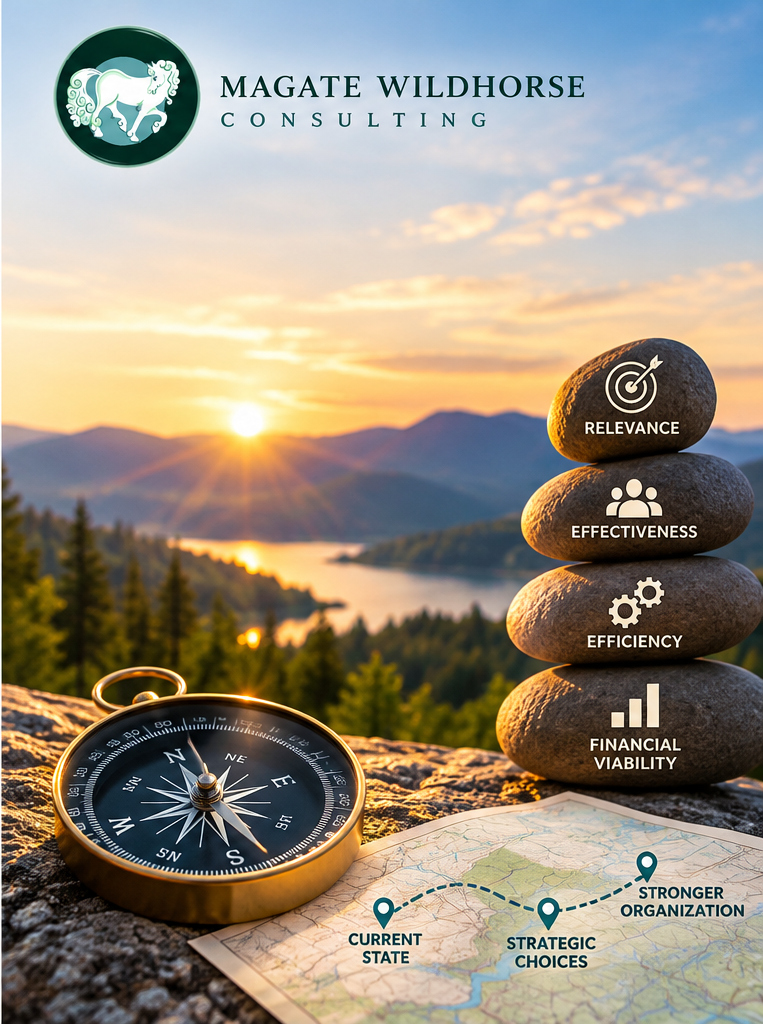
A strategic plan must be grounded in an accurate understanding of the organization it is intended to guide. Ambitious goals alone do not establish whether an organization has the capacity, resources, systems or readiness to deliver them. Organizational assessments and current-state assessments provide evidence that helps leaders make realistic strategic choices.
Although related, these assessments are not interchangeable. Their scope and purpose differ.
Understanding the Distinction
An organizational assessment is a comprehensive examination of an organization’s performance, capacities and functioning. It can consider governance, leadership, organizational culture, management practices, technical capabilities, financial viability, operating systems and relationships with the external environment. Its applications extend beyond strategic planning to institutional strengthening, organizational development and performance improvement.
A current-state assessment conducted for strategic planning is generally more focused. It establishes a baseline of the organization’s position on matters relevant to the strategic decisions ahead. It may draw selectively on organizational assessment methods, performance evidence, stakeholder perspectives and environmental scanning without examining every dimension of organizational functioning.
In either exercise, the Evaluand—the subject being assessed—is the organization, not individual office holders. Assessing governance and leadership arrangements is not the same as appraising individual board members or executives. The purpose is to understand how organizational functions contribute to results and where improvements are needed.
Four Questions About Organizational Performance
A key reference for Magate Wildhorse Consulting is the Universalia/International Development Research Centre (IDRC) Institutional and Organizational Assessment Framework. It considers organizational performance through four important questions:
Effectiveness: How successfully is the organization fulfilling its mission and achieving intended results?
Efficiency: How well does it use available resources to deliver services and achieve results?
Relevance: Has it adapted to changing needs, stakeholder expectations and conditions in its operating environment?
Financial viability: Can it secure and manage the resources necessary to sustain its work?
The framework also recognizes the influence of organizational capacity, motivation and the external environment. These dimensions help explain not only how an organization is performing but why. The ability to interpret and use assessment results is essential to achieving improvements.
Frameworks and Tools That Deepen the Diagnosis
No single instrument captures every dimension of organizational performance. Magate Wildhorse draws on established approaches, selecting tools according to the assessment’s purpose and the organization’s context.
Universalia/IDRC Institutional and Organizational Assessment Framework: Supports an integrated assessment of performance and its underlying influences.
McKinsey Organizational Capacity Assessment Tool (OCAT): Supports structured consideration of organizational capacities, strengths and areas for development.
McKinsey 7-S Framework: Examines alignment among strategy, structure, systems, shared values, skills, style and staff. A strategy may be sound but difficult to implement when these elements are misaligned.
Governing Good Board Self-Evaluation Questionnaire: Supports reflection on governance practices, board effectiveness and opportunities to strengthen oversight and strategic stewardship.
TCC Group’s Core Capacity Assessment Tool (CCAT): Identifies leadership, adaptive, management and technical capacities, alongside organizational culture. Magate Wildhorse draws on selected questions relating to these dimensions when assessing organizational leadership, board-related practices and capacity. Using selected questions does not mean administering the full CCAT instrument.
Other methods may include document and policy reviews, interviews, surveys, facilitated discussions, stakeholder analysis, process mapping, SWOT analysis, gap analysis, financial review and examination of performance indicators. The choice of methods should follow the assessment questions, not the other way around.
Why the Assessments Matter for Strategic Planning
They establish an evidence-based baseline. Leaders can distinguish demonstrated strengths and constraints from assumptions and compare future performance with an informed starting point.
They reveal strategic capacity gaps. An organization may wish to expand services but lack sufficient staffing, funding, technology or management systems. An assessment makes those limitations visible before commitments are made.
They improve strategic prioritization. Findings help leaders distinguish immediate operational problems from issues that require longer-term strategic responses. They also reveal opportunities to build on existing capabilities.
They strengthen organizational learning and accountability. Evidence about performance, governance and stakeholder needs can support more constructive dialogue about change, provided findings are used to improve the organization rather than assign personal blame.
They connect organizational realities with environmental change. A current-state assessment for strategic planning should consider relevant external developments alongside internal evidence, so that strategic choices respond to both capability and context.
From Evidence to Strategic Choices
A useful assessment does more than catalogue strengths and weaknesses. It examines patterns, tests findings across multiple sources and identifies implications for action.
An example from Magate Wildhorse’s consulting experience illustrates the value of evidence-based assessment. During an organizational assessment, some members expressed the view that the organization’s mission had become outdated. However, the assessment found that the mission remained highly relevant. This finding demonstrated the importance of testing perceptions against evidence before making decisions about an organization’s strategic direction.
The lesson is significant: organizational assessment does not necessarily establish a need to change an organization’s mission. It may instead confirm that the mission remains appropriate while identifying other aspects of organizational performance or capacity that require attention.
Consider also a nonprofit experiencing growing demand for services. An assessment may reveal strong community trust but limited unrestricted funding and overextended staff. A plan promising rapid expansion without addressing those constraints would be unrealistic. A stronger strategy might prioritize funding diversification, operational improvements and partnerships.
These examples demonstrate why assessment findings must be translated into strategic decisions, resource implications, implementation priorities and measures of progress.
A Credible Starting Point
Organizational assessment offers a comprehensive understanding of institutional performance and capacity. A strategically focused current-state assessment provides the targeted baseline needed to inform the next planning cycle. Either can strengthen strategic planning when its scope is appropriate, its evidence is credible and its findings are put to use.
Magate Wildhorse Consulting helps nonprofits, government departments and international development organizations connect organizational assessment, current-state analysis, environmental scanning and stakeholder engagement with evidence-informed, participatory strategic planning. The objective is not simply to produce a plan, but to develop a strategy grounded in organizational reality and capable of guiding meaningful change.
Share your thoughts on social media or by email at: magate.wildhorse@gmail.com.
Copyright © 2026 by Meegan Scott and Magate Wildhorse. All rights reserved.
