Organizational Assessment and Current-State Assessment: Informing Strategic Planning

Building an evidence-based understanding of organizational performance, capacity and readiness for strategic change.
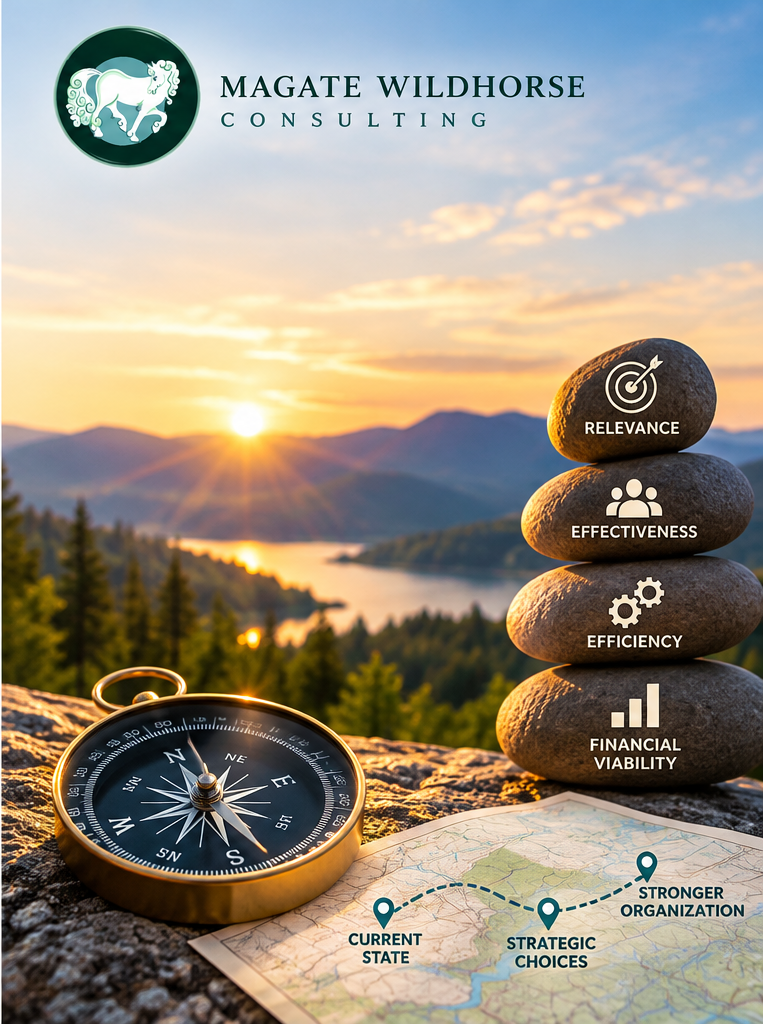
Magate Wildhorse logo, white horse on green moss agate stone. mountains and sunshine in the background, trees, rocks with the words, relevance, effectiveness, efficiency, financial viability stacked in the foreground with a compass and a map with current state, strategic choice and stronger organization mapped.

A strategic plan must be grounded in an accurate understanding of the organization it is intended to guide. Ambitious goals alone do not establish whether an organization has the capacity, resources, systems or readiness to deliver them. Organizational assessments and current-state assessments provide evidence that helps leaders make realistic strategic choices.

Although related, these assessments are not interchangeable. Their scope and purpose differ.

Understanding the Distinction

An organizational assessment is a comprehensive examination of an organization’s performance, capacities and functioning. It can consider governance, leadership, organizational culture, management practices, technical capabilities, financial viability, operating systems and relationships with the external environment. Its applications extend beyond strategic planning to institutional strengthening, organizational development and performance improvement.

A current-state assessment conducted for strategic planning is generally more focused. It establishes a baseline of the organization’s position on matters relevant to the strategic decisions ahead. It may draw selectively on organizational assessment methods, performance evidence, stakeholder perspectives and environmental scanning without examining every dimension of organizational functioning.

In either exercise, the Evaluand—the subject being assessed—is the organization, not individual office holders. Assessing governance and leadership arrangements is not the same as appraising individual board members or executives. The purpose is to understand how organizational functions contribute to results and where improvements are needed.

Four Questions About Organizational Performance

A key reference for Magate Wildhorse Consulting is the Universalia/International Development Research Centre (IDRC) Institutional and Organizational Assessment Framework. It considers organizational performance through four important questions:

Effectiveness: How successfully is the organization fulfilling its mission and achieving intended results?

Efficiency: How well does it use available resources to deliver services and achieve results?

Relevance: Has it adapted to changing needs, stakeholder expectations and conditions in its operating environment?

Financial viability: Can it secure and manage the resources necessary to sustain its work?

The framework also recognizes the influence of organizational capacity, motivation and the external environment. These dimensions help explain not only how an organization is performing but why. The ability to interpret and use assessment results is essential to achieving improvements.

Frameworks and Tools That Deepen the Diagnosis

No single instrument captures every dimension of organizational performance. Magate Wildhorse draws on established approaches, selecting tools according to the assessment’s purpose and the organization’s context.

Universalia/IDRC Institutional and Organizational Assessment Framework: Supports an integrated assessment of performance and its underlying influences.

McKinsey Organizational Capacity Assessment Tool (OCAT): Supports structured consideration of organizational capacities, strengths and areas for development.

McKinsey 7-S Framework: Examines alignment among strategy, structure, systems, shared values, skills, style and staff. A strategy may be sound but difficult to implement when these elements are misaligned.

Governing Good Board Self-Evaluation Questionnaire: Supports reflection on governance practices, board effectiveness and opportunities to strengthen oversight and strategic stewardship.

TCC Group’s Core Capacity Assessment Tool (CCAT): Identifies leadership, adaptive, management and technical capacities, alongside organizational culture. Magate Wildhorse draws on selected questions relating to these dimensions when assessing organizational leadership, board-related practices and capacity. Using selected questions does not mean administering the full CCAT instrument.

Other methods may include document and policy reviews, interviews, surveys, facilitated discussions, stakeholder analysis, process mapping, SWOT analysis, gap analysis, financial review and examination of performance indicators. The choice of methods should follow the assessment questions, not the other way around.

Why the Assessments Matter for Strategic Planning

They establish an evidence-based baseline. Leaders can distinguish demonstrated strengths and constraints from assumptions and compare future performance with an informed starting point.

They reveal strategic capacity gaps. An organization may wish to expand services but lack sufficient staffing, funding, technology or management systems. An assessment makes those limitations visible before commitments are made.

They improve strategic prioritization. Findings help leaders distinguish immediate operational problems from issues that require longer-term strategic responses. They also reveal opportunities to build on existing capabilities.

They strengthen organizational learning and accountability. Evidence about performance, governance and stakeholder needs can support more constructive dialogue about change, provided findings are used to improve the organization rather than assign personal blame.

They connect organizational realities with environmental change. A current-state assessment for strategic planning should consider relevant external developments alongside internal evidence, so that strategic choices respond to both capability and context.

From Evidence to Strategic Choices

A useful assessment does more than catalogue strengths and weaknesses. It examines patterns, tests findings across multiple sources and identifies implications for action.

An example from Magate Wildhorse’s consulting experience illustrates the value of evidence-based assessment. During an organizational assessment, some members expressed the view that the organization’s mission had become outdated. However, the assessment found that the mission remained highly relevant. This finding demonstrated the importance of testing perceptions against evidence before making decisions about an organization’s strategic direction.

The lesson is significant: organizational assessment does not necessarily establish a need to change an organization’s mission. It may instead confirm that the mission remains appropriate while identifying other aspects of organizational performance or capacity that require attention.

Consider also a nonprofit experiencing growing demand for services. An assessment may reveal strong community trust but limited unrestricted funding and overextended staff. A plan promising rapid expansion without addressing those constraints would be unrealistic. A stronger strategy might prioritize funding diversification, operational improvements and partnerships.

These examples demonstrate why assessment findings must be translated into strategic decisions, resource implications, implementation priorities and measures of progress.

A Credible Starting Point

Organizational assessment offers a comprehensive understanding of institutional performance and capacity. A strategically focused current-state assessment provides the targeted baseline needed to inform the next planning cycle. Either can strengthen strategic planning when its scope is appropriate, its evidence is credible and its findings are put to use.

Magate Wildhorse Consulting helps nonprofits, government departments and international development organizations connect organizational assessment, current-state analysis, environmental scanning and stakeholder engagement with evidence-informed, participatory strategic planning. The objective is not simply to produce a plan, but to develop a strategy grounded in organizational reality and capable of guiding meaningful change.

Share your thoughts on social media or by email at: magate.wildhorse@gmail.com.

To request a solution, fill our service request form below:

https://forms.gle/Gr1eaDuCb3KbX1YC6

Written by Meegan Scott. Copyright © 2026 Meegan Scott and Magate Wildhorse Ltd. All rights reserved.

Strong Strategy Development Starts Before the Planning Session

Magate Wildhorse logo, landscape with Fall coloured green and yellow green shrubs, distant background with sunshine and up close puzzle pieces of landscape with a hand holding one puzzle piece.

Organizations often think of strategic planning as the point at which leaders, board members and stakeholders come together to decide priorities for the next three to five years. The planning session is important—but strong strategy development begins well before anyone enters the room.

Organizations operate in constantly changing environments. Government policies shift. Economic conditions change. New technologies emerge. Stakeholder expectations evolve. Funding environments change. Internally, organizations experience changes in leadership, capabilities, resources, performance and priorities.

Developing strategy without understanding these conditions risks making decisions based on assumptions rather than evidence.

At Magate Wildhorse, we approach strategic planning as an evidence-informed process that can take an organization from understanding its environment and current state through stakeholder engagement, strategy development, implementation and performance assessment:

Environmental Scan → Current-State/Organizational Assessment → Stakeholder Engagement → Strategic Planning & Facilitation → Implementation & Performance Framework

These components are not necessarily separate or sequential assignments. An environmental scan, for example, may be commissioned independently or incorporated into a broader current-state or organizational assessment.

Organizations can engage us for the complete process or for individual components according to their needs.

An Approach Tailored to the Organization

How strategy is developed matters.

Depending on the organization, community, assignment and intended results, our consulting approach can incorporate methods that are collaborative, participatory, results-oriented, systems-oriented, community-informed, equity-centered and anti-oppressive.

This can mean working collaboratively with clients throughout the assignment; creating meaningful opportunities for stakeholder participation; considering the broader systems in which the organization operates; incorporating community knowledge and perspectives; examining barriers, power and inequities where relevant; and maintaining a clear focus on the results the strategy is intended to achieve.

The appropriate combination of approaches depends on the purpose, context and needs of each engagement.

1. Environmental Scan: What Is Changing Around You?

Before determining where an organization should go, it is important to understand the environment in which it will be operating.

An environmental scan examines external forces, trends and developments that could affect the organization’s future. Depending on the organization and sector, these may include political, economic, social, technological, environmental, legal, demographic, industry and competitive developments.

A useful environmental scan goes beyond collecting information. It asks:

  • What is changing?
  • Which changes matter to the organization?
  • What opportunities and risks are emerging?
  • What assumptions may no longer hold?
  • What should leadership continue to monitor?

Environmental scanning helps organizations make strategic choices based on the environment they are likely to face rather than the conditions that existed when their previous plans were developed.

It may be undertaken as a standalone assignment or incorporated into a broader current-state or organizational assessment.

2. Current-State and Organizational Assessment: Where Are You Now?

Before deciding where to go, an organization needs a well-grounded understanding of where it is today.

Depending on its purpose and scope, a current-state or organizational assessment may examine both internal organizational conditions and the external operating environment. The external component can therefore incorporate an environmental scan.

Internally, an assessment may consider governance, leadership, organizational structure, programs and services, human resources, operations, financial sustainability, partnerships, communications, organizational culture, systems, performance management and capacity.

The specific areas assessed should be determined by the questions the organization needs answered.

Among those questions might be:

What is working well? What is not? Where are the important gaps, constraints and opportunities? How well are our structures, systems, resources and capabilities aligned with our ambitions? What needs to change?

Rather than simply describing the organization, the assessment should generate evidence and insight that can inform decisions about its future direction.

3. Stakeholder Engagement: What Do the People Who Matter See?

Employees, clients, members, partners, funders, government actors, communities and other stakeholders may see opportunities and challenges from very different perspectives.

Stakeholder engagement can uncover information that is not readily available from documents or management discussions. It can reveal different expectations, identify emerging concerns and provide insight into where stakeholder interests converge or diverge.

Depending on the assignment, engagement may include stakeholder identification and mapping, interviews, surveys, focus groups, facilitated discussions, workshops or other consultation methods.

Stakeholder engagement does not mean that every stakeholder determines the strategy. Strategic decisions remain the responsibility of those charged with governing and leading the organization.

It means ensuring that decision-makers have access to relevant stakeholder intelligence before making those decisions.

4. Strategic Planning and Facilitation: Where Are You Going?

Once the evidence has been assembled, the organization is better positioned to make strategic choices.

Environmental intelligence, organizational evidence and stakeholder perspectives come together to help determine where the organization intends to go, what it will prioritize and—equally importantly—what it will not prioritize.

Depending on the organization’s needs, this may include examining or developing its strategic direction, mission, vision, values, strategic priorities, objectives and intended results.

Effective facilitation helps boards, leadership teams and other participants examine evidence, surface different perspectives, work constructively through disagreement and build sufficient consensus around future direction.

Magate Wildhorse brings competencies in Technology of Participation (ToP) facilitation methods, Workshop Design and Group Process Facilitation to the design and delivery of strategic planning processes. These competencies help us design purposeful participatory sessions and guide groups from discussion toward decisions and agreed strategic direction.

The objective is not simply to produce an attractive strategic plan. It is to make deliberate choices about the organization’s future.

5. Implementation and Performance: How Will Strategy Become Action?

A strategic plan creates little value if it cannot be implemented.

Implementation can falter when priorities are not translated into responsibilities, actions, milestones and measurable results. An implementation and performance framework helps make that connection.

Depending on organizational needs, it may establish:

  • strategic objectives and expected results;
  • initiatives, responsibilities and timelines;
  • milestones and key performance indicators;
  • targets and reporting arrangements; and
  • mechanisms for reviewing progress and adapting when circumstances change.

Magate Wildhorse also brings evaluation competency to this stage. This allows evaluation thinking to be incorporated from the outset by considering intended results, appropriate indicators, evidence requirements and how progress and performance will be assessed.

The question becomes not simply “Did we complete the activities?” but also “Are our actions contributing to the results our strategy was intended to achieve?”

This connects strategy, implementation, performance monitoring, evaluation, learning and accountability.

Strategic Planning Is a Process, Not an Event

A planning retreat can be valuable. But the retreat itself is not the strategy-development process.

Strong strategy development requires organizations to understand their environment and current position, listen intelligently to stakeholders, make deliberate choices and establish mechanisms for turning those choices into results.

Our approach connects:

Environmental Scan → Current-State/Organizational Assessment → Stakeholder Engagement → Strategic Planning & Facilitation → Implementation & Performance Framework

The components can be integrated, adapted or commissioned independently.

Planning for 2027 and Beyond?

Before asking “When should we hold our planning session?”, organizations preparing for their next strategic cycle should also ask:

What has changed within and around us? Where are we now? What are our stakeholders telling us? What strategic choices do we need to make? And how will we know whether our strategy is producing the intended results?

Magate Wildhorse provides strategic and corporate planning, environmental scanning, current-state and organizational assessment, stakeholder engagement and assessment, facilitation, evaluation and performance-monitoring support.

Organizations may engage us for an end-to-end strategic planning process or for individual components tailored to their needs.

Preparing for a new strategic planning cycle—or trying to determine what your organization needs before planning begins? Contact Magate Wildhorse to discuss your organization’s needs and how we can support the process.

To request a solution fill our service request form below:

https://forms.gle/Gr1eaDuCb3KbX1YC6

Email us at: magate.wildhorse@gmail.com.

Where We Create Impact By Design.

Written by Meegan Scott. Copyright © 2026 Meegan Scott and Magate Wildhorse Ltd. All rights reserved.

.