
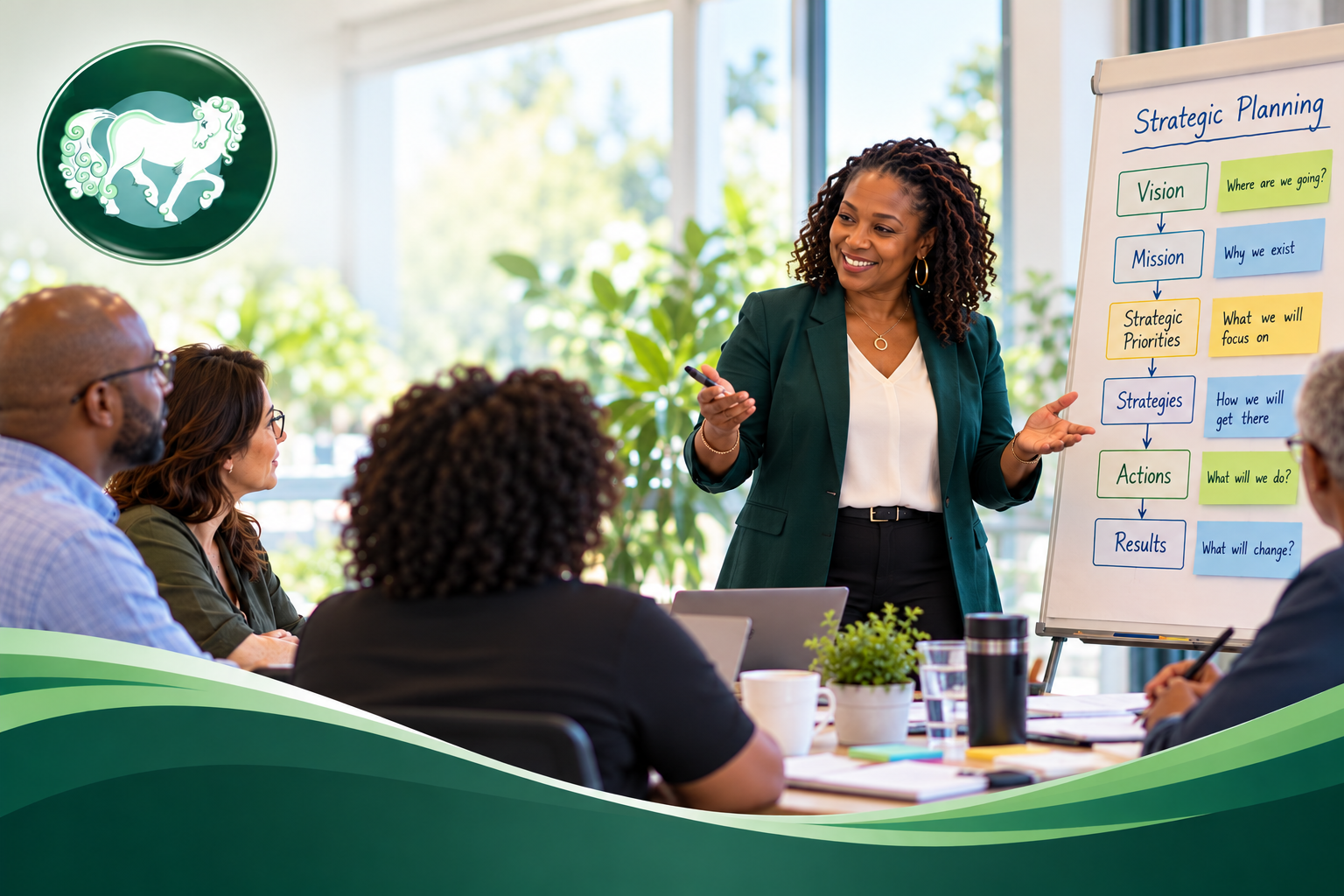
Effective strategic planning requires more than a well-designed workshop, a collection of analytical tools, or agreement on organizational priorities. It requires a structured, participatory process through which evidence is interpreted, strategic choices are made, and organizational commitment is secured.
The preceding articles in this series examined the foundations of strategic planning: preparation, environmental scanning, organizational and current-state assessment, and stakeholder engagement, assessment and analysis. These activities provide the evidence and insights needed to inform strategy development.
The strategic planning exercise brings these elements together, enabling participants to move from understanding their organization’s circumstances to determining its future direction.
Understanding the Strategic Planning Process
Strategic planning establishes an organization’s long-term direction, priorities, intended results, and approaches to achieving them. It connects organizational purpose and aspirations with strategic choices, resource allocation, implementation, and performance measurement.
An effective planning workshop begins by establishing workshop norms, objectives and a common understanding of strategic planning terminology, concepts, and processes. Participants should understand the distinctions between corporate strategic planning and strategic operational planning, including how organizational priorities translate into departmental, functional, team, and individual responsibilities.
The five levels of strategic planning should also be clarified within the organization’s planning framework, ensuring participants understand how decisions and responsibilities connect across organizational levels.
The proposed strategy formulation approach, workshop objectives, expected outputs, and decision-making arrangements should be explained before substantive deliberations begin.
The Role of Strategic Planning Facilitation
A strategic planning facilitator does more than manage an agenda or encourage participation. The facilitator creates the conditions for constructive discussion, thoughtful examination of alternatives, shared understanding, and collective decisions about organizational direction.
Four competencies are particularly important:
- Active listening: Understanding participants’ perspectives, identifying underlying concerns, and ensuring contributions are accurately interpreted.
- Effective communication: Explaining complex concepts clearly, asking purposeful questions, summarizing discussions, and maintaining a common understanding.
- Group dynamics management: Encouraging balanced participation, managing dominant voices, and helping participants navigate different stages of group development.
- Conflict resolution: Managing disagreements constructively, distinguishing competing interests from substantive strategic differences, and facilitating acceptable resolutions.
At Magate Wildhorse Ltd., strategic planning is led by a trained facilitator with additional training in workshop design, corporate strategy planning for government, and the Balanced Scorecard approach.
Our facilitation methodology incorporates group process techniques that help participants navigate the forming and storming stages of group development while progressing toward productive collaboration and consensus.
Techniques such as brainstorming, clustering, naming, and consensus-setting support the identification, organization, interpretation, and prioritization of ideas. Participants are guided through processes of codification, elaboration, and conversion, transforming contributions into clearly articulated strategic choices and actionable commitments.
Establishing Strategic Direction
An important component of the strategic planning exercise is developing agreement on the organization’s desired future.
Participants examine the organization’s vision, mission, and values, considering whether these remain appropriate in light of changing circumstances and emerging aspirations.
Facilitated discussions support consensus on the vision, clarification or revision of the mission, and affirmation or refinement of organizational culture and values.
Where preliminary strategic directions have been developed through earlier assessments or leadership deliberations such as the board visioning exercise, these are presented for examination and expanded through participants’ contributions.
Potential growth and development options are explored, including opportunities for organizational expansion, service innovation, partnerships, market development, operational improvement, or institutional strengthening.
The objective is not simply to generate ideas but to make informed choices about where the organization should concentrate its efforts.
Connecting Strategic Choices to Organizational Reality
Although environmental scanning and organizational assessment precede the workshop, their findings must be actively integrated into strategy formulation.
Participants revisit relevant PESTLE findings, examining political, economic, social, technological, legal, and environmental influences. SWOT analysis helps consolidate organizational strengths, weaknesses, opportunities, and threats.
These discussions test whether proposed strategic directions are realistic, responsive, and aligned with organizational capabilities.
Additional tools, including force field analysis, may be used to identify forces supporting or resisting proposed changes.
Through facilitated dialogue, participants examine assumptions, strategic risks, competing priorities, resource constraints, and the implications of alternative courses of action.
Translating Strategy into Action
Strategic direction must eventually become an organized programme of action.
Participants identify strategic priorities, desired outcomes, critical initiatives, and the actions necessary to achieve them.
Related activities are clustered into task arenas, which are organized and named to establish clear areas of responsibility and implementation.
Planning templates are introduced to support Consistency in documenting objectives, initiatives, responsibilities, resources, performance indicators, and timelines.
Participants review SMART performance indicators—specific, measurable, achievable, relevant, and time-bound—to strengthen accountability and establish measurable expectations.
Working groups may then be formed, with participants volunteering responsibility for developing specific components of the plan or advancing priority initiatives.
Participants identify the financial, human, technological and other resources required to implement proposed strategic initiatives. Potential funding sources and financing options are explored, alongside existing budgetary allocations, resource gaps and opportunities for partnerships or resource mobilization. This helps ensure that strategic priorities are financially realistic and supported by appropriate resource planning.
Next, participants assess the Feasibility of proposed strategic initiatives, considering available resources, organizational capacity, potential risks and implementation constraints. Where competing priorities exceed available resources, strategic trade-offs are examined to determine which initiatives should be prioritized, deferred, modified or discontinued. These deliberations help ensure that strategic choices are realistic, sustainable and aligned with the organization’s mission and long-term objectives.
Commitments, timelines, milestones, and immediate next steps are agreed upon before the workshop concludes.
Selecting Appropriate Strategy and Performance Frameworks
Different organizations require different tools for articulating and implementing strategy.
Government organizations may employ logic models, theories of change, and strategy maps to connect policy objectives, interventions, outputs, outcomes, and public value.
Nonprofit organizations frequently use theories of change and strategy maps to explain how their activities contribute to intended social outcomes.
Private sector organizations may use the Business Model Canvas, Balanced Scorecard, strategy maps, or Objectives and Key Results (OKRs) to articulate their business models, strategic objectives, performance priorities, and desired results.
These approaches are not exclusive to particular sectors. Their selection should reflect organizational purpose, operating context, planning maturity, and performance management needs.
The workshop should also introduce the proposed performance monitoring and evaluation framework, including how progress will be tracked, results evaluated, and strategic adjustments informed.
Consolidating the Strategic Plan
As the workshop progresses toward closure, participants review planned tasks, agreed actions, responsibilities, and timelines.
The outcomes provide the basis for preparing the draft strategic plan, which should capture strategic direction, priorities, objectives, implementation arrangements, and performance expectations.
Participants reflect on the emerging plan, considering its coherence, feasibility, organizational alignment, and potential implementation challenges.
Critical success factors are identified to clarify the conditions necessary for effective execution. Where appropriate, participants may also develop a guiding slogan that captures the strategic ambition and helps sustain commitment throughout the planning cycle.
A final review confirms outstanding matters, follow-up responsibilities, and arrangements for completing and validating the draft plan.
The workshop concludes with participant reflection, session evaluation, and formal closure.
Beyond the Planning Workshop
A successful strategic planning workshop is not measured solely by the volume of ideas generated or the completion of a planning document.
Its value lies in the quality of strategic choices, the extent of shared understanding, the strength of organizational commitment, and the readiness to translate decisions into action.
Effective facilitation helps organizations navigate complexity, engage diverse perspectives, resolve competing priorities, and establish a common direction.
However, the workshop is a critical milestone rather than the conclusion of strategic planning. Strategy must subsequently be refined, documented, communicated, implemented, monitored, evaluated, and adapted.
At Magate Wildhorse Ltd., we approach strategic planning and facilitation as an integrated process that connects evidence, participation, strategic decision-making, and implementation readiness. Our objective is to help organizations develop strategies that are not only credible and ambitious but also practical, measurable, and supported by those responsible for delivering results.
Magate Wildhorse Ltd. provides strategic planning, stakeholder engagement, assessment and analysis, as well as environmental scanning services to support organizations in developing evidence-informed strategies and strengthening organizational performance.
Share your thoughts on social media or by email at: magate.wildhorse@gmail.com.
Written by Meegan Scott. Copyright © 2026 Meegan Scott and Magate Wildhorse Ltd. All rights reserved.
