
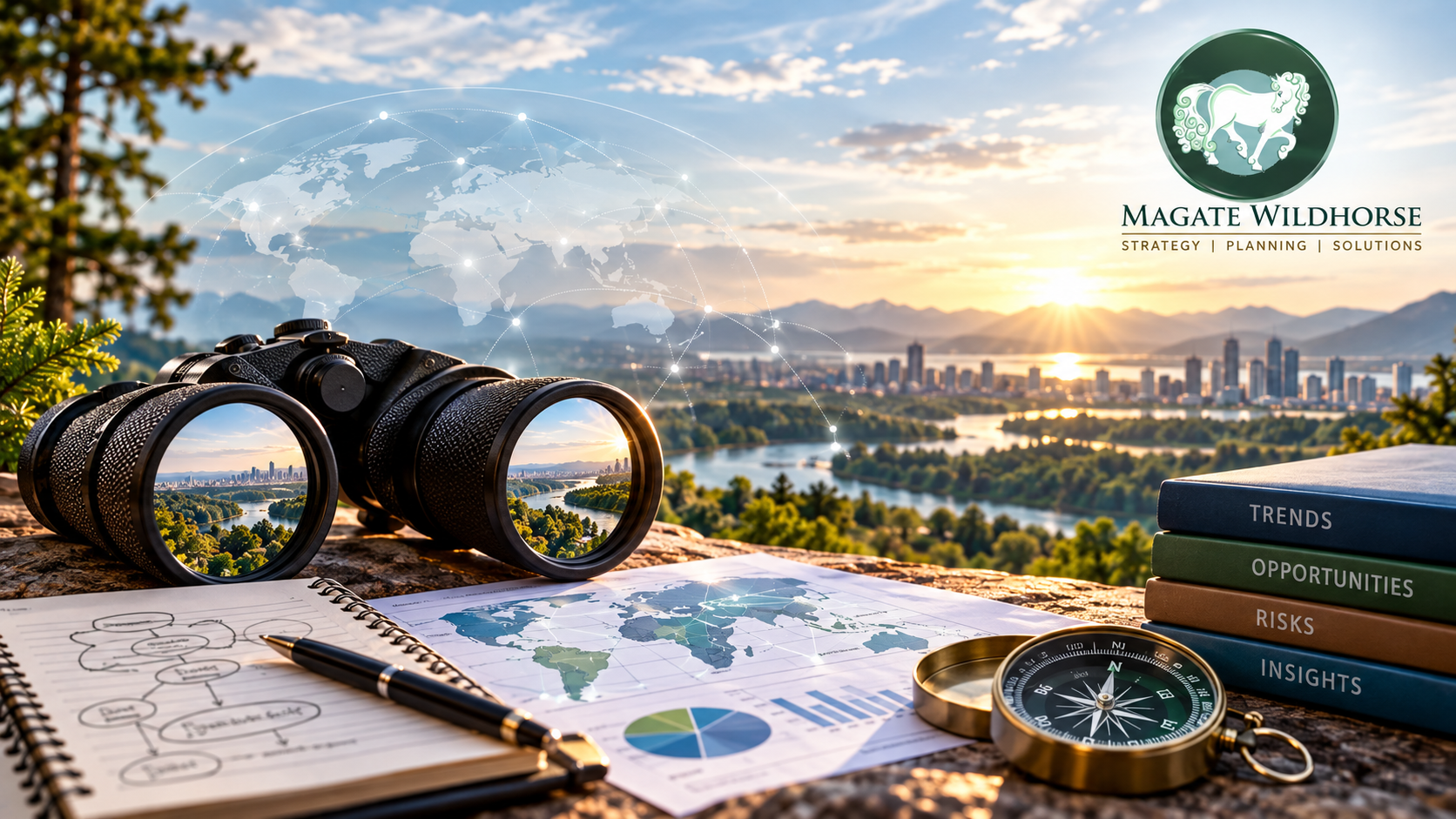
Strategic planning requires organizations to make choices about the future. But those choices cannot be made effectively by looking inward alone.
Organizations operate within environments shaped by changing government policies, economic conditions, demographic shifts, technological developments, social expectations, funding arrangements, competitors, partners and developments within their industries and sectors. These forces can create opportunities, introduce risks, alter stakeholder expectations and, in some cases, challenge the assumptions underlying an organization’s existing strategy.
An environmental scan helps organizations understand that changing landscape before determining where they should go next.
At Magate Wildhorse, environmental scanning is an important component of our approach to strategic planning and organizational strategy. Our methodology is founded on an evidence-informed, participatory, collaborative and systems-based approach that integrates organizational assessment, environmental analysis, stakeholder engagement and strategic analysis.
The objective is not simply to collect information about trends. It is to determine what developments in the operating environment mean for the organization and how they should influence strategic choices.
What Is an Environmental Scan?
An environmental scan is a structured process for gathering, examining and interpreting information about the forces and developments that may affect an organization and its ability to achieve its mission.
A strong environmental scan examines both the environment surrounding the organization and the implications of changes occurring within it.
For strategic planning, the scan can help answer questions such as:
- What is changing in our operating environment?
- Which developments are most likely to affect our organization?
- What emerging opportunities should we be preparing to pursue?
- What threats or pressures could affect our ability to deliver?
- How are the needs and expectations of our stakeholders changing?
- What are comparable or competing organizations doing?
- Which assumptions underlying our current strategy may no longer hold?
- What capabilities might we need to strengthen for the future?
These questions help move strategic planning beyond assumptions and internal perspectives toward decisions informed by evidence.
Going Beyond Traditional PESTLE Analysis
PESTLE analysis—examining Political, Economic, Social, Technological, Legal and Environmental factors—is one of the most widely used frameworks for environmental scanning.
It provides an important starting point, but complex organizations often operate within environments that require a broader lens.
At Magate Wildhorse, our environmental scanning approach therefore builds upon and expands the traditional PESTLE framework according to the organization, sector and strategic questions being examined.
Depending on the assignment, the external scan may consider:
Demographic trends. Changes in population size, age, migration, geographic distribution, workforce composition and other demographic characteristics can significantly affect demand for services, labour availability and stakeholder needs.
Policy developments and political-legal pressures. Government priorities, legislation, regulation, public policy changes and political developments can create new requirements, constraints, funding opportunities or strategic openings.
Macroeconomic conditions. Inflation, interest rates, employment conditions, economic growth, labour costs and broader fiscal pressures can influence organizational costs, revenues, demand and investment decisions.
Socio-cultural influences. Changing public expectations, values, behaviours and attitudes can reshape how organizations engage communities, employees, clients and other stakeholders.
Technological developments. Artificial intelligence, automation, digital service delivery, cybersecurity, data systems and emerging technologies can change operating models, stakeholder expectations and competitive conditions.
Global trade and international developments. Supply chains, tariffs, geopolitical developments and international market conditions can have significant implications even for organizations whose primary operations are domestic.
Funding models. Changes in government funding, grants, philanthropy, investment models, reimbursement arrangements or other revenue structures can fundamentally alter organizational sustainability and strategic choices.
Sector transformation. Major reform initiatives—including health system transformation, public-sector modernization or regulatory restructuring—can change roles, relationships and expectations across an entire system.
Jurisdictional comparisons. Examining how other jurisdictions address similar challenges can identify alternative models, emerging practices and potential lessons.
Competitor and comparator analysis. Understanding how comparable organizations are positioning themselves, delivering services or responding to change can reveal strategic gaps, opportunities and areas of differentiation.
Leading and emerging practices. Identifying developments within and beyond the organization’s immediate sector can help leaders consider approaches that may strengthen performance, service delivery or organizational resilience.
The factors selected should never become a mechanical checklist. Their relevance depends on the organization and the decisions the strategic plan must support.
Evidence Matters—but So Does Participation
Environmental scanning should not be based solely on desk research.
Documents, statistics, policies, sector reports, academic and professional literature, economic information and other secondary sources provide essential evidence. However, stakeholders often possess knowledge that cannot be found in published material.
Employees may recognize operational pressures before they appear in formal reports. Clients and service users can identify changing needs. Partners may see emerging system-level challenges. Government and sector stakeholders may provide insight into policy direction, funding conditions or future priorities.
That is why Magate Wildhorse combines research and environmental analysis with stakeholder engagement.
Interviews, surveys, focus groups, facilitated discussions and other engagement methods can be used to test findings, identify emerging issues and understand how external developments are being experienced by those closest to the organization and its work.
This participatory approach strengthens both the quality of the evidence and the relevance of the resulting strategy.
Connecting the External Environment to Organizational Capacity
An environmental scan becomes strategically useful when external findings are considered alongside the organization’s internal realities.
An emerging opportunity may appear attractive, for example, but the organization may lack the people, technology, funding or partnerships required to pursue it. Conversely, an organization may possess capabilities that position it particularly well to respond to a new policy direction, demographic need or market development.
For this reason, our approach integrates environmental scanning with organizational assessment.
Together, these analyses allow us to explore the relationship between external opportunities and threats and internal strengths, weaknesses, resources and capabilities. Strategic tools such as SWOT analysis can then help synthesize the evidence and identify the issues that warrant strategic attention.
From Information to Strategic Insight
One of the greatest risks in environmental scanning is producing an impressive collection of information that never influences strategy.
A 100-page report describing trends is not automatically a useful environmental scan.
The critical step is strategic interpretation.
Which developments matter most? How significant could their impact be? How quickly are they developing? Which issues require immediate attention? Which should be monitored? Where might the organization have an opportunity to lead rather than react?
These questions transform information into strategic intelligence.
The resulting insights should inform strategic priorities, organizational positioning, resource decisions, risk considerations and performance expectations.
Seeing the Environment Before Choosing the Direction
Strategic planning is ultimately about making informed choices under conditions of uncertainty. No organization can predict the future perfectly, but it can develop a much clearer understanding of the forces shaping that future.
A rigorous environmental scan helps leaders challenge assumptions, recognize emerging opportunities, anticipate pressures and make strategic choices grounded in evidence rather than intuition alone.
At Magate Wildhorse, we use environmental scanning as part of a broader strategic planning process that connects evidence, organizational realities, stakeholder perspectives and external developments to strategic decision-making.
Because before an organization decides where it wants to go, it should understand the environment in which it will have to get there.
Magate Wildhorse provides environmental scanning, strategic planning, organizational assessment, stakeholder engagement, performance measurement and related strategy services to organizations seeking evidence-informed approaches to navigating change and planning for the future.
Share your thoughts on social media or by email at: magate.wildhorse@gmail.com.
To request a solution fill our service request form below:
https://forms.gle/Gr1eaDuCb3KbX1YC6
Written by Meegan Scott. Copyright © 2026 Meegan Scott and Magate Wildhorse Ltd. All rights reserved.
